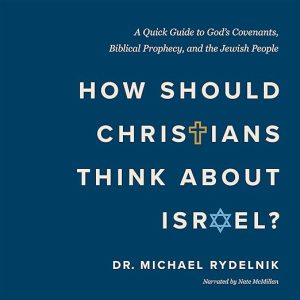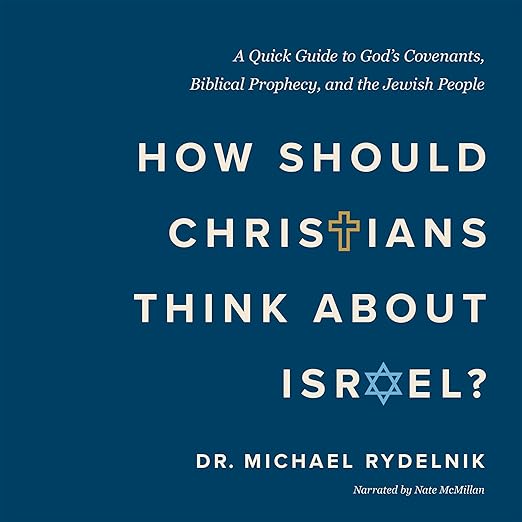
Quick Take
- Narration: Nate McMillan keeps the tone measured and clear, appropriate for a short theological argument that needs to be followed closely.
- Themes: Christian theology and modern Israel, biblical prophecy and fulfillment, replacement theology versus covenant continuity
- Mood: Earnest and scripturally focused, written for believers seeking theological clarity on a politically charged subject
- Verdict: A concise, clearly argued biblical case for Christian engagement with modern Israel, best suited to listeners already working within an evangelical framework.
I will be upfront about my position as a reviewer here: I am not the primary intended audience for this book. Dr. Michael Rydelnik writes explicitly from within an evangelical Christian framework and addresses listeners who are trying to reconcile their faith with what they see happening in the news about Israel and the Jewish people. That framing is the book’s strength and also its limit, and both are worth being honest about.
At just under three hours, this is a short theological argument with a specific claim: that a biblical worldview, grounded in scriptural prophecy and its fulfillment, provides clear answers about the modern state of Israel’s significance and the ongoing role of the Jewish people in God’s plan. Rydelnik has spent more than thirty years as a professor of Jewish Studies and Bible at Moody Bible Institute, and his command of the relevant scriptural and historical material is evident throughout.
Our Take on How Should Christians Think About Israel?
The book addresses three primary questions that its own synopsis identifies: the relationship between modern Israel and the biblical kingdom of Israel, whether the Jewish people are still God’s people in a theologically meaningful sense, and how the church should relate to the Jewish people and their homeland. Rydelnik’s answers are consistent with a dispensationalist and pro-Israel reading of scripture, pushing back explicitly against what he calls replacement theology, the view that the church has superseded Israel as the recipient of biblical promises.
Reviewer Helianthus2026, in a detailed response, noted that the middle content leans scholarly as Rydelnik lays out biblical explanations, which is accurate and should be flagged for general-interest listeners. This is not a breezy survey; it is a theological argument that requires following a line of scriptural reasoning across multiple passages. But Rydelnik writes accessibly enough that listeners without a seminary background should be able to follow the core argument.
Why Listen to How Should Christians Think About Israel?
Nate McMillan’s narration is clean and clear, well-suited to theological content that benefits from precise delivery. The runtime of under three hours means the argument is tight and does not repeat itself unnecessarily. Several reviewers describe this as required reading for Christians trying to navigate contemporary events through a biblical lens, and for that specific audience, the book delivers what it promises.
Reviewer Neal described it as exactly the resource for Christians trying to discern how to view modern events through biblical eyes, which captures the book’s practical purpose accurately. Rydelnik is not making a political argument in the conventional sense; he is making a scriptural one, and he keeps those categories reasonably distinct throughout, though not perfectly so.
What to Watch For in How Should Christians Think About Israel?
The book’s theological position is not neutral, and listeners should know that going in. Rydelnik argues from a specific tradition within Christian thought, one that emphasizes covenant continuity for the Jewish people and the ongoing prophetic significance of the modern state of Israel. This is one position in a genuine theological debate, not the only one. Listeners coming from different Christian traditions, including those that hold replacement theology or who approach the question from a Catholic or mainline Protestant perspective, will find the argument one-sided.
The book also does not engage seriously with Palestinian Christian perspectives or with the political complexity of the modern state of Israel as a secular democracy with complex internal politics. These limitations are partly inherent to the book’s stated purpose, a biblical rather than political analysis, but they are limitations nonetheless.
Who Should Listen to How Should Christians Think About Israel?
Evangelical Christians seeking scriptural grounding for their engagement with modern Israel, and particularly those wrestling with replacement theology, will find this a clearly argued and well-sourced short resource. Listeners interested in Jewish-Christian relations from a theological perspective will find Rydelnik’s depth in Jewish Studies adds value. Listeners looking for a politically balanced or ecumenically broad treatment of the subject should look elsewhere. Non-Christian listeners or those from very different theological traditions will likely find the argumentative framework unfamiliar.
Frequently Asked Questions
Is this book politically neutral about the modern state of Israel?
The book explicitly frames itself as a biblical rather than political analysis, but the theological position it defends, covenant continuity for the Jewish people and the prophetic significance of modern Israel, has clear political implications. Rydelnik keeps the focus on scripture, but the argument is not theologically neutral.
What is replacement theology, and why does Rydelnik argue against it?
Replacement theology is the view that the church has superseded or replaced Israel as the recipient of God’s biblical promises, meaning the promises made to the Jewish people are now fulfilled spiritually through the church. Rydelnik argues from scripture that this interpretation misreads the biblical text and that God’s covenant with the Jewish people remains active and meaningful.
Is three hours enough time to make a thorough theological argument on this subject?
Rydelnik makes a focused, tightly constructed argument in the available runtime. Some middle sections lean scholarly and require close attention. For listeners who want deeper engagement, this would serve as an introduction to his thinking rather than an exhaustive treatment.
Does the book engage with Palestinian Christian perspectives or other minority views within Christianity?
No. The book is written from within an evangelical dispensationalist framework and does not engage with Palestinian Christian theology, Catholic social teaching on Israel and Palestine, or mainline Protestant approaches. These are acknowledged limitations of its scope.