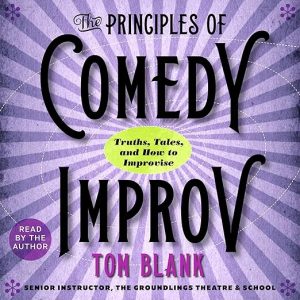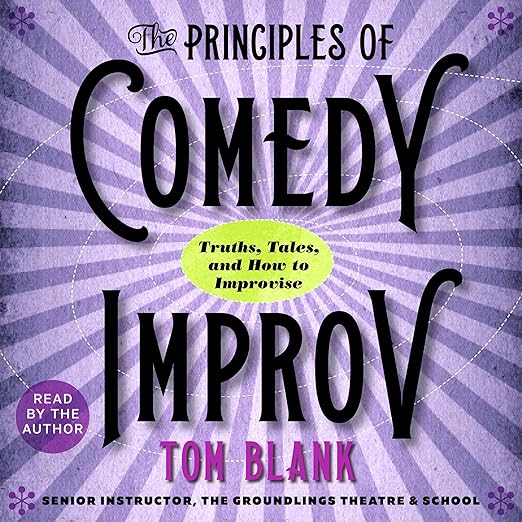
Tom Blank's The Principles of Comedy Improv audiobook arrives at a genuinely unusual position in the performing arts instruction space: it's comprehensive enough to serve as a reference text, entertaining enough to hold a non-performer's attention for nearly nine hours, and specific enough in its craft instruction that working improvisers will find material they haven't seen organized this clearly before. That's a difficult combination to pull off, and Blank does it by narrating his own work, which transforms the audio format from delivery mechanism into performance.
Blank brings two decades of experience to the project, and the organizational structure reflects that depth. Rather than the simplified beginner's guide that most improv books aim to be, this one attempts something more ambitious: a comprehensive mapping of improv's principles from first contact with a scene through the development of sustained character and the construction of narrative. The scope is what drew comparisons to Truth in Comedy, the Del Close and Charna Halpern text that defined the form's second wave, and the comparison isn't unearned.
Yes-And as a Tool Beyond the Stage
The book's central insight is that improv's principles are not performance tricks but ways of inhabiting the present moment, and that this makes them transferable beyond the stage. Blank makes this case without the kind of vague self-help generalization that usually follows it. When he connects improv's yes-and principle to professional communication or conflict resolution, he does so through specific scenarios rather than inspirational abstraction. The connection feels earned rather than retrofitted.
One reviewer describes the book as audacious for attempting to provide insight into something that is largely incomprehensible, which captures both the ambition and the risk of the project. Improv at its best is ineffable, a real-time negotiation between performers and audience that can't be fully explained without destroying what makes it work. Blank navigates this by treating the principles as navigational tools rather than formulas, pointing toward the territory without claiming to map it completely.
A Modern Truth in Comedy, But Better
The book moves through starting a scene, creating a character, and discovering a story in a sequence that mirrors how performers actually develop these skills in practice. This is not the logical order a theorist might impose from outside the form; it's the order that emerges from doing the work, and that practitioner's perspective is audible throughout. A second reviewer calls this a modern-day Truth in Comedy but way better, noting that among all the improv books available, none come close to hitting the mark the way this one does.
Self-Narration Built From Decades of Teaching
Self-narration is not always the right choice for instructional audiobooks, but here it's essential. Blank's delivery carries the rhythms of someone who has spent decades performing and teaching, not just studying. When he demonstrates a principle through example, the example lands the way it would in a workshop rather than in a textbook. The humor is present but never at the expense of the instruction; he's funny because the material is genuinely comic, not because he's performing for the microphone.
A 4.9 Rating Across Very Different Listeners
The accompanying PDF, available in the Audible Library with purchase, contains supplementary material that complements the audio. Listeners should know that the audio is complete as a listening experience; the PDF adds exercises and reference material but isn't required for the core instruction to land. For performers who want to return to specific principles, the PDF becomes more valuable as a study companion over time. At eight hours and forty-five minutes, the production is substantial, but the pace Blank maintains means the time never drags.
The 4.9 rating across fifteen reviews indicates consistent quality of experience across different kinds of listeners, not just committed improvisers. Newcomers to the form praise it as a useful primer; experienced practitioners find depth they weren't expecting; non-performers note applications in their own professional and personal contexts. That breadth of positive response is a reliable signal about the book's range of usefulness.
The Philosophical Chapters Come Before the Practice
At eight hours and forty-five minutes, the book is longer than most performing arts instruction texts in audio form, and some listeners may find the comprehensiveness demanding if they come in expecting a quick practical guide. The early chapters on improv's philosophical foundations are essential groundwork but may feel abstract to listeners who want to skip straight to scene technique. Blank's approach requires engaging with the why before arriving at the how, and that structure demands patience in the opening sections.
The book also assumes that the listener will engage actively rather than passively. The principles Blank describes are designed to be tried, not just understood intellectually, and listeners who don't have access to an improv class or an informal practice partner may find the later chapters more theoretical than they'd like. That's not a flaw in the instruction but a feature of the art form: improv is inherently collaborative and some of what Blank teaches only becomes fully clear in practice.
For Improvisers a Year In, and Beyond
Working improvisers who have been practicing for a year or more and want a framework for understanding what they're already doing will get the most immediate value. Acting students and comedy writers will find the character and scene principles directly applicable to their work in other forms. The book is also genuinely useful for listeners outside performance contexts who want to understand how spontaneous collaboration works and how to become better at it in everyday situations.
Complete beginners to performance who want a first introduction to improv will benefit but may want to supplement with actual class time to make the principles concrete. And listeners who approach the book purely for entertainment value, without interest in the craft, will find it intellectually stimulating but may wish for more anecdote and less pedagogy. The 4.9 rating suggests most listeners find exactly what they came for, but knowing the book's orientation going in helps set accurate expectations.