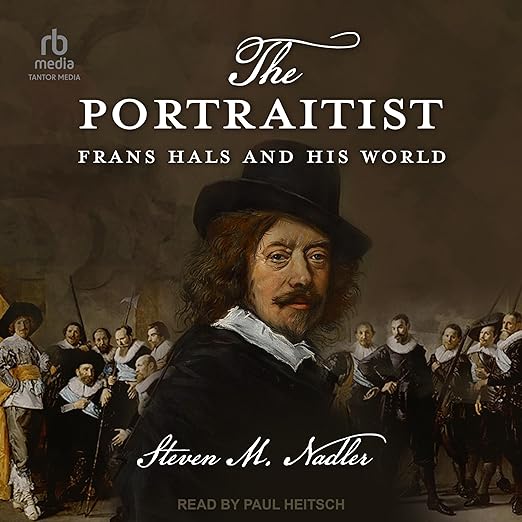
Before You Press Play
- Narration: Paul Heitsch delivers Nadler's scholarly but accessible prose with measured clarity, matching the book's tone without over-dramatizing the archival gaps in Hals's biography.
- Themes: Dutch Golden Age society, portraiture as innovation, the gap between archive and biography
- Mood: Scholarly, atmospheric, and visually imaginative
- Verdict: Nadler builds a credible and engaging biography out of fragmentary evidence, and the cultural history surrounding Hals is as compelling as the man himself.
Frans Hals left behind almost no written record. The first full-length biography of the great Dutch portraitist in many years, Steven Nadler's The Portraitist, is built almost entirely from civil court records about debt, church registers of baptisms and marriages, and the paintings themselves. Which are abundant, distinctive, and stubbornly resistant to neat narrative. The audiobook, narrated by Paul Heitsch, is something relatively rare in art biography: a serious scholarly account of an important painter that acknowledges the limits of what can be known while still building a vivid picture of the world in which Hals worked.
What made Hals remarkable, and what Nadler establishes early, was the visible brush stroke. His contemporaries in seventeenth-century Haarlem were producing the fine detail and smooth finish that Dutch patrons expected. Hals was painting with energy and immediacy: the sitter's presence captured in motion rather than posed for posterity. Some called his work sloppy. Others recognized it as a fundamentally different idea about what portraiture was for. The debate about his legacy continued for centuries, and the argument that Hals prefigured Impressionism by two hundred years is now widely accepted.
A Philosopher Writes About an Opaque Inner Life
Nadler is a philosopher by training. He has written extensively on Spinoza and Descartes, and that background shapes how he approaches the problem of writing about someone whose inner life is almost entirely opaque. He is rigorous about the distinction between what the historical record shows and what it implies, which makes the book more honest than many art biographies but occasionally more cautious than the dramatic material warrants. Reviewer Christian Schlect notes that the biographical information available is "mostly from brief and dry extracts from the archives of civil courts," and Nadler's achievement is transforming that material into something readable by placing Hals precisely within seventeenth-century Haarlem: its commerce, its Calvinist theology, its civic institutions, and its artistic culture.
The Great Trifecta framing, placing Hals alongside Rembrandt and Vermeer as the defining painters of Dutch Baroque, is used not to elevate Hals artificially but to establish what was distinctive about him relative to his contemporaries. Rembrandt's psychological depth, Vermeer's luminous interiors, and Hals's kinetic immediacy each represent a different understanding of what painting can do. Nadler handles the comparisons with enough care that the book functions as an implicit argument for Hals's specific contribution to the tradition rather than a generic ranking exercise.
Heitsch Avoids Turning This Into a Lecture
Paul Heitsch's narration suits the material. Nadler writes academic prose that has been deliberately made accessible: the arguments are clear and the sentences are grammatically complete, but the tone is measured rather than popular. Heitsch matches that register without making the listening experience feel like an academic lecture. The 10-hour-49-minute run time is appropriate for the scope: Nadler is covering not just Hals's life but the artistic, social, political, and religious worlds of the seventeenth-century Dutch Republic, and that context is handled in enough depth to make the biography feel situated rather than merely illustrative.
Reviewer Robert Moody, a frequent reader of art books, calls Nadler "a vastly talented essayist" and notes he was "thoughtful in his selection" of what to include. It's a meaningful compliment for a subject whose documentary record is so thin. The book earns those selections. The sections on Haarlem's patron class, the merchants and militiamen and theologians who commissioned Hals's work, are particularly strong: they ground the paintings in the social transactions that produced them without reducing the art to sociology.
The Paintings Themselves Cannot Be Heard
The paintings themselves cannot be heard. This is the central limitation of any audiobook covering a visual artist, and reviewer Thule makes this point with some force. Art biography in audio format requires the listener to hold mental images of the works being discussed without immediate visual reference. Nadler describes the paintings with care, but descriptions of brushwork and compositional energy are necessarily approximate. Having a collection of Hals's paintings open in a browser tab while listening is not optional for full engagement. It's how this audiobook works best.
The book's caution about biographical inference, while intellectually honest, occasionally produces stretches that feel more like historical context than biography. Listeners who want consistent personal narrative, the arc of a life felt from the inside, will find those sections requiring patience. Hals's debts are documented; his feelings about them are not. Nadler is correct to distinguish between the two, but that correctness has a cost in emotional immediacy. Specialist readers who know Haarlem well will also occasionally feel the context moves slowly; generalists will find it essential.
A Mystery No Biography Can Fully Resolve
Art history readers, Dutch Golden Age enthusiasts, and anyone with a serious interest in portraiture as a form will find this audiobook substantive and rewarding. Nadler's account of what Hals was doing differently from his peers: the energy, the immediacy, the apparent informality that was in fact a radical technical choice, is the clearest explanation of Hals's significance available in English, and the Haarlem context is richly rendered throughout.
Listeners who want biographical intimacy will find the archival gaps frustrating. Listeners who are primarily interested in Rembrandt or Vermeer and approaching Hals tangentially may find the balance between life and context skewed toward context in ways that make the book feel more like cultural history than biography. Both responses are legitimate, and both reflect the genuine constraint Nadler is working under. Seek it out if you want the best available English-language account of Hals; go in understanding that the man himself will remain, in certain essential respects, a mystery that no biography can fully resolve.
Can you follow The Portraitist audiobook without being familiar with Frans Hals's paintings?
Nadler describes the paintings with care, but the audiobook works best with a reference collection open alongside it. His accounts of Hals's visible brushwork and the kinetic energy of the portraits are precise, but the visual argument requires visual evidence. Listeners without prior familiarity should spend a few minutes with a Hals image search before starting.
How does Paul Heitsch's narration handle the scholarly tone of this biography?
Heitsch matches Nadler's measured, accessible academic register without making the listening experience feel like a lecture. The 10-hour-49-minute run time benefits from his clear delivery, which keeps the cultural-historical sections as engaging as the biographical narrative sections.
Is The Portraitist primarily a biography of Hals or a history of Dutch Golden Age culture?
Both, and the balance leans toward cultural history in sections where the documentary record about Hals is thin, which is often. Nadler places Hals precisely within seventeenth-century Haarlem's commerce, Calvinist theology, and civic institutions, and that context is as substantive as the biographical material. Readers who want a conventional life narrative may find this balance occasionally frustrating.
Does this audiobook address how Hals influenced later painters?
Yes, though the treatment is integrated into the biography rather than given a dedicated section. Nadler's case for Hals as a precursor to Impressionism is present throughout the discussion of his technique, and the comparison with Rembrandt and Vermeer establishes his specific contribution. The influence argument is made through specific analysis of his brushwork rather than through later reception history.