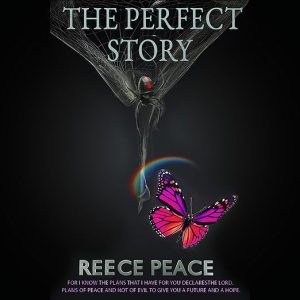
Reece Peace narrates his own audiobook, which is the first and most important thing to know about The Perfect Story. The author is also the narrator, and the book is his account of surviving five assassination attempts organized by his ex-wife and her hired associates. That setup is so extreme it could tip easily into sensationalism or disbelief, but Peace's self-narration grounds it in something the synopsis calls testimony: the voice of a person describing events he lived through, speaking directly to a listener he is trying to reach.
The book sits at a 4.0 rating from 26 listeners, which is a smaller sample than most titles with this level of promotional intensity in the synopsis, but the reviews that exist are entirely at the five-star end of the scale. Readers describe it as a page-turner, as faith-filled, as a book they literally could not put down. The language they use consistently mirrors the evangelical register of the text itself, which tells you something about the audience this audiobook has found and is designed for.
Five Assassination Attempts, Read as Testimony
Reece Peace is a man of faith telling a story about surviving violence through what he understands as divine intervention, and The Perfect Story is built entirely on that framework. The narrative moves through five separate assassination attempts, each one evidently survived against odds that Peace attributes to God's hand on his life. The book does not present these events as investigative journalism or legal documentation. It presents them as a faith account, in the tradition of survival testimonies that have existed in religious literature for centuries.
A Devotional Memoir, Not a Secular Thriller
That genre distinction matters for how a listener should approach it. The Perfect Story is not a thriller in the secular commercial sense, despite the synopsis's use of that language. It is a devotional memoir with dramatic content, written by someone whose primary relationship to his own story is theological. He survived, and he believes he survived for a reason. The entire book is organized around that conviction, and every chapter points back toward it.
Self-narration here is not simply a production choice. Peace's voice carries the particular quality of someone who has told this story before, in church settings, in personal conversations, in whatever forms of testimony his faith community practices. The result is less like a performed audiobook and more like listening to someone speak directly to you about something that shaped their life completely. That is an unusual listening experience, and it is more affecting than a polished celebrity narrator performance would be for this particular material.
The Emotions Feel Real, One Reviewer Says
Listeners who come from faith traditions that take divine protection seriously will find Peace's account coherent and moving on its own terms. One reviewer, a longtime Christian, called it wonderful and noted that the emotions feel real. Another described it as inspirational and suspenseful and said it made the claim that with God all things really are possible feel demonstrated rather than just asserted.
Testimony as Its Own Form of Evidence
The audiobook operates on the logic that lived experience, narrated honestly by the person who lived it, constitutes its own form of evidence. Peace is not making a philosophical argument for theism. He is describing what happened to him and naming what he believes it means. For listeners who are open to that kind of testimony, the book delivers a concentrated version of it across its full runtime.
The content warnings in the synopsis point toward material involving planned violence, marital betrayal, and fear of ongoing threat. Peace handles these elements without graphic exploitation, but the circumstances are not softened. Listeners who want inspirational faith content without exposure to the darker territory of personal danger may find some sections heavier than they expected. That heaviness is also part of what gives the survival narrative its weight.
A Prior Belief the Book Doesn't Defend
Listeners coming to this audiobook without a faith context will have a different experience than the one the book is designed to produce. Peace's argument is not one that translates across worldview assumptions. The claim that God protected him from five assassination attempts rests on a prior belief that God intervenes in human events in specific and personal ways. Listeners who do not share that prior will read the same events through a different frame, one the book does not engage with or defend against.
Unpolished Narration, By Design
The synopsis uses the language of thriller and suspense in ways that set up an expectation the audiobook may not fully satisfy for genre listeners. This is not a plot-engineered narrative with chapter hooks and escalating stakes in the way a crime thriller constructs them. The tension comes from the biographical reality of what is being described rather than from narrative craft in the commercial sense. Listeners who want both the faith content and a structured thriller architecture may find the book leans heavily toward the former.
Reece Peace's narration is also, by the standards of professional audiobook production, unpolished. That is not a criticism. It is a characteristic of the listening experience that some listeners will find more authentic and others will find harder to stay with across the full runtime. The choice to self-narrate was almost certainly deliberate and meaningful, and it shapes how the material lands.
The Framework Is Not Incidental, It's the Book
Faith readers who are drawn to testimonial memoirs about survival and divine intervention will find this audiobook directly in their tradition. Peace is writing for people who already believe that God can protect someone from calculated human violence, and for whom that protection is not a metaphor but a category of actual event. For that audience, the book is compelling and affirming.
Listeners looking for secular true crime or thriller content will find The Perfect Story less satisfying. The devotional framework is not incidental to the book. It is the book. Removing it leaves nothing to analyze or enjoy. If the faith premise does not resonate, the audiobook will not either.
Listeners who are open to faith memoirs but have no prior relationship to Peace's specific tradition may find the book accessible as an account of resilience, even if they interpret the survival events differently than Peace does. The core story of someone surviving extreme violence and choosing to live purposefully in its aftermath has a human resonance that is not entirely dependent on the theological framing.
At a Glance
- Read by: Reece Peace self-narrates his own memoir, which gives the assassination-attempt sequences a visceral authenticity that no outside narrator could replicate.
- At its heart: Survival faith, divine purpose, resilience against targeted violence
- Vibe: Urgent and testimony-driven, with evangelical warmth throughout
- Short version: Peace's audiobook works as a faith memoir for listeners who take seriously the idea of divine protection, though its devotional register will not suit every audience.