The Short Version
- Narrator: Jill Tanner narrates with an unhurried, literate register that lets Molly Peacock's poet-crafted sentences land fully.
- Subjects: Late-life creativity, botanical art, women's biography
- Tone: Reflective and lyrical, closer to memoir-adjacent essay than brisk biography
- Bottom line: A rewarding listen for anyone drawn to late-blooming creativity, though the print edition's images remain a real trade-off.
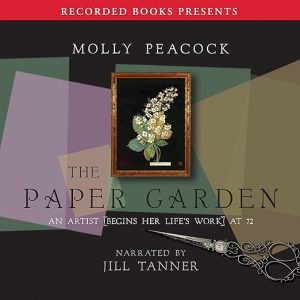
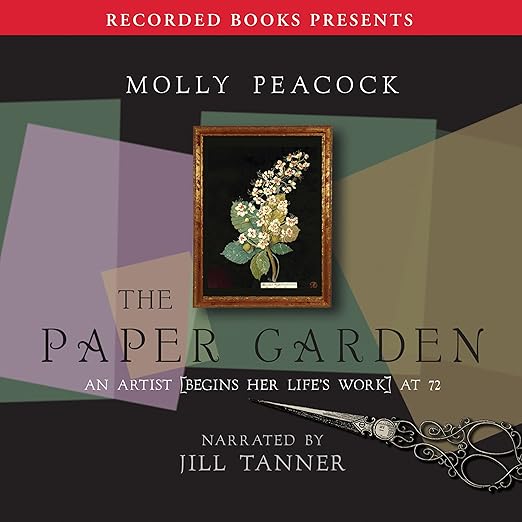
At seventy-two, twice widowed and nearly out of money, Mary Delany picked up scissors and colored paper and invented an art form nobody had asked for: intricately layered paper 'mosaick' flowers so botanically precise that naturalists still reference them today. Molly Peacock, an acclaimed poet turned biographer, tells Delany's story in The Paper Garden, and the audiobook, narrated by Jill Tanner across nearly twelve hours, treats that late-life reinvention as the whole point rather than a charming footnote. This is less a conventional cradle-to-grave biography than an extended meditation on what it means to begin real, lasting creative work shockingly late, framed through eighteenth-century Britain's own understanding of gentlewomen, botany, and art.
Two Women, Two and a Half Centuries Apart
Peacock's background as a poet shapes this book at the sentence level, not just in its subject matter. Reviewer Coneflower Books praises the 'prose from a poet' quality directly, and that attention to language is audible throughout: Peacock does not simply narrate Delany's biography in sequence, she interweaves her own life as a contemporary writer alongside Delany's eighteenth-century one, drawing parallels between two women separated by two and a half centuries but connected by the specific, hard-won discovery of a creative calling arriving later than convention allows for. Reviewer Stacia M. Fleegal calls the result 'visually, textually, and conceptually stunning,' and that three-part description is apt; this is a book as interested in how creativity actually happens, unpredictably, resistant to tidy timelines, as it is in Delany's specific biographical facts.
Botanical Documentation Before Photography Existed
The specific claim that naturalists and botanical historians still consult Delany's mosaics today is worth sitting with, since it separates this from a purely sentimental story about creative rediscovery. Her paper flowers were accurate enough, petal structure, layering, coloration, that they functioned as genuine scientific documentation of specific plant specimens in an era before photography, meaning Delany was not just making beautiful objects, she was doing something close to botanical illustration work using an entirely self-invented medium. That dual identity, artist and de facto scientific recorder, gives Peacock's book a sturdier spine than a simple appreciation of an overlooked woman artist would have; the mosaics survive in museum collections not merely as curiosities but as documents with continuing reference value, an unusual legacy for anyone, let alone someone who began the work at seventy-two.
Worth noting too why paper specifically became her medium: twice widowed and nearly without money by her seventies, Delany turned to a material that was, unlike oil paint or sculpture, genuinely inexpensive and accessible even to someone watching her finances carefully. That practical constraint shaping an art form now studied for its precision is its own quietly remarkable detail, craft born partly from necessity rather than unlimited resources.
Tanner Lets Every Sentence Breathe
Jill Tanner narrates with the unhurried, literate register this material needs; a book built around close reading of paper flowers and interwoven personal reflection would collapse under a narrator pushing for pace or drama, and Tanner instead lets Peacock's sentences breathe. That restraint matters especially in sections describing the actual mosaics themselves, layered cut-paper petals built up in translucent botanical accuracy, since the descriptive language is doing real work that a rushed reading would blur past. Reviewer Mary L. Tabor opens her review by quoting a specific line from the book directly, 'some things take living long enough to do,' and calls it the line that evokes the spirit and inspiration of the whole project; hearing language like that requires a narrator willing to let a sentence land fully before moving to the next one, which is exactly Tanner's approach here.
Peacock's decision to write herself into the narrative, rather than disappearing entirely behind Delany's biography, is a craft choice some listeners will find more rewarding than others; it is closer to a hybrid memoir-biography than a conventional life-and-times account. For listeners who enjoy that blended form, seeing a contemporary writer's own creative anxieties reflected against a historical subject's, the payoff is real. For those who picked this up wanting Delany's story exclusively, Peacock's own presence in the text may occasionally feel like a detour worth knowing about in advance.
985 Mosaics, Not a Brief Late-Life Hobby
The structural challenge built into any audio version of this book is unavoidable: Delany's mosaics are a profoundly visual art form, and no amount of skilled descriptive narration fully substitutes for actually seeing the layered paper-cut precision that made her work remarkable enough to survive in collections nearly two hundred fifty years later. Coneflower Books specifically praises the print edition's full-page colored reprints of Delany's work, physical features that simply do not exist in an audio purchase. That is not a flaw in Peacock's writing or Tanner's narration, both handle the descriptive burden about as well as language can, but listeners drawn to this story primarily for the art itself, rather than the biographical and creative-life themes surrounding it, should know upfront that a print or illustrated edition will deliver something this format cannot.
Mary L. Tabor's review states Delany completed her first mosaic in her seventy-third year, a detail that sits slightly differently from the framing of her beginning the project at the age of seventy-two, though both are plausible readings of the same timeline depending on how a birthday lands within a given year. Either way, the number that matters most is 985, the total mosaics Delany completed before her death, an output that makes clear this was not a brief late-life hobby but a sustained decade-long body of work produced at an age when most of her contemporaries, in an era with far shorter average lifespans, were long past any expectation of starting something new.
Wondering if It's Too Late to Begin
This audiobook is built for listeners drawn to art history, women's creative biography, or specifically the late-blooming-creativity subgenre that has grown into its own small canon; anyone who found real resonance in stories of artists and writers who found their calling well outside a conventional career timeline will recognize the appeal immediately. Reviewer Stacia M. Fleegal's framing, a book about women and creativity as much as about one specific eighteenth-century gentlewoman, captures why this reads as more universally relevant than a narrow historical biography might suggest, especially for anyone currently wondering whether it is too late to begin something new.
Skip this one if you want a fast-moving, plot-driven biography rather than a reflective, language-forward meditation that moves at a poet's pace rather than a narrative historian's. Listeners who need the visual component of Delany's actual mosaics to fully engage, rather than accepting Peacock's descriptive prose as a substitute, should strongly consider the illustrated print edition instead, or use it alongside the audio. And if eighteenth-century social and botanical detail interests you less than the central late-life-creativity theme itself, be aware Peacock spends real time grounding Delany's story in the specific texture of Georgian England before the paper flowers ever enter the narrative.