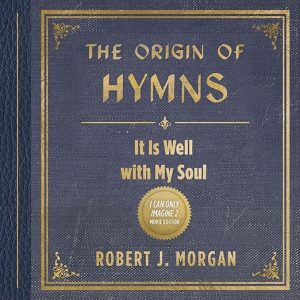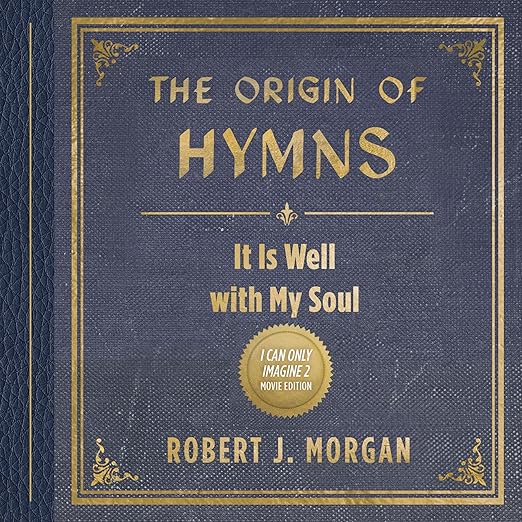
Hymns are among the strangest survivals in English-language culture: verses written by grieving Victorians and eighteenth-century clergymen that millions of people still sing from memory without ever wondering who wrote them or why. Robert J. Morgan has spent a career answering that question, and The Origin of Hymns audiobook gathers fifty of those stories into four hours and fifty-one minutes. The description opens with three words that matter more here than usual: read by the author.
Read by the Author, and It Shows
Read by the author is a line that appears on plenty of listings and means very little on most of them. It means something on this one. Morgan is a pastor, and the material is devotional storytelling built to be delivered rather than studied, the kind of writing that started life spoken from a pulpit and only later got typeset. Hearing it returns the prose to the register it was composed in.
The Whole Story of Horatio Spafford
Fifty hymns get the same treatment: where the words came from, what was happening to the person writing them, and how the song traveled afterward. The publisher frames the throughline as "the history, evolution, and redemptive thread of 50 beloved hymns of the faithful", which is accurate but undersells the structure. Each entry is a short biography with a song at the end of it, and the accumulation is what does the work.
Horatio Spafford supplies the example the description leads with, and it is the right choice. His hymn "It Is Well with My Soul" was written out of catastrophe, and Lee Nearpass, one of five people who left written comments, singles out the completeness of the account, noting that Morgan "includes the WHOLE story of Horatio Spafford". That reviewer, who describes researching hymns professionally, calls the book "the most accurate and well written history of hymns, concisely written and easy to follow".
Fifty Six-Minute Stories You Can Break Up
Devotional books rarely survive contact with an hour of concentrated attention, and this one is built so that it does not have to. Fifty self-contained stories at roughly six minutes each make an unusually flexible listen. One before the day starts, one on the drive, one at a time over ten weeks, or the whole thing straight through. Almost nothing at all is lost by breaking it up, which is decidedly not true of most nonfiction at this length. The unit of the book is the story, not the chapter, and stories survive interruption in a way that arguments do not.
Curated From a Much Larger Bestselling Series
Lee Nearpass describes the prose in terms that read like an argument for the audio without meaning to: Morgan writes in a style that is "conversational, making it easy to read" and lands "as though he was in the room talking to me". The recording makes that literal. Whatever a listener thinks of the theology, the format and the writing are matched here in a way that is genuinely uncommon.
Curated is the operative word, and the description says where from. These stories are "Selectively curated from Morgan's bestselling Then Sings My Soul series", meaning this is a greatest-hits assembly rather than fresh research. Anyone who already owns those volumes should check for overlap before buying. Anyone who does not gets the strongest material from a long-running project in a single sitting-sized package, which is the better end of that trade. Fifty pieces selected from a much larger body of work should, by definition, be the ones that earned their place.
A Visual Complement That Isn't Visual Here
Visual is a word the publisher uses twice about this title, describing it as "A written and visual complement to the critically acclaimed movie, I Can Only Imagine 2". Half of that promise cannot survive the format. Whatever illustration, photography or design the print edition carries, none of it reaches a listener, and the description was clearly written for the book first. The same paragraph also appears twice in the listing copy, which suggests the page was assembled quickly.
Sheet Music Lives in a Separate PDF
Sheet music is the concrete casualty, and the listing is upfront about the workaround: it "can be found in the audiobook companion PDF download". One of the stated benefits is to "Use the full lyrics and music provided to enhance personal or congregational worship", and doing that from a recording means retrieving a separate file. Worship leaders and church musicians should plan for the PDF rather than assume the audio is self-sufficient.
Twenty-two ratings sit behind an aggregate of 4.9, and the five written comments were posted between February 21 and March 17 of 2026, every one of them at five stars. This is a new listing rather than a settled one, and nothing about a warm early response is remotely irregular for a book aimed squarely at people who already love the subject. It does mean the sample is small, uniformly enthusiastic, and drawn from the choir in something close to the literal sense.
Devotional Reading for Believers, Not Scholars
Churchgoers who have sung these hymns for decades without knowing their origins are the obvious audience, and the pool bears that out. Steven L Campbell reports "singing to myself these songs from my childhood with the words to remind me". GC writes that the history "reminds me of my growing up years". Recognition is a large part of the pleasure on offer here, and it deepens the further back your own hymnbook memories happen to go.
Worship leaders, choir directors and anyone who programs music for a congregation will find practical use beyond the devotional reading. Michelle Shortt praises the "Great set up and history of the hymns" and calls out the "great reference points", which is a practical compliment rather than a devotional one, and a signal that the material holds up as a lookup source rather than only as a read-through. Joshua Walsh notes that it "clearly walks you through the history of the hymns to present day".
Bypass it if you want musicology, hymnody scholarship or a critical history of church music. The mode here is devotional and the framing is explicitly Christian, addressed to believers rather than to observers. A listener outside that frame will find the biographical stories interesting and the interpretation constant, and nearly five hours is a long stretch to spend disagreeing politely. Morgan is not making a case to skeptics. He is telling believers where their own songs came from, and the warmth of that address is the whole texture of the book.
Good to Know
Does The Origin of Hymns audiobook include the sheet music mentioned in the description?
Not in the recording itself. The listing states that sheet music appears in a companion PDF download that accompanies the audio. If you intend to use the full lyrics and music for personal or congregational worship, plan on retrieving that file separately rather than working from the audio alone.
Is this audiobook connected to the film I Can Only Imagine 2?
The publisher presents it as a written and visual complement to that movie. The connection is thematic rather than a novelization, and one reviewer notes the book goes further than the film does on the Spafford story. You need no familiarity with the film to follow it.