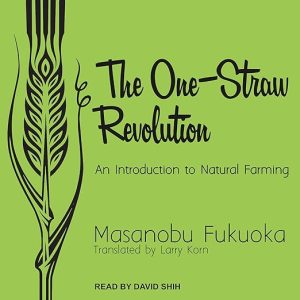
Doing less is the whole argument, and it took a scientist thirty years to prove it. Masanobu Fukuoka trained in a laboratory, rejected modern agribusiness and then rejected centuries of conventional practice along with it, on the theory that the best cultivation copies what nature already does. The audiobook of his manifesto lasts five hours and seven minutes, which is very short for a book this consequential, and the reading is David Shih's. Zen and the Art of Farming is one of the labels the copy tries out. A little green book is the other.
The Verdict, Briefly
Subtraction is what the method consists of. The do-nothing technique, as Fukuoka called it, works by removing things: pesticides, fertilizer, tillage, and above all wasted effort, on the argument that most farm labor exists to repair damage the previous intervention caused. Stop plowing and the soil rebuilds. Stop spraying and the predators return. The claim is not that farming is easy but that most of what farmers do is unnecessary, which is a far more provocative statement and one that took three decades of results on his own land to make in public.
Categorizing this book defeats most readers, and one of them says so precisely. A five-star from April 2012 describes it as neither a how-to manual, which is what people who dislike it seem to have wanted, nor entirely a philosophical treatise, and lands on thoroughly interesting as the honest verdict. That entry also makes the observation that matters most: the text reads as though it had just been written, despite having been written roughly four decades earlier. Very few books about agriculture survive that test, and the reason this one does is that its subject was never really agriculture.
What Makes The One-Straw Revolution Worth Hearing
Damage is where the argument gets its urgency. A five-star from February 2017 lays out what Fukuoka watched industrial farming do to the water, to the land, and to farmers themselves, in their way of life and in their debt, and then reports the payoff: soil rebuilt on his family's farm over a number of years, and yields that matched or beat what the entry calls the petroleum farmers, achieved with no chemicals and by what it fairly describes as the lazy man's route. That combination of ecological seriousness and practical result is why the book still gets assigned.
Specifics are more plentiful than the philosophical framing suggests. A five-star from August 2021, the entry that calls Fukuoka the original author and a genius ahead of his time, comes away with a list of concrete claims: that you can grow food without heavy chemical fertilizer, that a family of five can be sustained on roughly an acre and a quarter, that rice does not require a paddy and will grow in a dry field, and that green manure plus animal or human waste replenishes a plot adequately. Those are testable propositions, not aphorisms.
Points to Consider
Two registers alternate throughout, and a reading has to keep them apart. One is agronomic and precise, about seeds, straw, clover and timing; the other is closer to a spiritual memoir, about the limits of what human knowledge can be trusted to know. Wendell Berry, quoted in the copy, identifies exactly this doubleness when he calls the book at once practical and philosophical. Blur the two and the practical passages sound mystical while the philosophy sounds like instruction. Sample a passage of actual method, not the opening, since the opening is where the book is at its most quotable and least representative.
Credits on this listing are thin in a way that matters. The description quotes Berry's preface at some length, and nothing on the record indicates whether that preface is part of the recording, or who reads it if it is. No translator is named in any field either, on a book that reached its English readers through somebody's work other than the author's. A buyer choosing between editions has no way to tell from this page what actually plays in the first ten minutes.
Three numbers on this page cannot all be right. The badge reads 4.7. The counter beneath it reads a single rating. And the five written grades visible underneath average 4.8 between them, which is a different figure again, produced by a group five times the size of the one the counter admits to. Any two of those could be reconciled with effort. All three together cannot, and the sensible reading is that the number at the top is not measuring the column below it.
Should You Listen to The One-Straw Revolution?
Gardeners and smallholders are the obvious constituency, and the book addresses them directly, from the guerrilla gardener to the kitchen gardener to anyone committed to slow food. The academic audience is real too: a four-star from March 2026 was assigned the book for a class and came away having enjoyed it and learned from it, which is not the usual verdict on required reading. A five-star filed from India in January 2026 names the other use, a short book worth returning to repeatedly, and at five hours that is a genuinely practical proposition.
Practical instruction is what this book refuses to provide, and buyers should take that seriously. Nobody finishes it knowing how to plant next season, because the method was developed for one climate on one piece of land and the author is arguing about knowledge, not issuing a plan. Listeners who want technique should shelve this beside a manual instead of in place of one. Skeptics of the anti-scientific register will also find plenty to argue with, and arguing with it is a reasonable way to read it.
Common Questions
Is this audiobook a practical guide to growing food?
Not really. The method is described and defended, but the book is an argument about knowledge and effort rather than a set of instructions, and it was worked out for one climate on one farm. Use it for the reasoning and buy a manual for the technique.
Does the audiobook include Wendell Berry's preface?
The record does not say. The description quotes the preface directly, yet no field indicates whether it appears in the recording or who would read it. Anyone buying specifically for that introduction should check the sample before committing.