At a Glance
- Voice: Tom Vitale narrating his own memoir about Anthony Bourdain is an essential creative choice; the director's voice carries the weight of direct memory rather than performed recollection, and his delivery in difficult passages feels unguarded in the way that close grief often is.
- Big ideas: Grief for a complex mentor, behind-the-scenes television production, friendship under extreme conditions
- Atmosphere: Honest and elegy-adjacent, with flashes of absurdist humor that feel true to the original context
- Worth it?: Vitale's audiobook is one of the more complete portraits of Bourdain to emerge since his death, and the self-narration makes it feel less like a tribute and more like a conversation that never got finished.
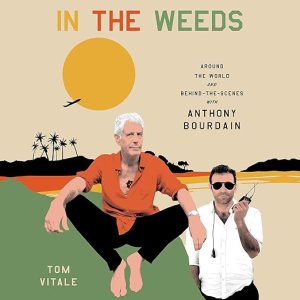
Tom Vitale narrates this audiobook about Anthony Bourdain as the person who spent more than a decade directing him through some of the world's most volatile filming locations, and that distinction shapes everything about how the material lands. In the Weeds, which Vitale narrates himself across eight hours and forty-seven minutes, was nominated for the 2022 BookTube Prize in Nonfiction and received a starred review from Kirkus, which called it the most complete picture yet of Bourdain's complex and conflicted character. That is a significant claim, and it holds because Vitale is not writing biography from the outside. He is writing the memoir of a specific working relationship that crossed the line from professional to something harder to categorize.
Vitale served as Bourdain's director and producer across years of location television in places ranging from Borneo to Iran to Libya to the Democratic Republic of Congo. From the outside, this job looked like a funded adventure. Inside, it was constant controlled collapse, and Vitale documents that collapse with the precision of someone who spent years figuring out how to make the chaos serve the broadcast. The more things went wrong, the better the show. That production philosophy is also, it turns out, a useful frame for understanding Bourdain himself.
Highlights
The self-narration is not incidental. Vitale reading his own work about a person he knew intimately introduces a quality of unrehearsed honesty that professional narrators, however skilled, rarely replicate in memoir. When Vitale describes Tony as a boss, a friend, a hero, and sometimes a tormentor, the weight is audible in a way that printed text cannot quite carry. The Kirkus description of the writing as seductively alive, pulsating with events and vividly rendered observations, holds in the audio format partly because Vitale's delivery does not attempt to aestheticize grief. He speaks about Bourdain the way someone speaks about a person they have not yet fully processed losing.
One reviewer noted being moved by amazing people and momentous moments in history that I never knew happened, which points to a secondary strength of the audiobook: the global context. These were not just television shoots. Libya, Iran, Congo, Vietnam: Vitale documents what was happening in those places politically and socially while the cameras were rolling, and the memoir becomes, in sections, a document of a specific era in global journalism-adjacent television, where a chef with a camera could walk into regions that news organizations were treating with extreme caution. That dimension gives the audiobook a historical weight that straight celebrity memoir rarely achieves.
Things to Know Before Starting In the Weeds
One critical review flags that the book is non-chronological and does not cover the early years of No Reservations in depth. This is a legitimate structural note for completionist Bourdain followers. Vitale is not writing a comprehensive biography; he is writing a memoir of a specific working relationship, and the material he includes is shaped by what served the emotional arc of that relationship rather than by the completeness of the Bourdain record. Listeners who come to this audiobook primarily wanting a thorough career retrospective will find gaps; those who come for an honest accounting of what it was like to know and work alongside this specific, difficult, brilliant person will find something more.
The non-chronological structure works in the audio format because Vitale's voice is a consistent through-line. The listener is always anchored in his perspective, which means the temporal jumps feel organic rather than confusing. The structure mirrors how memory actually works after a loss: not in sequence, but in thematic clusters, returning to the aspects of a person that keep reasserting themselves. That quality makes this a genuinely different listening experience from a standard behind-the-scenes television memoir, where chronological career arc typically dominates. Vitale is more interested in who Tony was when the cameras were down than in the legacy the public television persona left behind.
The political and historical texture of the book is worth one more note. Vitale's account of filming in Libya, Iran, and the Democratic Republic of Congo is not merely travelogue; these were productions that intersected with significant historical moments, and his perspective as a crew member rather than a journalist gives him access to a different kind of observation than most political or cultural accounts of those regions provide. The way a film crew moves through a place, what they are allowed to see and what is kept from them, what the local fixers and guides reveal over days of proximity, this granular record of presence is something that most media coverage cannot provide. Vitale's memoir preserves it, and his own voice in the narration makes the preservation feel immediate.
Is This One for You?
Listeners who followed Anthony Bourdain's television work and want a portrait of the person behind the camera persona will find this audiobook among the most substantive accounts available. The self-narration makes it particularly effective in audio form; this is one of those memoirs where listening is almost certainly the preferred format over reading. Completionist Bourdain historians looking for a linear career account should supplement this with other sources. Anyone interested in the logistics and human cost of long-form international television production will find material here that goes well beyond the subject's celebrity and into the texture of what it costs to care about the work the way Vitale and Bourdain both did.
Common Questions
Does the In the Weeds audiobook require familiarity with Anthony Bourdain's TV work to be meaningful?
Familiarity helps but is not required. Vitale provides enough context for each situation that listeners without deep Bourdain knowledge can follow the narrative. That said, the emotional weight of passages about the show and Bourdain's contradictions will land harder for listeners who experienced the television work firsthand.
Why does Tom Vitale narrating his own audiobook matter for this particular book?
Vitale's direct memory of Bourdain is the book's primary source of authority, and self-narration makes that authority audible. The way he pauses in certain passages, or the texture of his delivery when discussing Bourdain's private contradictions, carries information about grief and proximity that a voice actor working from a script would not have access to.
Is In the Weeds audiobook appropriate for listeners who are sensitive to discussions of suicide and mental health?
Bourdain's death is present in the context of the memoir, and Vitale does not avoid the reality of working closely with someone whose inner life was more troubled than his public persona suggested. Listeners who find discussions of suicide and depression difficult should be aware that these themes are woven into the book, though they are handled with care rather than sensationalism.