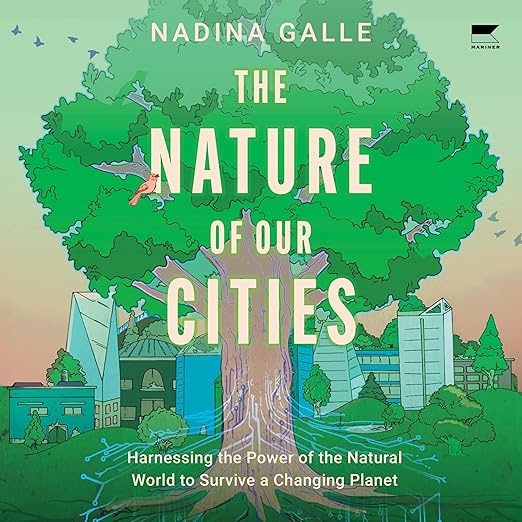
The Nature of Our Cities arrives at a moment when the phrase urban resilience has been stretched thin by overuse, but ecological engineer Nadina Galle does something useful in this audiobook: she fills it back up with concrete examples. Galle is a fellow at MIT's Senseable City Lab and appeared on Forbes' 30 Under 30 list, and the book she has written reads like the work of someone who has spent years in the field before sitting down to synthesize what she has learned. Eileen Stevens narrates with measured clarity, navigating the book's blend of science, policy, and reportage without tilting too far toward either lecture or lifestyle pitch.
Galle's central concept is what she calls the Internet of Nature, the idea that we can use emerging technologies to make urban green infrastructure function as smart, adaptive systems rather than passive aesthetic features. Laser-mapping that identifies at-risk neighborhoods, AI-powered robots that create buffers against wildfires, intelligent water gardens designed to absorb flood surges, advanced sensors that have achieved 99% tree survival in arid summer conditions. These are not speculative futures; they are documented programs already underway in cities across the world. The nine hours and thirty-five minutes give her enough room to move from one case study to the next without rushing any of them.
Urban Nature as Infrastructure, Not Just Parks
The book situates itself explicitly in the tradition of Elizabeth Kolbert and Michael Pollan, writers who have made scientific and environmental complexity accessible to a general readership without dumbing it down. The comparison is apt in some ways and slightly ambitious in others. Galle's prose has not yet reached the narrative density of Pollan at his best, but she writes clearly and with genuine enthusiasm for her subject, which is more than sufficient for a debut work of this scope. The scientific claims are grounded, the policy implications are drawn carefully, and the global scope, covering projects in America, Europe, Asia, and beyond, prevents the book from reading as a purely American story.
The opening argument, that humanity now spends 90% of its time indoors while the natural systems around us have never been more critical, functions as the book's moral pivot. Galle is not simply arguing that parks are nice. She is arguing that urban nature is infrastructure, as load-bearing as roads or water systems, and that ignoring it is a risk management failure with measurable health, longevity, and economic consequences. The mental health dimension, specifically the connection between access to urban nature and outcomes for wellbeing and longevity, is one of the book's more surprising threads, and Galle supports it with research rather than sentiment.
A Most Hopeful Read, Backed by Evidence
Stevens's narration suits the material particularly well. Science writing that is genuinely data-rich requires a narrator who can pace the listener through numbers and citations without losing the broader narrative, and Stevens holds that balance throughout. Reviewer J P describes the book as reading like a joyful fiction book on a summer day while simultaneously delivering a climate call to action, which captures the tonal balance Galle achieves. Reviewer Jared Hanley notes the way Galle intertwines environmental science and tech with urban planning, and this integration is precisely what distinguishes the book from either a pure climate polemic or a pure technology showcase.
Reviewer Stanley Sampson calls it a Most Hopeful Read, which matters in a genre often dominated by catastrophism. Galle's optimism is not naive; she is specific about what has been tried, what has worked, and what the conditions for success look like. The prescriptions she offers for addressing flood risk, wildfire exposure, heat islands, and biodiversity loss are backed by projects that already exist and are producing measurable results. That evidence base is what makes the hope credible rather than cosmetic, and it is one reason the audiobook sustains over nearly ten hours without flagging.
More Than Climate, Also Public Health Equity
Listeners approaching this book primarily as a climate narrative will find it answers that call while also covering territory they may not have expected, including public health equity, the economics of green investment, and the role of community participation in urban ecology programs. The intersection of technology and nature is the book's through-line, and Galle is careful to present technology as a tool in service of ecological goals rather than a replacement for natural systems.
The nine-hour runtime gives the book room to breathe, but some sections move through case studies quickly in ways that will leave some listeners wanting more depth on specific programs. Galle is writing for a general audience rather than a specialist one, so the treatment of individual technologies is accessible rather than exhaustive. For readers who want to go deeper into any particular thread, the book functions as an excellent orientation to a field where the primary literature is considerably more technical and significantly less readable.
Purposeful Rather Than Purely Atmospheric Listening
Urban planners, architects, environmentalists, and public health practitioners will find direct professional relevance here. But the book is also well-suited to any listener who has walked through a city and felt the contrast between its green spaces and its concrete heat traps, and wondered whether that contrast could be different. Parents and educators thinking about what a livable future looks like for the next generation will find the book's combination of honest problem framing and documented solutions unusually sustaining.
Listeners looking for a pure entertainment listen will find this audiobook more purposeful than atmospheric. But for those who find genuine pleasure in well-organized, optimistic environmental nonfiction backed by real evidence, The Nature of Our Cities rewards the full nine-plus hours with something close to a blueprint for the urban future Galle is working to build.
A Few Questions About The Nature of Our Cities
Does this audiobook require a background in environmental science or urban planning to follow?
No. Galle writes explicitly for a general audience, and Stevens's narration keeps the technical concepts accessible. The book introduces its scientific and technological terms as they arise, so no prior expertise is needed.
Is The Nature of Our Cities audiobook primarily about American cities or does it cover global examples?
The scope is genuinely global. Galle profiles programs on multiple continents, and American examples appear alongside international projects rather than dominating the narrative. European and Asian case studies feature prominently throughout.
How does listening to this audiobook compare to reading the print edition?
Stevens narrates fluidly enough that the audio experience serves Galle's prose well. The print edition includes visual data that is unavailable in audio form, but Galle describes her examples with enough specificity that the absence of visuals does not undermine comprehension.
Is the tone of this audiobook primarily alarming about climate change, or does it offer solutions?
Multiple reviewers specifically highlight the book's hopeful register. Galle is clear-eyed about the scale of urban climate challenges but structures the audiobook around documented interventions that are already producing results. The spirit is pragmatic optimism rather than either denial or despair.