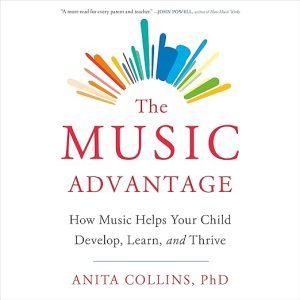
Clapping in time to a song sounds like nothing, and yet this audiobook opens with the claim that it can genuinely help a struggling young reader, which is the kind of specific, testable detail that separates Dr. Anita Collins's book from the usual vague case for putting your kid in piano lessons. Collins is a cognitive development and music education researcher, and narrator Olivia Mackenzie-Smith carries a genuinely science-forward argument here: that learning and even simply appreciating music can, in Collins's own words, grow and repair the brain at any age, not just during some narrow childhood window.
A Full-Body Workout for the Brain
The book's central image, that playing an instrument functions as "the cognitive equivalent of a full-body workout", does real structural work across the whole argument. Collins uses it to justify why music education researchers keep finding effects across such a wide range of domains at once: language ability, social skills, concentration, impulse control, emotional development, working memory, and planning and strategy competence, spanning from infancy straight through adolescence. That breadth could read as overreach in a less careful writer's hands, but Collins keeps tying each claim back to specific cognitive mechanisms rather than asserting benefits by association.
Reviewer Nick, describing himself as a parent, singles out just how comprehensive the book is on the actual brain science behind music's benefits, and says it changed how he parents and encourages music in his own household. That kind of concrete behavioral shift, from information to action, is a meaningful signal for a book that could otherwise risk staying abstract or purely academic in its framing.
Collins is also careful to separate formal music education from mindful appreciation, meaning a family that cannot afford instrument lessons or a music program still has a real, evidence-based path into these benefits through attentive listening alone. That distinction matters enormously for accessibility, and it keeps the book from reading as an argument only useful to families who can already afford private instruction.
The clapping-and-reading example from the opening is worth returning to, because it is a useful test case for how the whole book argues. Collins is not claiming music replaces reading instruction; she is pointing at a specific, narrow mechanism, rhythmic timing, that appears to support a completely different cognitive skill, decoding written language, in a way that would not be obvious without the underlying research. That kind of cross-domain transfer, one skill quietly reinforcing an apparently unrelated one, recurs throughout the book's broader case and is a large part of why the argument holds up better than a simple correlation between music lessons and good grades would, since it points to mechanism rather than mere association.
An Argument the Industry Struggled to Make
The audiobook includes a downloadable PDF with further reading suggestions organized by chapter, and that companion material signals something important about how Collins wants this book used: not as a single pass-through listen, but as a jumping-off point for parents and educators who want to go deeper into the specific research behind any given chapter's claims.
Reviewer J.Day, describing themselves in a position to judge the book's value for parents, teachers, and school administrators alike, calls it insightful and engaging while also crediting it with honest humor drawn from real experience, which is a useful signal that Collins is not writing a dry research summary despite the genuinely academic grounding underneath it.
Reviewer TJ frames the book's value in almost evangelistic terms for anyone connected to music education or the music products industry professionally, noting that the industry has struggled for years to make exactly the case Collins builds here about music's developmental importance. That professional-audience enthusiasm, alongside the parent-focused praise from Nick and J.Day, suggests the book successfully speaks to both audiences without favoring one over the other.
The full-body-workout comparison also functions as a useful corrective to a common misconception the book seems aware of throughout: that musical talent is a fixed trait some children simply have and others do not. Framing instrument practice as a workout implies a training effect available to any child who puts in consistent effort, not a gift reserved for the naturally gifted, and that democratizing framing runs underneath the specific cognitive claims Collins makes about language, memory, and emotional development throughout the book.
Mackenzie-Smith Holds a Scientific and Warm Register
This is persuasive, evidence-driven nonfiction more than a practical curriculum you can follow step by step, and listeners hoping for a structured at-home music program with specific exercises should recalibrate expectations; the synopsis does promise real-life stories and practical strategies, but the book's real center of gravity is the why behind music education, not a lesson-by-lesson how-to.
Listeners who want to act on specific research citations rather than simply absorb the overall argument will need to actually seek out and open the companion PDF rather than relying on the audio alone, which is worth knowing upfront if supplementary source material is part of why you are choosing this format.
Olivia Mackenzie-Smith's narration needs to hold both a scientific register and a warmer, parent-to-parent register across the book's seven-plus hours, and a 4.8 rating across 51 reviews suggests that balance lands well, though listeners should expect a measured, informational tone rather than a highly animated or performative delivery given the material's research-heavy foundation.
Listeners without young children in their own lives right now, grandparents, teachers of older students, or adults simply curious about cognitive science generally, can still get real value here, since the underlying research about music and brain plasticity extends beyond the parenting frame the marketing leans on, even though the practical strategies are aimed squarely at adults actively raising or teaching children.
The runtime itself, a little over seven hours, sits comfortably in the range where a persuasive nonfiction argument can develop real depth without overstaying its welcome, and Collins uses that space efficiently, moving from the underlying brain science into practical parenting and teaching application without either half feeling rushed or padded relative to the other, a balance thinner books in this space often fail to strike.
Ammunition for Teachers and Administrators
Parents of young children, especially those weighing whether music lessons are worth the cost and time commitment, will find Collins's specific, mechanism-by-mechanism case more useful than the usual general encouragement toward extracurricular enrichment.
Teachers, school administrators, and music education advocates will find real ammunition here, per reviewer TJ's description of the book making an argument the music products industry has struggled to land effectively on its own for years.
Anyone hoping for a hands-on, exercise-based music curriculum to follow directly rather than a research-grounded case for why music matters should recalibrate expectations; this leans toward the why over the how, with the deepest practical resources tucked into that supplementary chapter-by-chapter reading list instead of the narration itself.
Good to Know
Does this audiobook explain specific exercises parents can do with their kids, or is it mostly research?
It leans toward research and mechanism over a step-by-step exercise program, though the synopsis notes real-life stories and practical strategies are included, and a downloadable PDF with further reading by chapter supplements the audio for parents who want to go deeper into specific activities.
Do I need the companion PDF to get full value from this audiobook, or does the narration stand on its own?
The narration stands on its own as a complete argument and set of research findings, but the downloadable PDF adds further reading suggestions organized by chapter, so listeners wanting to dig deeper into specific studies will want to access that supplementary material separately.