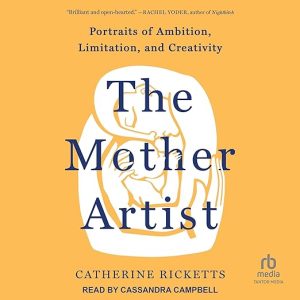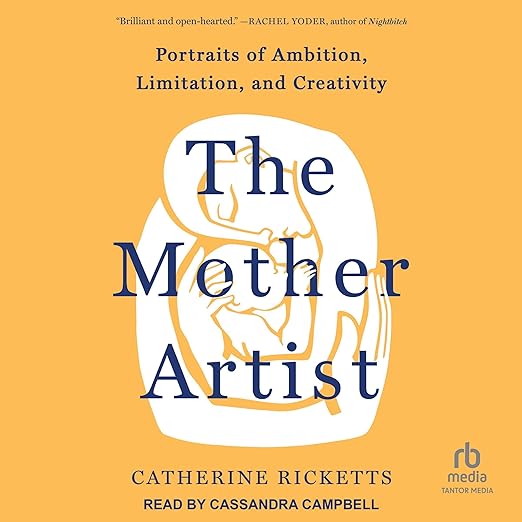
A museum job during early motherhood is where Catherine Ricketts started asking the questions that became this audiobook, and The Mother Artist widens that question into a genuine work of cultural criticism. How does a woman keep making art while also raising a child, and what does the historical record actually show about the few who managed both? Ricketts moves between her own experience as a young mother and case studies of real artists, and the resulting audiobook reads more like connected essays than a single argument pushed straight through.
Senga Nengudi's Sculptures of the Pregnant Body
The specific artists Ricketts studies give the book real weight: Senga Nengudi's sculptures celebrating the pregnant body, Toni Morrison's writing on childbirth, Joan Didion's meditations on maternal grief, and Alice Neel's unflinching portraits of mothers and babies all get dedicated attention, alongside sculptor Ruth Asawa, printmaker and activist Elizabeth Catlett, and writer Madeleine L'Engle. Reviewer Kelly captured the effect well, describing the writing as 'an insightful, beautiful breath of fresh air' that lets a reader into an artist's life while also making them feel seen, and challenging their previously held beliefs about what creative ambition is supposed to look like.
Narrator Cassandra Campbell has a long track record with serious nonfiction that blends analysis and personal narrative, and her measured, unhurried delivery suits a book this reliant on both memoir intimacy and cultural-critical distance without tipping too far into either register.
The Mother Artist as One Compound Identity
Madeleine L'Engle's inclusion carries a nice resonance for anyone who grew up on A Wrinkle in Time: L'Engle wrote much of her own celebrated fiction while raising three children, and Ricketts folding her into this lineage of mother-artists connects a beloved children's book directly to the larger argument about creative work surviving, and sometimes drawing strength from, the demands of caregiving.
The book's own title collapses two roles into one compound identity, the mother artist, rather than treating motherhood and artist as two separate, competing labels a woman has to balance. That framing runs through the entire project: caregiving and creative practice are presented as entangled rather than opposed, a more interesting thesis than a simple time-management argument about finding room for both.
The synopsis describes Ricketts's own prose as incantatory, with an intuitive gaze, language that promises something more associative and rhythmic than a standard argumentative nonfiction style. That promise matches how reviewers describe their actual experience, Emily Graves finishing the entire book in two days suggests prose propulsive enough to read as compulsively as narrative nonfiction rather than academic art criticism, even while covering genuinely serious intellectual ground.
A Revolution of Tenderness for Working Mothers
What makes Ricketts's approach distinct from a standard art-history survey is her refusal to treat motherhood as a footnote in these artists' biographies. Senga Nengudi's pregnant-body sculptures and Alice Neel's portraits of mothers and infants get read as central artistic statements, not biographical trivia, and that reframing carries real intellectual stakes for how art history typically handles women who were also mothers.
The synopsis frames the book's audience deliberately broadly, for mothers who aspire to make art, anyone eager to discover the stories of visionary women, and all who long for 'a revolution of tenderness.' That last phrase previews the book's actual tone well: serious about its ideas without losing warmth toward its subjects, Ricketts included.
Ruth Asawa and Elizabeth Catlett both get treated as more than footnotes here too. Asawa, known for her looped-wire sculptures and her decades of arts advocacy in San Francisco, and Catlett, whose prints and sculptures confronted Black and Mexican identity and social justice directly, both built major bodies of work while also raising children, and Ricketts uses their example to push back against the idea that ambition and caregiving are natural opposites.
Campbell's Pacing Keeps the Prose Propulsive
Toni Morrison's inclusion carries particular weight given how directly her own writing engaged with motherhood and family across her fiction, and Ricketts drawing specifically on Morrison's writing about childbirth gives that section real literary depth beyond biography alone. Didion's own contribution carries a harder emotional register too, consistent with the elegiac tone her later work became known for, a reminder that this is not an uncomplicated celebration of motherhood and art coexisting smoothly.
Cassandra Campbell's steady pacing likely supports that same propulsive quality in audio form, since a narrator prone to over-lingering on any single passage could easily slow incantatory prose into something closer to a formal lecture than the immersive reading experience reviewers describe.
Closer to Rachel Cusk Than a Catalog
This is not a straightforward art history survey, and listeners expecting a chronological biography-style structure should recalibrate. The book moves associatively between Ricketts's own parenting experience and the artists she studies, closer in shape to Rachel Cusk's writing on motherhood and creative identity than to a conventional museum-catalog biography. Reviewer thomas lunt, who identifies as a mother rather than an artist, found the book inspired a reclaiming of parts of herself lost in early motherhood, which suggests the memoir sections land even for listeners without a specific art background.
At 7 hours and 18 minutes, the pacing allows real depth per artist, though listeners wanting a comprehensive, encyclopedic survey of women in art history will find this more selective and personal than that.
A Museum Employee's Questions, Raising a Child
The book's origin as a young museum employee's private questions gives it a specific, grounded starting point rather than a purely theoretical thesis. Ricketts was working inside institutions that decide which artists get remembered at all while raising a small child, and that dual vantage point, insider access to art-world gatekeeping plus lived caregiving experience, shapes the argument in ways a purely academic study would not.
At just over seven hours, the book moves through a genuinely wide range of disciplines, painting, sculpture, writing, dance, and music, and listeners should expect breadth across many short case studies rather than exhaustive depth on any single artist covered.
An Actual Thesis About Ambition and Limitation
Mothers who make art or want to, and readers of feminist art history and criticism looking for a book that treats caregiving and creative ambition as connected rather than opposing forces, are the clearest audience. Reviewer Emily Graves finished the audiobook in two days, which speaks to how readable Ricketts keeps material that could easily have turned dense or academic.
Purely biographical or chronological art history, without memoir interiority woven through it, sits outside what this book is trying to do, and readers expecting exactly that may find the associative structure less satisfying than a more traditional survey. This book asks readers to sit with Ricketts's own parenting experience as much as with the artists she profiles, and that pairing is the whole point rather than a detour.
Reviewer Kelly's point about the book challenging previously held beliefs is worth taking seriously as a claim about argument, not just tone, this is a book with an actual thesis to defend about ambition and limitation, not simply a warm collection of artist profiles.
The Short Version
- Narration: Cassandra Campbell's measured, unhurried delivery balances memoir intimacy against cultural criticism without overplaying either.
- Themes: Motherhood and creative ambition, caregiving as generative rather than limiting, women artists overlooked by history
- Mood: Reflective and intimate, closer to connected personal essays than a straight biography
- Verdict: A rewarding listen for mothers and art-history readers alike, less suited to those wanting a strictly chronological survey.