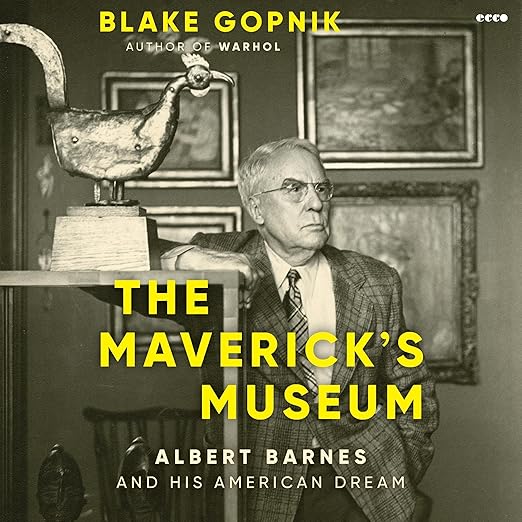
In Brief
- Voice: Jeremy Arthur handles a dense, contradiction-filled biography with steady control.
- Big ideas: Art collecting, Progressive Era politics, class and access to culture
- Atmosphere: Rich and character-driven
- Worth it?: A thoroughly researched, sharply argued biography for anyone curious about the real story behind the Barnes Foundation.
A Philadelphia slum childhood, a hard-won medical degree, and an unlikely fortune from a newborn antiseptic treatment are the origins behind one of America's greatest art collections, and Blake Gopnik's audiobook treats that improbable path as the key to everything Albert Barnes did afterward. The Maverick's Museum digs into how a man raised among the working class ended up owning 181 Renoirs, 69 Cezannes, and 59 Matisses, and then, instead of guarding that collection for the elite, built an institution explicitly designed to put working-class Philadelphians ahead of wealthy visitors. Gopnik, a prominent art critic and biographer, brings real authority to a subject that rewards exactly that kind of expert framing.
Arthur Narrates a Genuinely Contradictory Man
Jeremy Arthur narrates a book dense with proper nouns, contested art history, and a genuinely contradictory central figure, generous to intimates, ruthless to nearly everyone else, and the nine-and-a-half-hour runtime gives him room to let that complexity build gradually rather than rushing toward a tidy verdict on Barnes's character. One reviewer calls Gopnik's own account "a masterful job at guiding the reader along the path to understanding, if not appreciating, the difficult Dr. Albert Barnes". That's precisely the balancing act the narration has to sustain too: making an abrasive, litigious, occasionally cruel man comprehensible without either excusing or flattening him.
A Miner Beats a Mine Owner Here
What sets this apart from a standard collector biography is the argument underneath the anecdotes. Barnes wasn't just accumulating masterpieces, he was waging a deliberate campaign against the idea that fine art belonged to the wealthy, famously arranging his foundation around one guiding line: "A miner was more likely to get access than a mine owner." Gopnik roots that egalitarian streak in Barnes's own Progressive Era politics and his refusal to forget the working-class neighborhood he came from, which gives the book a sharper thesis than most collector biographies bother to attempt.
181 Renoirs, 69 Cezannes, 59 Matisses
The contradictions are where the book earns its title. Barnes made more enemies than friends across every class he interacted with, and yet he was, in the synopsis's own words, "a model of intelligence, generosity, and loyalty" to his small circle of intimates even as his temper became the stuff of legend elsewhere. One listener calls the finished institution and its holdings "masterpieces" that "transcend his convoluted artistic theories", which gets at something real: a listener doesn't have to admire Barnes personally to be won over by what he ultimately built, and Gopnik's research makes both halves of that equation equally vivid.
Gopnik doesn't shy away from the uglier chapters either. Barnes's legal battles, his public feuds with Philadelphia's cultural establishment, and the byzantine restrictions he placed on his own foundation after his death all get real attention rather than a sanitized hagiography treatment. That willingness to sit with the genuinely unflattering material is part of what gives the book its credibility; a collector biography that only celebrated Barnes's vision without reckoning with how difficult he made himself to work with would be a lesser, less honest book than the one Gopnik actually wrote.
The sheer scale of the collection is worth sitting with on its own terms: 181 Renoirs, 69 Cezannes, 59 Matisses, and 46 Picassos assembled by one Philadelphia physician-turned-industrialist is a staggering concentration of modern art in private hands, rivaling major museum holdings built by entire institutions rather than one determined individual. Gopnik traces how Barnes acquired pieces early and aggressively, often before the artists themselves were widely recognized, which is its own story of taste and timing running alongside the biography's larger themes.
Filed as Architecture, Really a Character Study
This is filed under an architecture tag, which undersells what the book actually is: a biography of a collector and his politics, not a study of the Barnes Foundation's building design. Listeners specifically hoping for architectural history, the physical museum space itself, its galleries, its construction, will find that isn't the book's real focus. What Gopnik delivers instead is a character study wrapped around an art-world origin story, arguably richer material, but worth knowing going in if the tag is what drew a listener here.
At nine hours and twenty-seven minutes, this asks for real commitment, and Barnes's story doesn't move in a straight line; his contradictions, his feuds, his late-life mellowing toward some former enemies all require patience to track across the full runtime. One reviewer notes the book was "revelatory" precisely because of how much myth and gossip surrounded the Barnes Collection beforehand, which suggests the payoff is worth the density, but listeners wanting a brisk, surface-level survey of a famous collection should know this goes considerably deeper than that.
A 4.3 average from 67 ratings reflects a book that clearly rewards patient listeners more than casual ones, consistent with the density and runtime already discussed. Listeners should also know Gopnik writes as a critic first, meaning the art analysis carries real opinion and interpretation rather than neutral cataloguing; readers wanting a purely factual, opinion-free account of Barnes's holdings should recalibrate for a biography that argues a thesis throughout rather than simply reporting one.
Compared to more conventional single-collector biographies, which often stay narrowly focused on provenance and acquisition history, Gopnik's approach reads more like social and political history using Barnes as its central thread. That wider lens is part of what makes the book feel substantial rather than niche, even for listeners who walk in with only passing interest in the art world itself.
Who Decides What Counts as Important Art
Art history enthusiasts and anyone curious about the Barnes Foundation's real, contested origins will find this exactly as rewarding as the reviews suggest, especially listeners drawn to Gilded Age and Progressive Era biography more broadly. Gopnik's critic credentials mean the art analysis itself, why these particular paintings, why hung the unconventional way Barnes insisted on, carries real expertise rather than secondhand summary, which matters for a listener who wants more than a life-and-times narrative wrapped around famous paintings.
Listeners interested in the broader question of who gets to decide what counts as important art, and who gets access to see it, will find Barnes's story resonates well beyond one collector's biography. His insistence on placing paintings in idiosyncratic, non-chronological arrangements designed to teach visual principles rather than art history, and his refusal to let critics or wealthy patrons dictate how his collection should be displayed, both speak to arguments about institutional access still very much alive in museums today.
Nine and a half hours is a lot to ask for a quick, breezy museum-world anecdote, and casual listeners should reconsider that commitment, since Gopnik's approach is thorough rather than brisk. Anyone drawn purely by the architecture tag will find the actual content is biography first, building history a distant second at best. For listeners genuinely interested in how one difficult, contradictory man reshaped access to modern art in America, though, the depth is the entire point, and the runtime reflects a subject that resists a shorter treatment.
Before You Listen
Does this audiobook focus on the Barnes Foundation's building and architecture?
Not primarily. Despite an architecture-adjacent listing tag, the book is a character-driven biography of Albert Barnes rather than a study of the museum's physical design.
How long is The Maverick's Museum audiobook?
It runs nine hours and twenty-seven minutes, a substantial but rewarding listen for a densely researched biography.
Do listeners need prior knowledge of the Barnes Collection to follow this audiobook?
No, Blake Gopnik builds the collection's story and Barnes's biography from the ground up, making it accessible to newcomers.