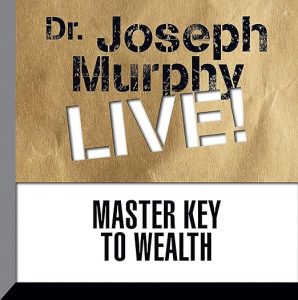
Sixty-one minutes is all it takes to hear Dr. Joseph Murphy, in his own recorded voice, deliver the prosperity lecture that gives this audiobook its entire reason for existing: a direct instruction to stop saying “I can’t” and start saying “I can do all things through the power of my own subconscious mind.”
That single substitution is the entire thesis of The Master Key to Wealth, and Murphy spent decades building an audience for it. He was minister-director of the Church of Divine Science in Los Angeles, wrote and taught to thousands weekly, reached millions more through a daily radio program, and published more than thirty books that have sold upward of fifteen million copies. The synopsis places him as the direct spiritual heir to James Allen, Dale Carnegie, Napoleon Hill, and Norman Vincent Peale, and as a formative influence on Tony Robbins, Zig Ziglar, and Earl Nightingale, a lineage that positions this short lecture as a single strand pulled from one of the twentieth century’s most influential self-improvement traditions.
A Live Lecture, Compressed Into One Sitting
This is a live lecture, not a book-length treatise, and the audiobook is honest about that framing from its own title: “The Master Key to Wealth is Dr. Murphy’s live lecture on this subject.” Judged as what it actually is, a focused, single-sitting talk, it delivers exactly what it promises: a clear articulation of Murphy’s core idea that the subconscious mind is the real engine behind both scarcity and abundance, and that changing your internal language changes your results. It’s a narrow claim, deliberately so, and the lecture never wanders far from proving that one point through repetition and example rather than expanding into tangential subjects.
The “Murphy Live” framing matters for calibrating expectations. This isn’t a narrative memoir or a multi-chapter system with exercises; it’s closer to attending an actual talk, compressed into an hour, delivered by the man whose ideas shaped the genre in the first place.
The synopsis explicitly labels Murphy part of the human potential movement, and it’s worth sitting with what that label actually meant in practice for him: not just positive thinking as a mood, but a specific, teachable technique built around redirecting subconscious belief. That’s a more concrete claim than most modern motivational content makes, and it explains why his influence reaches so directly into the specific psychological-money advice ecosystem that Tony Robbins and Zig Ziglar later built their own careers on. Listeners familiar with any of those later figures will recognize the DNA immediately, right down to the specific rhetorical move of replacing a limiting phrase with an empowering one. It also explains the specific appeal to listeners who’ve already read Think and Grow Rich or How to Win Friends and Influence People and are looking for the metaphysical throughline connecting that whole tradition together.
A Preserved Talk From Before Murphy Died
Hearing Murphy narrate his own material is a genuinely different value proposition than a modern author reading their own book for authenticity’s sake. Murphy died in 1981, so this recording is an archival document, a real historical talk preserved and made available rather than a contemporary self-narration choice. One listener described the effect directly: “the message that I received from this CD was very simple and yet to the point, and I can say with confidence that it clicked.”
Reviewers consistently frame this as material meant for repetition rather than a single listen. One wrote, “I am going to read it for the next 60 days,” and another added, “I will read over and over again.” Two of the three attached reviews independently land on the same habit, which tells you this audio is designed to be revisited daily, closer to a spoken affirmation practice than a story with a beginning, middle, and end.
Eda’s review specifically credits the lecture with explaining “how to be aligned with God in every thought,” which signals something worth knowing upfront: Murphy’s language throughout blends spiritual and financial vocabulary freely, treating prosperity as a natural byproduct of correct spiritual alignment rather than as a separate, secular skill to be learned independently. That fusion is either the book’s biggest asset or its biggest barrier to entry, depending entirely on how a given listener relates to explicitly God-centered prosperity language. It matters to know this before pressing play, since it shapes nearly every sentence of the lecture. Reviewers across generations continue discovering this material fresh, evidenced by the CD-era phrasing in one review sitting alongside streaming-native listeners in the same rating pool.
Formal, Oratorical, From a Different Broadcasting Era
Sixty-one minutes is genuinely short, and listeners wanting a comprehensive treatment of Murphy’s full philosophy, rather than one focused lecture on wealth specifically, should know this is a single talk, not his larger body of written work condensed into audio.
It’s also worth being upfront about the framework itself: Murphy’s central claim, that consciously redirecting subconscious thought patterns can causally shape real-world financial outcomes, sits within the New Thought tradition and asks for real openness to a metaphysical premise. Listeners who want their prosperity advice grounded strictly in behavioral economics or personal finance mechanics, rather than a mind-as-cause philosophy, should go in aware of that framing rather than surprised by it partway through.
Because this is a preserved recording of an actual mid-twentieth-century lecture rather than a studio-produced modern audiobook, the pacing and delivery style reflect that era’s public-speaking conventions, more formal, more oratorical, than the conversational tone most contemporary self-help audio favors. None of the three attached reviews raise this as a complaint, but it’s a reasonable thing for a listener used to modern podcast-style narration to expect going in. Treat it less like a produced audiobook and more like historical archive footage that happens to be extremely actionable.
A Small Taste of Murphy's Larger Philosophy
Existing fans of Murphy’s writing, and anyone curious about the New Thought tradition that runs underneath a huge swath of modern motivational speaking, are the clearest audience. At 4.7 stars across 86 ratings, it’s also a reasonable low-commitment way to sample whether his voice and approach resonate before investing in a longer book.
Listeners specifically drawn to the history of American self-help and positive-thinking movements, not just the practical wealth advice itself, will find real value in hearing an originating voice of that tradition rather than one of its many later interpreters. That historical-primary-source angle is arguably as valuable as the direct financial advice for anyone who has already read the later generation of authors Murphy influenced.
Skeptics of mind-over-matter wealth philosophy, or anyone hoping for a full-length structured program rather than a single lecture, should treat this as a taste of Murphy’s thinking rather than its complete expression.
Frequently Asked Questions
Does Dr. Joseph Murphy narrate this audiobook himself?
Yes, and since Murphy died in 1981, this is an archival recording of an actual lecture he delivered, not a contemporary self-narration.
Do you need to believe in Murphy's subconscious-mind philosophy to get value from this audiobook?
It helps to be open to it. The lecture's core claim, that redirecting subconscious thought patterns causally shapes financial outcomes, sits within the New Thought tradition rather than behavioral economics.