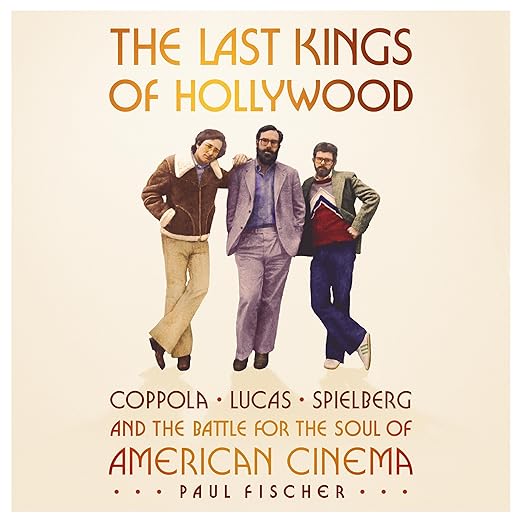
- Voice: Shaun Taylor-Corbett brings real energy to Paul Fischer's dense roster of characters and anecdotes, sustaining narrative momentum across a 13-hour chronicle without letting the sheer volume of material flatten the personalities involved.
- Big ideas: Creative ambition against institutional resistance, the price of artistic independence, friendship as both fuel and friction
- Atmosphere: Propulsive and richly detailed, with the texture of genuine insider research
- Worth it?: Fischer's account of how Coppola, Lucas, and Spielberg rewrote Hollywood's rules is the most comprehensively researched telling of this story yet committed to audio.
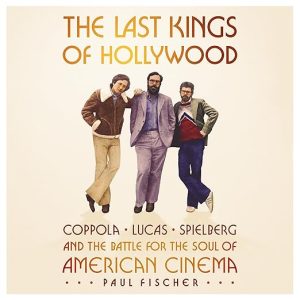
Paul Fischer's The Last Kings of Hollywood opens in the summer of 1967, and the audiobook earns its craft-forward framing from the very first chapter. A young George Lucas walks onto the Warner Bros backlot as an assistant to Francis Ford Coppola. Across town at Universal, a twenty-year-old Steven Spielberg is champing under the constraints of his television apprenticeship. Within a year these three men will know each other. Within fifteen years they will have made some of the highest-grossing films in the history of cinema. The structural question Fischer is pursuing, how three individuals with such different temperaments and visions could simultaneously remake an entire industry, is one that has attracted journalists and film historians for decades. What separates this telling is the access Fischer obtained: hundreds of original interviews with the inner circle of these filmmakers, and the depth of archival research that makes even familiar territory feel newly excavated.
This audiobook runs thirteen hours and twenty-seven minutes, and Shaun Taylor-Corbett holds the material together with genuine skill. The challenge for any narrator tackling this kind of crowded, event-dense history is the risk of letting it flatten into a recitation of extraordinary accomplishments. Taylor-Corbett largely avoids that trap by varying his pacing in response to the emotional shifts in Fischer's prose, slowing for the more personal and painful passages, picking up momentum through the competitive battles over box office records that structured the friendships and rivalries at the heart of the book.
Coppola's Ambition, Lucas's Retreat, and Spielberg's Pragmatism
Fischer is not simply chronicling success. The book's most interesting passages concern what it cost these three men to achieve what they achieved, and how differently they each related to that cost. Coppola, in Fischer's account, is the most nakedly ambitious and the most self-destructive, a man whose desire for total artistic and commercial independence from Hollywood's corporate machinery led him into financial crises that nearly consumed everything he had built. Lucas is presented as more internally driven and more guarded, a filmmaker whose retreat from directing after the original Star Wars had as much to do with the toll the process took on him as with any artistic philosophy. Spielberg, the youngest and in some ways the most instinctively commercial of the three, navigated the industry with a pragmatism that occasionally put him at odds with the more confrontational stances of his friends.
The record of their competitive friendship, the way they surpassed each other's box office records in a sequence, Godfather to Jaws to Star Wars to E.T., is narrated with genuine drama. Fischer captures not just the financial spectacle of those achievements but the personal dynamics that accompanied them: the pride, the occasional resentment, the reconciliations after falling-outs, and the deepening awareness each man had of the others' genius.
Taylor-Corbett Reads the Quotes Without Theatrics
The audiobook's great virtue is Fischer's commitment to primary sources. Rather than synthesizing existing accounts of the Hollywood New Wave, he has done the original interviewing with people who were actually in the room: collaborators, studio executives, family members, and the filmmakers themselves at various points in their careers. That research shows in the specificity of the details and the freshness of the anecdotes. Listeners who have read Peter Biskind's Easy Riders, Raging Bulls will find Fischer's account both complementary and corrective, offering different perspectives on overlapping territory with more direct access to Spielberg in particular.
Taylor-Corbett's narration serves this documentary quality well. He reads the quote-heavy passages, which are extensive, with enough variation to distinguish between speakers without resorting to exaggerated character voices that would undermine the book's journalistic register. The result is an audiobook that feels like listening to a very good piece of long-form narrative journalism rather than a theatrical performance, which is exactly the right approach for this material.
This Rewards Concentrated Listening, Not Background Play
The book covers an enormous amount of ground across fifteen years and hundreds of participants. Listeners unfamiliar with the detailed history of Coppola's American Zoetrope, the production circumstances of The Godfather, or the full arc of Lucas's post-Star Wars career will find themselves absorbing a great deal of new information. That density is one of the audiobook's strengths, but it does mean that concentrated listening is required. Treating this as background audio will lose much of what Fischer has worked to document.
The book's coverage is not perfectly symmetrical across the three subjects. Coppola receives the most extended treatment, and his financial disasters and artistic compromises are documented with a frankness that may feel uneven to those primarily interested in Lucas or Spielberg. Fischer is transparent about his sources and their limitations, but that transparency also means some gaps remain, particularly around Spielberg's more private life, where Fischer acknowledges that his subject was less forthcoming than the other two.
For Serious Film Enthusiasts, Not Casual Fans
This is an audiobook for serious film enthusiasts, for anyone who cares not just about the movies that defined American popular culture in the 1970s and 1980s but about the industrial and personal conditions under which they were made. Listeners who loved the films themselves and want to understand the friendship and competition behind them will find Fischer's account deeply satisfying. Those interested in creative entrepreneurship and the tension between artistic independence and commercial reality will find the Coppola and Lucas material particularly resonant. Casual fans of the films may find the depth of detail more than they need, but for the genuinely curious, thirteen hours will feel well spent.
Frequently Asked Questions
Is the audiobook narration suitable for 13 hours of listening without becoming fatiguing?
Taylor-Corbett paces the material well enough that the length does not become a burden. The book's structure moves through distinct phases of the three filmmakers' careers, giving the listening experience natural breaking points. Extended single sessions are viable, but the density of detail rewards spreading the listen across multiple sittings.
Does the audiobook treat all three filmmakers equally, or does one dominate the narrative?
Coppola receives the most extensive treatment, particularly around the American Zoetrope years and his later financial difficulties. Lucas and Spielberg are fully present but somewhat less excavated. Listeners who come primarily for Spielberg should know that Fischer acknowledges his subject was less open about his private life, which limits that coverage at points.