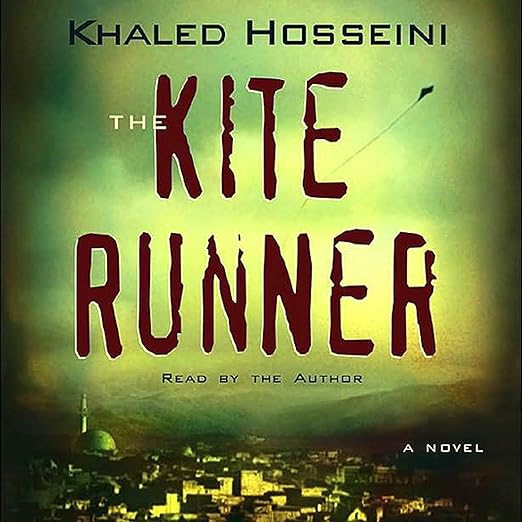
Khaled Hosseini reading The Kite Runner aloud is not simply a convenient production choice. It is a specific kind of cultural transmission. The novel, which moves from pre-coup Kabul through the Soviet invasion, the Taliban years, and into Afghan-American California, carries a particular rhythm in its prose that Hosseini's own voice restores to its source. This audiobook runs twelve hours and one minute, and the experience of hearing the author speak the words he wrote about Amir, Hassan, and the kite-flying world of their shared childhood is qualitatively different from hearing any other narrator give those same words to you. That is the first and most important thing worth knowing about this particular listening experience.
The novel itself requires little introduction by this point. Published in 2003, it became one of the defining literary events of the following decade, and the context in which it was published, the months following the US invasion of Afghanistan and the sudden global attention to a country most Western readers could not have located on a map, gave it a cultural weight beyond its strictly literary ambitions. Hosseini was writing about Afghanistan as he had known it, as a child of the educated Kabul elite, watching that world destroyed in layers: first by the coup, then by the Soviet invasion, then by the chaos of the post-Soviet period, and finally by the Taliban. Each layer of destruction is present in the book, and the audiobook carries all of them.
Guilt Without Easy Absolution
The central story is Amir's, and Amir is not a simple hero. He is a boy who witnesses something terrible and does nothing, who then spends the rest of his life shaped by that failure. Hassan, his companion, the son of his father's servant and a Hazara in a society structured around ethnic contempt, receives the consequences of Amir's inaction with a loyalty that makes the inaction more devastating rather than less. Hosseini is precise about the social architecture that makes Amir's choice comprehensible, even as he refuses to make it forgivable. The novel's power comes from that refusal: the guilt is real, and the path through it does not offer easy absolution or cheap redemption.
Reviewer Peter Shermeta, who had long resisted the book despite its popularity, described it as "wildly popular" with "book clubs and other clusters of bibliophiles" in a way that made him suspicious, then noted that when he finally read it, the reputation was fully earned. That arc, suspicion followed by genuine recognition, is a useful indicator for listeners who have similarly deferred. This is not a book whose wide appeal is sentimental or superficial. It holds up because the emotional logic is sound and Hosseini is willing to sit with discomfort rather than resolve it prematurely.
Cadences Only the Author's Own Voice Carries
The audiobook makes a specific argument for listening over reading that I find persuasive in this particular case. Hosseini's prose has a quality that reviewer Tom Weikert described as "a rich tapestry of literature using many brilliant and contrasting threads," and in audio that tapestry has a different texture than on the page. The embedded Dari words and phrases, the cadences of formal versus informal Kabul speech, the shifts between the warmth of early childhood and the deliberate flatness of traumatic retrospection: all of these come through differently when you hear the author's own voice carrying them. He knows where the weight falls in every sentence because he put it there, and that knowledge is audible in his performance.
The emotional peaks in this novel arrive without much warning, without the visual cue of the page turning and the chapter ending. In audio, that structural surprise is part of what makes the listening experience distinct from the reading one. Hosseini controls the pace, and his narration of the book's most difficult sequences is notably measured: he does not rush toward resolution, and he does not let the listener off the hook before the full weight of a moment has had time to register.
Only Sixty-Two Reviewers for a Modern Classic
Listeners who have read the book will know the emotional terrain and may be more prepared for its difficult passages. For listeners coming to the audiobook cold, without having read the novel first, be aware that the book's middle section contains a sequence of violence that is depicted without softening. It is not gratuitous; it is the hinge on which the entire novel turns, and the redemption that follows is only possible because of the specific nature of the failure that precedes it. But it is genuinely difficult to hear, and Hosseini does not spare the listener from its weight.
The rating of 4.7 from only 62 reviewers is notably small given the novel's cultural prominence. The audiobook has not accumulated the review volume one might expect, which likely reflects the fact that many listeners encounter the novel in print first and return to the audio version as a secondary experience rather than their first encounter. For those listeners, the author-narrated version is the version worth seeking out. For those coming to it fresh, it is simply one of the strongest author-narrated audiobooks available.
Reconsider It Even if You Dismissed It
This audiobook is for anyone who has not yet encountered the novel and wants the most immediate version of it available, and equally for those who have read it and want to experience what it sounds like in the voice of the person who wrote it. Readers who bounced off the novel's reputation as a cultural phenomenon and dismissed it without reading should reconsider; the book's wide appeal is earned on literary terms and holds up under scrutiny. Listeners who are sensitive to violence involving children should prepare themselves or approach the novel in print, where pacing is self-controlled. For everyone else, this is one of the audiobook format's clearest demonstrations of what author narration can add to great literary fiction.
Does Khaled Hosseini narrating his own novel make a meaningful difference to the audiobook experience?
Yes, significantly. The Afghan cadences in the English prose, the placement of Dari words and phrases, and the emotional weight Hosseini places in specific passages come through in ways a non-Afghan narrator could not fully replicate. The author's self-narration is widely described as one of the format's most essential examples.
Is this audiobook suitable for someone who has never read the novel before, or is it better experienced as a re-read?
It works well for both, but first-time listeners should know they are entering without preparation for some of the novel's most difficult content. Hearing it cold, with no prior knowledge of the plot, delivers a more immediate emotional impact that many listeners describe as overwhelming in the best sense.
How does this audiobook handle the novel's most violent and traumatic passages?
Hosseini narrates the difficult passages with restraint and without rushing, which makes them more rather than less affecting. The central traumatic sequence in the novel's middle section is not avoided or softened in the audio version; listeners sensitive to violence should be prepared.
Is the twelve-hour runtime appropriate for a novel of this scope, or does the audiobook feel stretched?
The runtime is well-proportioned. The novel covers thirty-plus years of Afghan and Afghan-American history through the lens of one man's guilt and redemption, and the pacing in the audiobook matches the novel's own deliberate rhythm. Reviewers consistently describe being unable to stop listening rather than feeling the length as an obstacle.