Quick Take
- Narration: Jennifer Jill Araya delivers the clinical and procedural content with consistent clarity, appropriate for a reference title targeting practitioners as much as general readers.
- Themes: Acute trauma response, disaster mental health, community resilience
- Mood: Methodical and reassuring, like a well-organized training session
- Verdict: A genuinely useful second edition from two of the field’s leading practitioners, with expanded cultural awareness and pediatric content, the companion PDF is essential for anyone using RAPID PFA in a professional context.
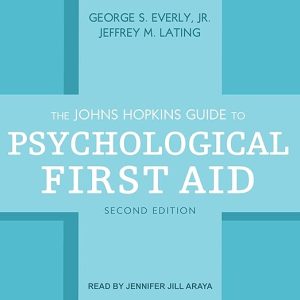
I came across this one while looking into emergency mental health resources after a particularly brutal news cycle. Psychological first aid occupies an interesting space, it is not therapy, not counseling, not crisis hotline work, but the immediate human response that bridges the gap between acute trauma and professional care. George Everly’s RAPID PFA framework has been deployed following the September 11 attacks, in Kuwait after the Gulf War, and during the COVID-19 pandemic, which gives the second edition’s updated content a specific kind of field-tested credibility.
Everly and co-author Jeffrey Lating are among the most cited researchers in the psychological first aid literature. The Johns Hopkins connection is not merely institutional branding; this book reflects the kind of rigorous academic grounding that distinguishes evidence-based PFA from the range of informal crisis support frameworks that proliferate after disasters. The second edition’s additions, cultural awareness, PFA considerations with children, and community mental health facilitation, respond directly to identified gaps in the first edition’s field application.
The RAPID Framework and How It Works in Audio
RAPID is an acronym organizing five phases: Rapport and Reflective Listening, Assessment, Prioritization, Intervention, and Disposition. The book builds each component carefully, with enough procedural specificity to be practically useful and enough theoretical grounding to explain why each element works the way it does. Everly is clearly writing for an audience that includes mental health practitioners and first responders who will apply this in real situations, but the language remains accessible to people with limited prior mental health training.
The audio format handles the procedural content reasonably well. Jennifer Jill Araya’s narration is measured and clear, which is the right approach for material that listeners may be encountering as preparation for actual deployment. She does not editorialize or attempt to create emotional intensity around content that is already dealing with emotionally intense subject matter. The companion PDF, included in the Audible library with purchase, is noted as an essential accompaniment, the RAPID framework includes structured tools and assessments that are far more useful in visual form.
What the Three New Chapters Add
The additions in the second edition represent substantive expansions rather than padding. The cultural awareness chapter addresses a documented limitation in first-generation PFA models, which were developed largely from Western clinical frameworks and did not always translate cleanly across cultural contexts. The pediatric chapter fills a gap that practitioners reported in real deployments, children require different assessment and intervention approaches, and the first edition’s general framework did not adequately address those differences.
The community mental health chapter is perhaps the most forward-looking addition. It positions PFA not just as an individual intervention but as a tool for building collective resilience, which aligns with current research suggesting that community-level psychological responses to disaster are at least as important as individual treatment capacity. For anyone deploying PFA in a public health or community crisis context, this chapter alone justifies the second edition.
For Practitioners and for Civilians
A French-language review describes the book as clear, precise, and very current, a strong endorsement from a professional reader. The English reviews suggest a similar range: mental health professionals, first responders, and engaged civilians who want to be meaningfully useful in the aftermath of crisis. One reviewer notes that it gets somewhat dense and less engaging in sections, a fair observation for a book that is at heart a clinical training guide and makes no pretense of being a narrative.
At eight hours and twenty-nine minutes, the runtime reflects the content’s depth without padding. This is a serious professional resource that happens to be accessible in audio format, and it should be treated accordingly.
Who Should Listen and Who Should Skip
Mental health practitioners, first responders, disaster response teams, community health workers, and anyone in a role where they may encounter people in acute crisis will find this essential. Curious lay listeners interested in understanding what psychological first aid is will get genuine value without needing to apply the protocols professionally. Download the companion PDF from your Audible library before you begin, the structured assessment tools add significant dimension to the audio content.
Frequently Asked Questions
What is the companion PDF included with this audiobook, and is it essential?
Yes, it is essential for professional use. The PDF contains the RAPID framework assessment tools, structured intervention guides, and reference materials that are designed to be used alongside the text. The audiobook explains the why; the PDF provides the what in a format you can actually use in a crisis situation.
Is the RAPID PFA framework different from other psychological first aid models like the WHO model?
Yes. RAPID is a structured, five-phase sequential framework developed by Everly and Lating, with specific procedural steps at each phase. The WHO model is broader and less prescriptive. RAPID was developed with first responder and disaster mental health contexts specifically in mind.
Do you need prior mental health training to follow this audiobook?
No. Everly explicitly designed PFA to be teachable to people with little or no prior mental health training, and the book reflects that design intent. Mental health professionals will find more depth in the theoretical sections, but the core framework is genuinely accessible.
How does the second edition differ from the first in ways that matter for someone who already owns the original?
Three entirely new chapters on cultural awareness, PFA with children, and community mental health facilitation represent substantive additions, plus updated content throughout reflecting pandemic-era field experience. If you work in cross-cultural contexts or with pediatric populations, the second edition has real incremental value.