
Key Details
- Narration: Marcia Ware-Wilder's deliberately paced, non-performative delivery is calibrated for therapeutic induction rather than entertainment, which is exactly what this program requires.
- Themes: Hypnotherapeutic sleep induction, somatic approaches to anxiety loops, subconscious reprogramming for nighttime distress
- Mood: Calm and directed, functioning as an environmental condition rather than a conventional audiobook experience
- Verdict: A clinically informed therapeutic audio program for listeners who have found standard sleep and anxiety approaches insufficient, with effectiveness depending substantially on openness to hypnotherapy as a modality.
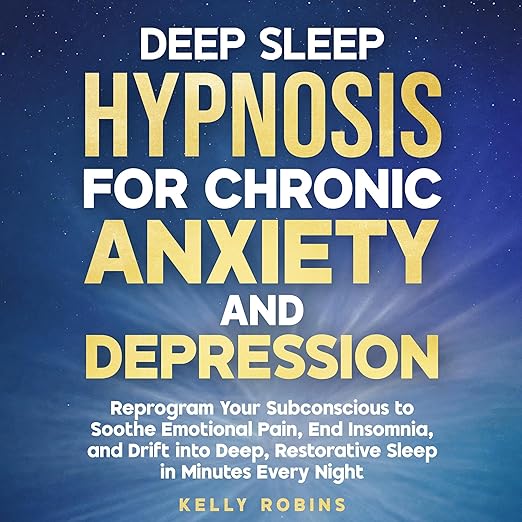
Deep Sleep Hypnosis for Chronic Anxiety and Depression positions itself at the intersection of clinical practice and personal audio ritual, and that positioning matters for understanding what kind of audiobook this actually is. Kelly Robins is a clinical hypnotherapist, and this program, narrated by Marcia Ware-Wilder, is not a conventional nonfiction book about sleep and anxiety. It's a therapeutic audio program that uses hypnotic scripts and healing imagery to facilitate what Robins calls 'subconscious reprogramming.' For some listeners, that framing will be exactly what they're looking for. For others, it requires a different set of expectations than standard health audiobooks provide.
The problem this audiobook addresses is real and precisely described in the opening pages. The synopsis captures it accurately: 'Night after night, you lie there. The world gets quiet, but inside, the chaos only amplifies. Anxiety spikes. Depression tightens its grip.' Robins is writing for people whose relationship with sleep has been systematically damaged by anxiety loops, hyperarousal, and the accumulated weight of emotional distress that resists conventional approaches. Her clinical experience with severe insomnia, depression, and PTSD-adjacent sleep disruption informs the specificity of the program, which is targeted rather than generic.
The program's approach combines several established techniques. The hypnotic scripts work through progressive relaxation and directed imagery, guiding the listener away from the hyperarousal state that prevents sleep onset. The 'subconscious calming sequence' Robins describes involves anchoring safe physical sensations and displacing the anxiety loops that typically intensify at night. The PTSD and hyperarousal-specific content addresses the particular terror of nighttime vulnerability that characterizes trauma-adjacent sleep disruption, using somatic approaches rather than purely cognitive reframing. This is more sophisticated than the standard sleep hygiene recommendation to 'limit screen time before bed,' and it reflects genuine clinical depth.
The distinction between this program and standard relaxation audiobooks is worth being clear about. Robins is working with hypnotherapeutic technique, which involves a degree of directed altered awareness that some listeners will find deeply effective and others may find uncomfortable or simply unable to engage with. Hypnotherapy requires a level of voluntary surrender to the guided experience that not every listener can access, and the program's effectiveness depends substantially on the listener's ability to follow the directed imagery rather than resist it. This is not a limitation of the audiobook; it's a realistic characterization of how hypnotherapy functions as a modality.
Ware-Wilder's Slow Delivery Aims for Induction
Marcia Ware-Wilder's narration is calibrated specifically for this kind of audio therapeutic work. Her delivery is slow, deliberately paced, and carries the quality of someone who is comfortable with silence as part of the listening experience. For a program designed to guide listeners into sleep-adjacent states, the narration needs to function more as an environmental condition than a performance, and Ware-Wilder understands that distinction. She doesn't dramatize the scripts, which is exactly correct. The goal is induction, not entertainment, and her voice serves that goal throughout the eleven-and-a-half-hour program.
The program's claim that it has helped 'thousands overcome severe insomnia, depression, and even CPTSD' is aspirational marketing language that should be read alongside the clinical method rather than as a guarantee. The underlying techniques, progressive relaxation, somatic anchoring, directed imagery for anxiety displacement, have genuine evidence bases in the broader therapeutic literature. Robins's application of them to the specific context of nighttime anxiety loops is thoughtful rather than casual. Listeners who have found conventional sleep aids, both pharmaceutical and behavioral, insufficient for their particular pattern of distress may find this program offers a different approach worth serious attention.
Complements Clinical Care Instead of Replacing It
Listeners with a resistance to the hypnotherapy framing should be honest with themselves about whether they can engage with directed imagery work. The program is ineffective for listeners who approach it analytically or who cannot follow the experiential guidance without evaluating it in real time. This is not a criticism of the audiobook; it's an accurate description of the population for which it is designed.
The program is also not a substitute for professional mental health treatment for severe depression, PTSD, or clinical anxiety disorders. Robins frames it as a complement to clinical care rather than a replacement, and that framing should be taken seriously. Listeners with severe or acute conditions should treat this program as one element of a broader approach rather than a standalone intervention. This particular listing carries no written listener reviews at all, only a star average, which means the strong rating (5.0 from 32 ratings) reflects genuine listener satisfaction, but assessing the program's consistency of effect across different severity levels of anxiety and depression requires care.
The somatic anchoring technique Robins uses most extensively involves directing the listener's attention to areas of physical tension and systematically releasing them through a combination of breath pacing and directed imagery. This technique has direct antecedents in established body-based therapies, and its adaptation for audio delivery is reasonably well executed. What Robins adds that standard progressive muscle relaxation audiobooks don't provide is the integration of emotional content alongside the physical, addressing the specific guilt, rumination, and self-critical loops that accompany anxiety and depression rather than treating the body's tension as isolated from the mind's activity. That integration is the program's clinical distinguishing feature.
Fits Listeners Already Open to Hypnotherapy
Best suited for listeners who have already explored standard cognitive behavioral approaches to sleep and anxiety and found them insufficient for their particular patterns of nighttime distress. Also valuable for listeners who respond positively to somatic and imagery-based approaches to emotional regulation and are open to hypnotherapy as a modality. Less appropriate for listeners who are skeptical of or resistant to directed imagery work, or those who need conventional nonfiction about sleep science rather than a therapeutic audio program. Works best as a nightly use program rather than a single-session listen.
Is Deep Sleep Hypnosis for Chronic Anxiety and Depression a conventional audiobook or a therapeutic program?
It's a therapeutic audio program using hypnotic scripts and directed imagery, not a conventional nonfiction audiobook about sleep science. This distinction matters: the program is designed to be used nightly as a practical intervention rather than listened to analytically as information.
Does this audiobook work as a standalone treatment for anxiety and depression or should it complement professional care?
Robins frames it as a complement to clinical care rather than a replacement. Listeners with severe or acute conditions should treat this as one element of a broader approach. It's not a substitute for professional mental health treatment.
How does Marcia Ware-Wilder's narration serve the hypnotherapy content?
Her delivery is slow, deliberately paced, and non-performative, functioning more as an environmental condition than a conventional narration. For a program designed to guide listeners toward sleep-adjacent states, this calibration is appropriate and effective.
Is this audiobook effective for listeners who are skeptical of hypnotherapy as a modality?
The program's effectiveness depends substantially on the listener's ability to follow directed imagery without analytical resistance. Listeners who approach the content skeptically or evaluate it in real time while listening will likely find it less effective than those who can engage with the experiential guidance.







