Quick Take
- Narration: Caitlyn L. reads this anxiety relief guide with a genuinely warm and unhurried delivery that serves the material well, the calm register is appropriate and not artificially induced.
- Themes: Anxiety interruption techniques, mindfulness and the neuroscience of stress, building personalized calm plans
- Mood: Gentle and constructive, this feels like a workshop companion rather than a lecture
- Verdict: A competent entry in a crowded category that earns its place through good structural organization and a narrator whose voice genuinely suits the subject.
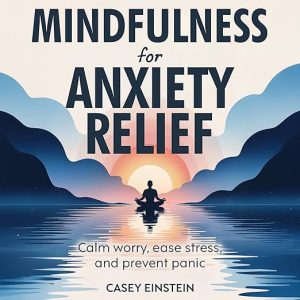
I put off listening to Mindfulness for Anxiety Relief for a few weeks after it landed in my review queue, mostly because the category has produced so much indistinguishable content that distinguishing good examples from generic ones requires more than reading the synopsis. After sitting with it properly on a long commute, I can say that Casey Einstein’s guide is better organized and more practically specific than most of its competitors, and that Caitlyn L.’s narration makes a real difference to how the exercises land.
Part of the Everyday Calm Series, this sits in the mindfulness-for-anxiety subsection of a wellness audiobook market that has grown enormously over the past decade. The challenge for any new entry is demonstrating either depth that competitors lack or accessibility that makes existing knowledge available to readers who haven’t found a way into it yet. Einstein’s book does more of the second than the first, which is not a criticism, there is a large audience that genuinely needs a clear, organized introduction to these tools without having to navigate the technical literature on anxiety and mindfulness.
The Neuroscience Framing and Whether It Holds
Mindfulness for Anxiety Relief opens with the neuroscience behind anxiety, how the amygdala processes threat signals, what happens in the body during the fight-or-flight response, why mindfulness practices appear to support prefrontal regulation of these responses. Einstein is working at a popular science level rather than a clinical one, which is appropriate for the audience this book is designed for. The explanations are accurate in broad outline, if occasionally simplified in ways that technical readers will notice.
What this framing does effectively is give the practical techniques a rationale beyond received wisdom. When the book moves into sensory grounding and box breathing, the reader understands why these techniques work rather than simply being told that they do. That mechanistic grounding makes the exercises easier to commit to and more effective when anxiety is actually present, because the user can reason about what they’re doing rather than performing rituals whose logic they don’t understand.
Structure as the Book’s Real Contribution
The strongest section of Mindfulness for Anxiety Relief is the personalized calm plan framework. Rather than offering a set of techniques and leaving listeners to figure out which apply to their particular anxiety profile, Einstein walks through a process for identifying which interruption strategies fit which situations, differentiating between the anxiety that shows up as racing thoughts before sleep, the anxiety that arrives unexpectedly during daily tasks, and the anxiety that builds slowly over a period of days. The customization logic is not elaborate, but the fact that it’s made explicit rather than leaving listeners to infer it themselves is a genuine service.
Reviewer Pat Walker notes that each chapter included real examples and clear practices, this structural consistency is where the book delivers on its promises. The examples are brief and generic enough to be relatable without being so specific that they exclude listeners whose anxiety situations differ. The practices within each chapter are clearly delineated, which matters in audio format where you can’t flip ahead to see where an exercise ends.
Caitlyn L. as the Right Narrator for This Material
Narration choice for anxiety-relief content is not a minor decision. A narrator who sounds tense, artificially serene, or performatively soothing can undermine the techniques being described by making the listening experience feel like an act rather than a practice. Caitlyn L. avoids all of these failure modes. Her pace is consistent and unhurried without being soporific, and she delivers the exercise instructions with enough natural inflection to suggest she’s actually engaged with what she’s saying. For a five-hour audiobook, that sustained quality matters, there’s no section where the narration becomes noticeably tired or rote.
At five hours, the runtime is appropriate for this category. Long enough to develop the neuroscience framing and the technique range with adequate depth, short enough to revisit specific sections when particular anxiety situations arise rather than needing to re-listen to the full book.
What It Doesn’t Cover
The book’s limitations are mostly scope-related rather than quality-related. It doesn’t address the clinical interventions, CBT, ACT, medication, that some anxiety presentations require alongside mindfulness practices. It doesn’t distinguish between anxiety as a clinical diagnosis and anxiety as the ordinary stress response that virtually everyone experiences, which occasionally makes the guidance feel broader than it is. And it doesn’t reference other books in the field that listeners might want to explore if they find the approach useful, a missed opportunity given how many strong resources exist in this space.
Who Should Listen and Who Should Skip
Listen if you are managing moderate anxiety and want a structured set of techniques with solid organizational logic and good audio delivery. The Everyday Calm Series framing suggests this is intended as a sustainable practice companion rather than a crisis intervention, and it works best in that register.
Skip if you’re seeking clinical-level guidance or if you already have a well-developed mindfulness practice. This is an entry-level to intermediate resource, and experienced practitioners will find the neuroscience framing elementary and the techniques familiar.
Frequently Asked Questions
Are the exercises in Mindfulness for Anxiety Relief guided practices you can follow in real time while listening?
Most of the techniques, including box breathing and sensory grounding, are described clearly enough to be practiced while listening. The calm plan exercises involve more reflection that benefits from pausing. Overall, the audio format works well for this material, though a notebook for the personalized calm plan sections is useful.
How does this compare to established mindfulness-for-anxiety resources like those based on MBSR or Jon Kabat-Zinn’s work?
Einstein’s book is more practically focused and less philosophically grounded than Kabat-Zinn’s approach. It covers similar techniques at a faster pace and with more emphasis on immediate application. For listeners who want the deeper philosophical and clinical context, Kabat-Zinn’s work provides more; for listeners who want organized practical tools, Einstein’s accessibility is an advantage.
Does the book address anxiety that’s connected to trauma history, or is it focused on general stress and worry?
The book addresses anxiety in a general rather than trauma-specific way. Reviewer meCP notes finding it useful for anxiety connected to an abusive past, but the content itself doesn’t specifically address trauma-informed frameworks. For trauma-related anxiety, a more specialized resource alongside this one would be appropriate.
Is this a standalone book or does it integrate with other volumes in the Everyday Calm Series?
It functions as a standalone. The series framing suggests thematic consistency across volumes, but Mindfulness for Anxiety Relief doesn’t require or reference other series entries. It covers its subject completely within its own runtime.