Quick Take
- Narration: Virtual Voice. For a guide that depends on a warm, mentoring tone to make rules feel like guidance rather than judgment, synthetic narration removes the interpersonal warmth the content requires.
- Themes: Social etiquette basics, workplace conduct, dining and grooming protocols
- Mood: Should be encouraging and accessible; landing closer to bureaucratic recitation
- Verdict: The content has real gaps according to reviewers who flag translation errors and incoherent passages, and the Virtual Voice narration adds nothing. Better etiquette guides with professional narration exist and are worth the search.
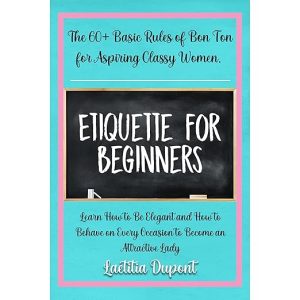
Etiquette books occupy an interesting niche in the self-improvement landscape. The genre has a long history, from Emily Post to Peggy Post to the various guides that have proliferated in recent years, and the best of them work because they deliver their rules through a voice that feels like a knowledgeable friend rather than a rulebook. Laetitia Dupont’s Etiquette For Beginners aims for exactly that register in its synopsis, promising guidance for women who want to carry themselves with elegance in any social situation. The execution has problems that the narrator cannot fix, and those problems are compounded by the narrator that was chosen.
The book covers the expected ground: personal etiquette, dressing well, grooming standards, dining protocols, workplace conduct, and social interaction skills. The organization is straightforward, and the chapter structure from understanding etiquette as a concept through to specific situational guidance gives the material a logical progression. At just over four hours, the runtime allows for reasonable coverage across each domain.
The Translation Problem
Two reviewers independently flag translation errors, which is the most serious quality concern in this book’s review profile. Reviewer JLynn of California describes sentences and paragraphs that make absolutely no sense and attributes this to editing failures. Reviewer Vanessa begins positively but reports that by the midpoint, translation errors made it nonsensical and almost impossible to read. These are specific and consistent complaints about the same problem, which suggests they reflect a genuine flaw in the text rather than reader unfamiliarity with the subject matter.
For a guide that requires clarity of instruction above almost anything else, etiquette guidance that is ambiguous or garbled defeats its own purpose. An etiquette book that tells you how to behave at a business dinner needs to be clear about what it’s asking. Passages that become incoherent partway through the audiobook represent a particular problem in audio format, where a listener cannot easily flip back to reread a confusing section.
Virtual Voice and the Etiquette Register
The genre of etiquette guidance depends heavily on tone. The point of learning etiquette is to feel more socially confident, and that confidence is partly transmitted through the warmth of instruction. Think of the difference between reading a rules list and having someone demonstrate why those rules exist and why following them will serve you. The latter requires a human voice that communicates investment in the reader’s success. Virtual Voice delivers rules. It does not deliver mentorship.
That gap is significant for this specific content type. Even if the text were perfectly written and translated, the synthetic narration would flatten the encouraging quality that etiquette guides need to justify their existence. There are plenty of free etiquette resources online; what a book like this has to offer is the sense of being guided through a subject by someone who cares about your development. Virtual Voice cannot supply that.
Content Gaps in the Guidance
Reviewer JLynn also notes that certain sections that should have been written about were absent from the content, suggesting the coverage is incomplete as well as occasionally incoherent. Without knowing which sections were omitted, it’s difficult to assess how significant this gap is, but the combination of missing content and translation errors represents a structural quality problem that affects the book’s usefulness as a practical reference.
The 3.9 average rating across 32 reviews is the lowest in this batch, and the pattern of the reviews suggests the rating reflects genuine content and quality concerns rather than audience mismatch. A higher-quality English-language etiquette guide with a human narrator would serve potential listeners better.
Who should listen: Listeners with low expectations who can tolerate occasional incoherence in exchange for the general framework of etiquette guidance, and who cannot access better alternatives.
Who should skip: Anyone for whom etiquette guidance is a genuine priority. The translation errors and Virtual Voice narration combine to undermine the book’s core purpose. Seek a more reliable alternative in this genre.
Frequently Asked Questions
Are the translation errors throughout the book, or limited to certain chapters?
Reviewer Vanessa reports that the errors become significant around the midpoint and worsen from there. Reviewer JLynn describes them throughout but doesn’t specify chapter locations. The impression from both is that the errors are structural rather than isolated.
Is this book suitable as an introduction to etiquette for someone with no background in the subject?
In principle, yes, the content covers basic etiquette concepts accessibly. In practice, the translation errors identified by reviewers create confusion precisely where clarity matters most, making this a risky choice as a primary learning resource for someone new to the subject.
Does the book cover modern etiquette situations like digital communication and social media?
The synopsis and chapter structure focus on traditional etiquette domains: grooming, dining, dressing, workplace conduct, and social interaction. There is no indication of digital etiquette coverage, which limits its applicability to contemporary professional and social contexts.
Are there better-reviewed etiquette audiobooks in a similar beginner-focused format?
Yes. Emily Post’s Etiquette and titles from the Emily Post Institute have substantially more review history and professional editorial standards. For a more modern take, books by Jodi R.R. Smith or Diane Gottsman offer well-produced alternatives with professional narration.