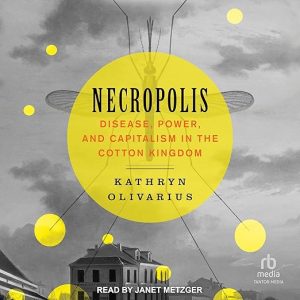
Quick Take
- Narration: Janet Metzger reads with composed historical authority, giving the archival density of Olivarius’s scholarship an accessible and engaging forward momentum.
- Themes: Disease and racial hierarchy, the commodification of immunity, how public health crises expose and entrench existing power structures
- Mood: Dense and revelatory, the kind of historical argument that makes the present feel uncomfortably legible
- Verdict: Olivarius’s concept of immunocapital is one of the most genuinely original frameworks in recent American history, and Necropolis makes it devastatingly clear.
I came to Necropolis via a podcast recommendation that described it as one of the best histories of how public health crises interact with existing social hierarchies. I was skeptical of that framing, the kind that promises urgent contemporary relevance by leaning on a historical event, because that strategy often produces books more interested in the present-day parallel than the historical record. What Olivarius has written is the opposite of that. It is a work of meticulous primary source scholarship about antebellum New Orleans and its yellow fever epidemics, and its contemporary resonance is a byproduct of rigorous historical argument rather than a rhetorical strategy.
Kathryn Olivarius is a historian of medicine and American slavery at Stanford, and Necropolis draws on years of archival work in New Orleans court records, plantation accounts, newspapers, and personal correspondence. The book makes a specific and original historical argument: that yellow fever in nineteenth-century New Orleans did not simply kill people randomly. It operated within and reinforced a social hierarchy through what Olivarius calls immunocapital, the leveraging of demonstrated immunity as a form of social and economic currency that accrued differently depending on race and legal status.
Immunocapital: The Most Original Framework in This Book
The concept Olivarius develops is her most significant scholarly contribution, and it is worth understanding precisely. Yellow fever killed between a third and half of those who contracted it. People who survived were immune for life, and in a city where the disease arrived every few years, surviving an epidemic meant something concrete: you could pursue economic advancement, enter into contracts, be trusted with responsibility, claim a kind of biological creditworthiness. Olivarius documents how white Orleanians explicitly used their acclimatization as evidence of fitness for the city’s commercial and political life.
For enslaved Black people, the calculus was perverse. They were in fact less susceptible to yellow fever due to partial genetic immunity that provided some protection, a biological reality that slaveholders recognized and exploited. But that immunity did not accrue to them as immunocapital. It accrued to their owners, who leveraged the fact that their enslaved laborers could survive conditions that killed white workers as evidence of the enslaved people’s economic value and their fitness for the most dangerous labor. Their biological advantage became another mechanism of their exploitation.
This is a historical argument that requires archival evidence to be credible, and Olivarius provides it. She traces specific individuals through the records, shows how immunity was documented and leveraged in commercial transactions, and demonstrates the ways that yellow fever’s social logic reinforced racial hierarchy even as it killed indiscriminately across the color line. The argument is not metaphorical. It is documented.
What the Archive Shows About Crisis and Power
One reviewer noted that reading Necropolis during the COVID-19 pandemic made its contemporary resonance unavoidable, particularly the observation that political actors argued those who died from yellow fever must have had some personal failing that explained their susceptibility. The structural parallel does not require Olivarius to draw the connection explicitly. She does not draw it, which is the right scholarly choice. The reader is left to do that work.
The book also illuminates something that medical histories often miss: the powerful in antebellum New Orleans were not indifferent to yellow fever. They had elaborate and well-documented rituals of flight, returning to the countryside when the disease season arrived, leaving their enslaved people in the city to work and die. This is not a story of universal suffering. It is a story of suffering distributed along racial and economic lines with considerable precision.
Janet Metzger and Nearly Fourteen Hours of Historical Argument
Necropolis is a book that rewards close attention. The archival material is dense with names, dates, and specific documented cases, and Metzger’s narration manages this without losing the reader. She reads with composed historical authority, giving the material the gravity it warrants without the pomposity that sometimes accompanies heavy academic prose. At thirteen hours and fifty-one minutes, this is a serious listen that asks for genuine engagement in return for genuine intellectual reward. John Dickerson’s description of the book as incredibly engrossing despite its grisly subject is a reasonable guide to what that engagement feels like.
Who Should Listen and Who Should Skip
Necropolis is essential for readers with interest in American history, the history of medicine, the history of slavery, or how disease interacts with social hierarchy. Its scholarship is accessible to general readers with patience for archival density. Those who prefer history light on primary source documentation will find Olivarius’s rigor demanding. Those who want the rigor will find it rewarding.
Frequently Asked Questions
Do you need prior knowledge of antebellum New Orleans or yellow fever history to follow the argument?
No. Olivarius establishes the historical context clearly before developing her central argument. The book is written for a general academic and educated lay audience, not specialists in Louisiana history or infectious disease. Some familiarity with the broad contours of antebellum American slavery is helpful but not required.
Is the immunocapital concept Olivarius develops original scholarship, or is she synthesizing existing historical work?
The immunocapital framework is Olivarius’s original contribution to the scholarly literature. She draws on existing history of yellow fever in New Orleans, but the specific argument about how immunity functioned as economic and social capital, and how that capital accrued differently by race, is developed from her own archival research.
How does Necropolis handle the distinction between the experiences of free Black people and enslaved people in New Orleans?
New Orleans had a significant community of free people of color, and Olivarius’s analysis distinguishes between their experiences and those of enslaved people. The immunocapital mechanism operated differently across these groups, and the book’s archival work is specific about those distinctions.
Is the audiobook appropriate for someone who typically reads lighter historical narrative rather than scholarly history?
Olivarius writes with more narrative drive than most academic historians, and several reviewers have noted the book is more readable and engaging than its scholarly apparatus might suggest. The thirteen-hour runtime requires commitment, but the engagement is genuine rather than dutiful.