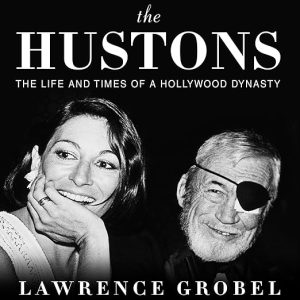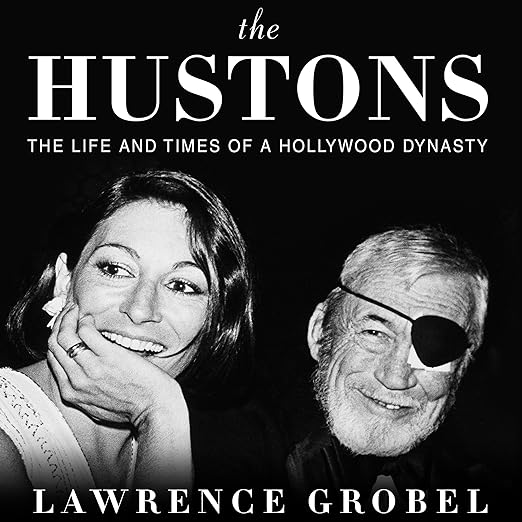
Thirty-seven hours and forty-three minutes is the number to reckon with before anything else. That is the length of this audiobook, which puts The Hustons among the longest single-volume biographies available in the format at all. My verdict, stated up front: the runtime is the method rather than padding, and whether that counts as a recommendation depends entirely on what you want a Hollywood biography to do. If you want a life, this is three of them. If you want an argument, this is testimony instead.
Oral History Wearing the Coat of a Biography
The runtime has a straightforward explanation, and it sits in the publisher description. Lawrence Grobel interviewed John Huston for over a hundred hours, then conducted two hundred further interviews with the four Huston children, three of the five wives, a number of the mistresses, and the producers, writers, technicians and famously interview-averse celebrities around them. A biography built out of that much recorded speech cannot be short without discarding most of what it went to the trouble of gathering. This is oral history wearing the coat of a conventional life story, and once you understand that, thirty-seven hours starts to look like restraint.
The scope is also wider than the cover suggests. John Huston is the center of gravity, and the roll call of his films earns it: The Maltese Falcon, The African Queen, The Treasure of the Sierra Madre, The Dead, Prizzi's Honor. But the book is a dynasty study, running from Walter on the vaudeville circuit through his later Broadway fame, into John's rise, and out again to Anjelica. Three generations of Oscar winners in a single family is a genuinely unusual subject, and Grobel treats the inheritance itself as the story rather than as background to one man's career. Anyone expecting a tight biography of the director will find the frame considerably larger.
David Drummond Must Hold Dozens of Named Speakers
The endorsements attached to this book are startling even by publishing standards. J.P. Donleavy named it the best book of the year on publication. James A. Michener called it a masterpiece and Kirkus called it spellbinding. Larry King rated it 'Biography writing at its absolute best'. Frederick Raphael contributed the sharpest line of the lot, describing 'a delicious, wicked guide to the delicious, wicked life' of a man the same blurb goes on to call a sly, sadistic scoundrel, and the Hollywood Reporter said it 'Reads like a gutsy movie that might have been made by Huston himself'. That last one is the most accurate of them.
The other reason to take an interest is the timing of this particular edition. The publisher notes that the complete story is now available as an audiobook for the first time, and the book itself was written close enough to the events that Anjelica's career is described as an emergence still in progress. You are therefore listening to a portrait assembled while many of its subjects were alive to argue with it, newly recorded decades later. That gives the whole thing a quality no contemporary biography can manufacture: the sources are speaking from inside their own moment rather than remembering it.
David Drummond is credited with the reading, and the challenge here is unusual enough to name precisely. A book stitched from two hundred interviews depends on attribution, and print handles that with a tag, a paragraph break and a page you can look back at. Audio has none of those. A listener has to hold dozens of named speakers, their relationships to Huston and their reasons for saying what they say, across a span longer than most people's total monthly listening. That is the specific thing I would test in a sample before committing.
EXHAUSTIVE, in One Reviewer's All-Caps Verdict
The most honest review on this listing has one word for a title, in capitals: EXHAUSTIVE. It awards four stars, and it explains the reservation without complaint, noting that the book 'covers the entire history of film from the thirties through the nineties through the prism of the Huston family'. Six decades of cinema filtered through one household means long stretches where the household recedes and the industry takes over. Some listeners will treat that as value; others will feel the family thread going slack for hours at a time. Both reactions are fair.
Do not expect the hundred hours of access to have bought John Huston any protection. The interview list includes the mistresses alongside the wives, and the blurb Frederick Raphael supplied is not the kind of thing an authorized biography prints. The same four-star reviewer asks 'whether he was a cad or not' before concluding that 'he was a larger than life character' regardless. A listener who needs a biographical subject to be admirable should choose a different one, because this book gives its sources room to be unkind.
Read the rating with its sample in mind. A 4.0 across thirty-three ratings is a soft average, and the written reviews explain it without much mystery: the enthusiasm is for the family and the prose, while the reservation is always about volume. One five-star reviewer calls the family interesting, the subject fascinating and the book 'Well written', ranking it among the best biographies they had read. Nobody argues the book is bad. Several people gently indicate it is a lot.
Treat the closing movement as a period document as well. The endorsement roster dates the book as precisely as a colophon would, and its account of the youngest generation describes a career that was then still ascending. None of that undermines the reporting, which is the enduring part. It does mean the final chapters read as a snapshot of a family caught mid-sentence rather than as a completed record.
A Very Long Conversation That Repays the Commitment
Serious film history listeners are the natural audience, particularly anyone who enjoys biography assembled from testimony rather than from archives and secondary sources. It suits people with genuinely long commutes, long drives or long repetitive work, since thirty-seven hours rewards a routine rather than a weekend. And it belongs with anyone curious about how talent, money and damage transmit down a family line, which is the actual subject underneath the movie titles.
Casual film fans should not start here, and neither should anyone wanting a compact account of a single director. Skip it too if you need biographies to settle on a verdict, because Grobel lets contradictory witnesses stand next to each other and declines to adjudicate. Come to it as a very long conversation with everyone who knew a difficult, magnetic family, and the commitment repays itself.
- Narrator: One reader, David Drummond, for two hundred interviewees across thirty-seven hours, which makes attribution the whole technical challenge.
- Subjects: Hollywood dynasty, three generations of Oscar winners, oral-history biography, inherited talent and damage
- Tone: Expansive, gossipy, unhurried
- Bottom line: A magnificent, sprawling oral history that asks for a month of your listening and mostly justifies it.