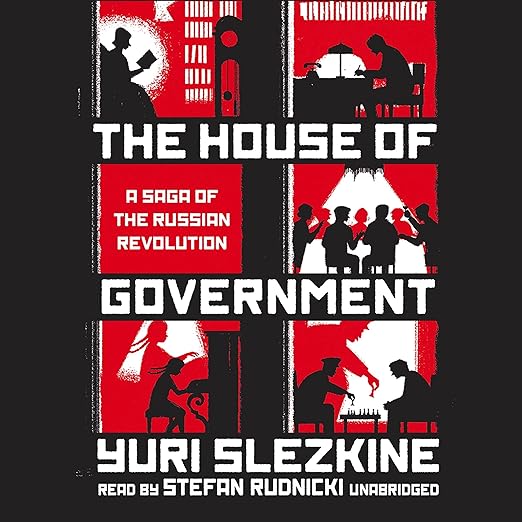
Eight hundred residents of one Moscow apartment building were eventually evicted, arrested, or killed, and this audiobook spends forty five hours explaining exactly how true believers ended up destroying each other inside their own paradise. The House of Government tells the story of an enormous residential complex built across the river from the Kremlin, completed in 1931, where the Communist elite lived alongside a movie theater, a tennis court, and a shooting range while ruling the Soviet state. Yuri Slezkine treats the building itself almost as a character, a structure that promised permanence to people whose entire ideology depended on radical, permanent change.
Bolshevism as Faith, With Scripture and Martyrs
Slezkine's own framing places this book in the company of Tolstoy's War and Peace, Grossman's Life and Fate, and Solzhenitsyn's Gulag Archipelago, and the ambition isn't false advertising. This is simultaneously architectural history, group biography, literary criticism of the residents' own diaries and letters, and an argument about millennial political movements more broadly, treating Bolshevism as a species of religious faith with its own scripture, martyrs, and eventual heretics.
The structure moves from the residents' conversion to Communism through their children's eventual loss of faith and the Soviet Union's collapse decades later, which gives the book a generational arc most single-building histories can't attempt. Slezkine draws on real letters, diaries, and interviews to reconstruct interior lives most Soviet histories only gesture at, and the result reads less like a chronicle of political events than a study of what it actually felt like to believe something completely and then watch that belief consume you.
The Soviet Union on a Therapist's Couch
One reviewer titled their response to the effect of putting the Soviet Union on a therapist's couch, which captures something real about the book's method: Slezkine is as interested in psychology and self-justification as he is in policy, tracing how ordinary conviction curdled into complicity and, for hundreds of residents, into victimhood at the hands of the very system they'd helped build.
The building at the center of this book has its own separate literary afterlife worth knowing about. Soviet novelist Yuri Trifonov, who actually grew up inside the House of Government and watched his own father taken during the purges, later wrote a famous novella called The House on the Embankment about the building and its residents. Slezkine's history and Trifonov's earlier fiction speak to each other across decades, and listeners who go on to seek out Trifonov's shorter, more personal account after finishing this one will find a genuinely rewarding companion piece.
Rudnicki's Stamina Pays Off Past Hour Twenty
Stefan Rudnicki is genuinely one of the strongest choices available for a project this demanding. He handles Russian names and terminology with real authority, which matters across forty five hours of unfamiliar patronymics and Soviet-era vocabulary, and he manages the tonal range Slezkine's prose requires, from an intimate reading of a private letter to the monumental sweep of a purge sweeping through an entire building, without the jarring shifts a less experienced narrator might introduce.
This is exactly the kind of demanding, extreme-length academic nonfiction where Rudnicki's reputation for stamina pays off. A weaker narrator can make dense scholarly material feel like homework somewhere around hour twenty; Rudnicki's steady, intelligent delivery is built to sustain listener attention across a runtime most audiobooks never approach, and that consistency across five sittings' worth of listening is arguably the single biggest reason to choose the audio edition over the print one.
A Shooting Range Inside a Utopian Brochure
One reviewer specifically praised the book as outstanding and remarkable while noting its considerable length as a real commitment rather than a flaw, which is a fair way to think about the audio format here: the length isn't a barrier to get through, it's the mechanism by which Slezkine earns the generational scope he's after.
Because so much of Slezkine's evidence comes from residents' own letters and diaries, hearing those passages read aloud rather than encountered on a printed page gives them an almost first-person, confessional quality, closer to overhearing a private conversation than reading an archival excerpt. That intimacy is a genuine advantage of the audio format specifically, and Rudnicki's restraint in those passages, never overplaying the emotion already present in the words themselves, is exactly the right choice for material this sensitive.
The building's own amenity list, a movie theater, a library, a tennis court, even a shooting range, reads almost like a utopian brochure, and Slezkine uses that self-contained luxury as a recurring visual argument about how completely the Bolshevik elite walled themselves off from the deprivation most Soviet citizens actually lived through. Hearing that list recited within the larger, grimmer arc of the book gives it a different weight than encountering it on a page, where a reader can too easily skim past it as set dressing.
No Relief From the Mounting Dread Here
Forty five hours is a genuine investment, roughly the length of five or six standard audiobooks combined, and this isn't a book that rewards distracted, background listening. The density of names, dates, and interwoven biographies means a wandering-attention listen will likely require backtracking, so treat this as a project to commit real focus to rather than something to run during a single week of commutes.
The subject matter is unrelentingly heavy: this is fundamentally a book about true believers destroying each other, and Slezkine doesn't offer much narrative relief from the mounting dread of knowing, from page one, how badly this ends for most of the people described. Listeners wanting a lighter entry point into Soviet history should look elsewhere first.
Elite History the Mainstream Often Neglects
One reader noted this history is often neglected by the mainstream discourse on Communist Russia specifically because it focuses on high-level officials rather than ordinary citizens, which is worth knowing going in: this is elite history, concerned with the people who built and then were consumed by the Soviet state's inner apparatus, not a broader social history of the era.
This is deliberately elite history, focused on the government officials and intelligentsia who lived inside one specific building rather than a broader social history of ordinary Soviet citizens. With hundreds of named residents passing through forty five hours of narrative, some listeners may find it genuinely difficult to keep every individual straight, since Slezkine offers relatively little hand-holding for a reader trying to track every name introduced along the way.
Pair This With Gulag Archipelago or Life and Fate
This is for serious nonfiction listeners with real appetite for scale, ideally readers who already enjoyed dense, ambitious works like Gulag Archipelago or Life and Fate and want something similarly demanding. Anyone specifically interested in how ideological conviction operates psychologically, not just politically, will find unusually rich material here.
Skip it if you want an introductory survey of the Russian Revolution or a shorter, more accessible entry point into Soviet history. This assumes real appetite for scholarly depth and forty five hours of sustained attention, and a lighter overview book will serve a first-time reader of this period far better.
At a Glance
- Narrator: Stefan Rudnicki is close to ideal casting, handling Russian names with authority and sustaining intelligent delivery across an exceptionally long runtime.
- Subjects: ideological faith and its collapse, architecture as political metaphor, the machinery of Stalinist purges.
- Tone: Dense and mournful, scholarly rather than dramatic, but genuinely absorbing.
- Bottom line: A demanding, extraordinary achievement in Soviet history that rewards listeners willing to commit real time and attention to it.