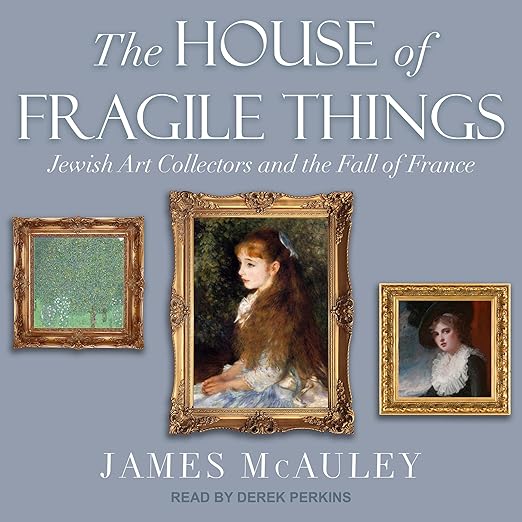
In Brief
- Voice: Derek Perkins brings a measured, scholarly tone to James McAuley's history that suits the material's weight; his pacing gives the archival evidence room to register without making the listen feel academic.
- Big ideas: Assimilation and its limits, cultural patronage as identity, the destruction of what was built in good faith
- Atmosphere: Elegiac and rigorously researched, with anger held in reserve beneath the historical precision
- Worth it?: McAuley has written a history that asks what art collection meant to people trying to belong to a country that did not want them, and Derek Perkins ensures the question lands with its full weight.
James McAuley's craft as a historian is visible from the first pages of The House of Fragile Things, narrated by Derek Perkins in this audiobook edition. The structure McAuley builds weaves together narratives of the Camondos, the Rothschilds, the Ephrussis, and the Cahens d'Anvers across the decades between 1870 and the end of World War II, and it is not organized around a single thesis so much as a sustained interrogation of what it meant to invest in France's cultural patrimony when France's antisemitism made that investment a paradox from the beginning. The book's title is exact: these things were fragile. So were their owners. And the distance between the two fragilities is the history McAuley has written.
McAuley works as a journalist and academic who reads French, and his direct engagement with primary sources gives the audiobook an archival density that distinguishes it from survey histories of the same period. He is not paraphrasing what others have found about these families. He is working from their letters, their diaries, the records of their transactions, the accounts of their social encounters in Marcel Proust and the Goncourt brothers' journals, and following the thread of their collections through acquisition, through the occupation, and into the complicated afterlife of what France eventually did with what was left behind. This level of primary source engagement produces historical texture that secondary surveys simply cannot match.
The Nazis Emptied the House Anyway
The central argument McAuley makes is that art collecting for these families was not a leisure activity. It was a statement about belonging. When Moise de Camondo built his Paris townhouse to resemble the Petit Trianon and filled it with eighteenth-century French decorative arts of museum quality, the act was simultaneously an aesthetic achievement and an argument: that his family had a legitimate claim on this country's culture, that their wealth had been put in service of preserving what France itself valued, that they were French. The Nazis emptied the house anyway. Camondo's descendants were deported. The French state accepted the collection as a donation and opened it as a museum.
That sequence runs through each family's story with variations. The Ephrussis appear here as some readers will know them through Edmund de Waal's The Hare with Amber Eyes, though McAuley's focus and methods are different and his analysis does not depend on the personal memoir dimension that de Waal brought to the same family. The Rothschild thread covers previously surveyed ground but gains new texture from McAuley's access to sources. The Cahen d'Anvers section contains archival material reviewers describe as including details not previously widely known. The cumulative effect of four narratives woven together is intensification rather than repetition.
Perkins Gives Archival Evidence Room to Register
Derek Perkins's narration is calibrated correctly for this material. He reads with the controlled weight of someone who understands that the history he is delivering requires gravity but does not require performance. The ten hours and twenty-one minutes make this a substantive listen, and Perkins maintains the scholarly tone without draining the human dimension from the individual family stories. The archival evidence arrives with room to register: he does not rush past a detail to get to the next one, which matters considerably in a history where the specific detail is frequently the argument itself.
The audiobook rewards listeners with some existing context about French Jewish history in the Third Republic and the Dreyfus Affair, which provides the political architecture within which these families were navigating. McAuley builds sufficient context for listeners without that background, but knowing the broad outline of the antisemitism Edmond Drumont's journalism fueled and the Dreyfus case's social consequences makes the specific family histories more immediately legible as political acts rather than simply cultural ones.
Millions Visit the Museums, Not the Families
The final section of the audiobook, which addresses what happened to the collections after the war and the complex question of French cultural memory, is where McAuley's argument becomes most explicit. He is not simply recording what was lost. He is asking what France has done with the knowledge of what happened to those who gave it so much, and the answer is not a comfortable one. The collections sit in museums that millions visit annually. The families who built them were largely destroyed. The tension between those two facts is what the audiobook ultimately refuses to resolve, and that refusal is the most honest thing about it.
Listen also for the way McAuley handles the accusation that Jewish collectors were invading France's cultural patrimony. He quotes the accusation from its antisemitic sources directly and then answers it with the evidence of what the collections actually were: not extraction but investment, not conquest but conversation with a culture these families considered their own. The counter-argument is implicit in the archive rather than stated as rebuttal, which makes it more powerful than a direct refutation would be.
Pair This With a Visit to the Camondo Museum
Readers interested in French history, Jewish history in Europe, the Holocaust's cultural dimensions, and the history of art collecting will all find material here that rewards sustained attention. This is not a casual listen: the density of archival detail and the weight of the history require the kind of attention that serious narrative nonfiction demands. Listeners who found Edmund de Waal's The Hare with Amber Eyes rewarding will find McAuley's approach complementary rather than redundant. Those specifically interested in the Camondo family will want to pair this audiobook with a visit to the Musee Nissim de Camondo in Paris if the opportunity exists: the audiobook will transform what you see there into something considerably more than a decorative arts museum.
Questions Listeners Ask
Does this audiobook cover all four families in equal depth, or does it focus on one more than the others?
The Camondos receive somewhat more attention, possibly because their story is among the most fully documented and their collection's survival as a museum makes it an especially vivid through-line. The Ephrussis, Cahens d'Anvers, and Rothschilds are all substantively treated rather than briefly mentioned.
How does The House of Fragile Things audiobook relate to Edmund de Waal's The Hare with Amber Eyes, which covers some of the same families?
The Ephrussi family appears in both books, but McAuley's approach is that of a historian working from a broad archival base rather than a personal memoir of object recovery. The books are complementary rather than redundant, with different primary sources and different central arguments.
Is prior knowledge of the Dreyfus Affair or French Jewish history necessary to follow this audiobook?
Not necessary: McAuley provides sufficient context. But familiarity with the Third Republic's antisemitic politics and the Dreyfus case will make the individual family stories more immediately legible within their political landscape.