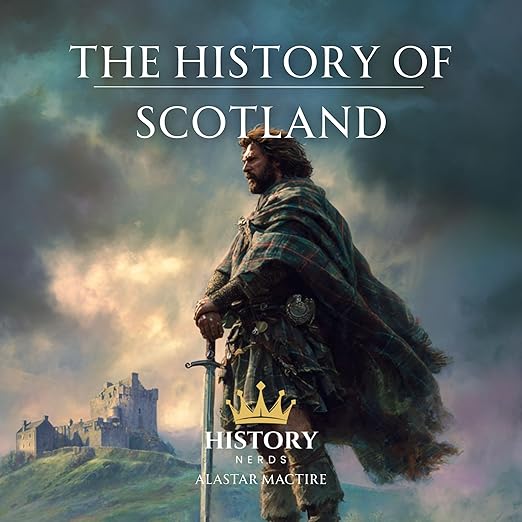
Quick Take
- Narration: Graham Mack brings declared passion and eloquence to the material, reviewers notice his voice as an active presence in the listening, which suits an introductory survey covering fifteen centuries.
- Themes: Scottish national identity and independence, the clan system, the long tension between Scotland and England
- Mood: Broad and sweeping, with enough personality to keep a general audience engaged through a considerable span of history
- Verdict: A solid introductory survey of Scottish history from the Pictish kingdoms through modern times, not the deepest account available, but an accessible and well-narrated starting point for listeners new to the subject.
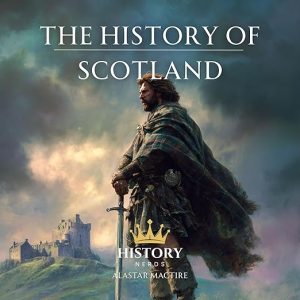
Three hours and thirty-six minutes to cover Scottish history from the ancient Picts and the Roman frontier through the Stuart monarchs, the Union with England, the Highland Clearances, and into the modern period. That is an ambitious scope for a short-form audiobook, and the question worth asking up front is not whether a three-and-a-half-hour survey can be comprehensive, it cannot, but whether it can establish enough of a framework to make subsequent reading more productive. For this book, published under the History Nerds imprint and narrated by Graham Mack, the honest answer is yes, though with expectations properly calibrated.
The History Nerds imprint operates in the accessible popular history space, aiming to make historical subjects approachable for listeners without existing background. That is a legitimate and underserved function. There is a real audience for books that do not assume you already know who Kenneth MacAlpin was or why Bannockburn mattered in the context of the broader independence struggle, and that audience is not well served by the scholarly monographs that tend to dominate the historiography of any national history. What this book offers is an organized narrative spine that a listener can use to orient subsequent deeper reading.
Graham Mack and the Question of Voice
The synopsis explicitly credits Mack’s narration as the vehicle for the listening experience, describing his voice as passionate and eloquent, language that reads like marketing copy but that the available reviews partially validate. One reviewer describes the book as a great tour guide for anyone wanting to visit Scotland, which suggests the narration creates a sense of place alongside the chronological framework. Another notes it can be a real page turner despite covering material that is sad and painful in places, which tells us something about the emotional range Mack brings to the material. For a survey covering fifteen-plus centuries of Scottish history, that range matters: the story moves through extraordinary violence, cultural suppression, and national assertion, and a narrator who can vary the register across those different chapters adds genuine value.
The 3.9 rating across 60 reviews is a middle-range signal for this type of book. It suggests an audience that found reasonable value without the kind of uniform enthusiasm that marks a genuinely exceptional production. The reviews are positive in tone but measured, the words adequate, overview, and basis for further study appear, which is accurate and slightly damning praise. This is a book for the beginning of an inquiry, not its culmination.
What Three Hours Covers, and What It Cannot
A reviewer notes the book begins with Scottish history around 400 AD, covering Roman-era material and extending through to modern times. This confirms the ambitious chronological scope and also implies significant compression throughout. The Highland Clearances alone, a period that reshaped Scottish identity and diaspora in ways still felt today, could sustain a full audiobook on its own. The Stuart dynasty and the complex relationship between Scottish and English crowns similarly demands more space than any three-hour survey can provide. What listeners will get is a coherent narrative skeleton, populated with enough specific detail to anchor the major periods.
Who Gets the Most From This
The ideal listener is someone with genuine curiosity about Scottish history who wants an organized introduction before reading more specialized accounts, or someone planning a visit who wants historical context for the places they will see. The reviewer who describes the book as a tour guide captures something real: this kind of survey is most useful when it prepares you for an encounter with the primary material rather than serving as the primary material itself. Listeners with existing Scottish history knowledge will find the survey level frustrating. Those entirely new to the subject will find it genuinely useful, and the narration ensures it never feels like homework.
Frequently Asked Questions
Does the book cover the Scottish independence debate and modern political history?
The synopsis describes the coverage as extending from the ancient kingdoms through to modern times, suggesting some treatment of contemporary Scottish political identity. At under four hours covering fifteen-plus centuries, the modern period is unlikely to receive extended treatment, but the narrative arc leading to it should be established.
How does this compare to Magnus Magnusson’s Scotland: The Story of a Nation as an introductory history?
Magnusson’s single-volume history is a significantly more substantial work with greater depth at every period. This audiobook serves a different function, an accessible survey for listeners without prior background, organized for audio delivery rather than sustained print reading. They are useful in sequence: this book first, Magnusson when you want more.
Does the book cover the Jacobite risings and the Battle of Culloden in meaningful depth?
At three and a half hours covering the full arc of Scottish history, the Jacobite period and Culloden will receive coverage proportional to a broad survey rather than dedicated treatment. Listeners specifically interested in the Jacobite cause and its aftermath would benefit from specialist titles alongside this introductory account.
Is there content about Scottish culture, literature, or arts alongside the political and military history?
The synopsis emphasizes coverage of the Picts, the clans, and the battles for independence, suggesting a primarily political and military narrative. The reviewer description of famous characters and sites indicates some cultural texture, but the book appears to be organized around historical events and figures rather than cultural history in the broader sense.