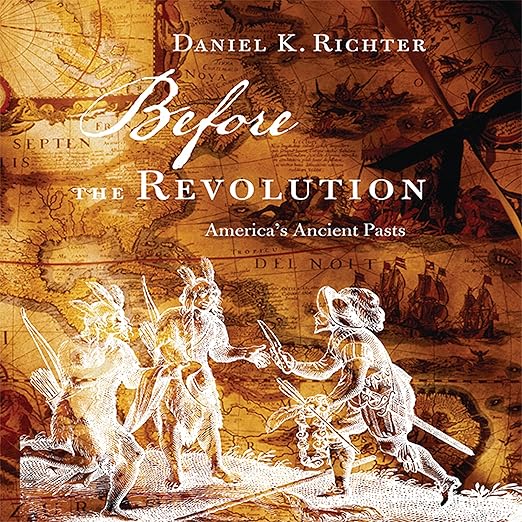
- Voice: Walter Dixon handles sixteen-plus hours of dense historical material with steady authority , his voice suits the scope of Richter's epic revisionist history.
- Big ideas: Pre-revolutionary North American history, Indigenous and colonial encounters, the multiple pasts beneath the American founding myth
- Atmosphere: Dense and revelatory, with the patience of serious scholarship
- Worth it?: Daniel Richter's Before the Revolution is the audiobook for listeners who want American history that actually begins at the beginning , seven centuries before the Founding Fathers entered the frame.
Daniel Richter's Before the Revolution is the audiobook adaptation of a book that argues, with seven hundred years of evidence, that the United States did not begin with the Founding Fathers. That argument is not a provocation. It is a sustained scholarly demonstration, read by Walter Dixon across sixteen hours and twenty-eight minutes, that the nation's pre-revolutionary past is not merely a prelude to independence but a complex, layered history with its own logic, its own conflicts, and its own stakes. Those stakes continue to shape the present in ways the conventional founding narrative actively obscures, and Richter makes that case with the patience and precision of a historian who has spent decades in the archives that most popular American history never opens.
Richter Recovers Seven Centuries Before the Founders
Richter's revisionist project spans more than seven centuries and ranges across North America, Europe, and Africa. The peoples he recovers are not the ones who typically anchor early American history courses: Indians, Spaniards, French, Dutch, Africans, English, all of them struggling for control of land and resources in a global context that predates the colonies by centuries. His central argument, articulated precisely by reviewer Shawn M. Warswick, is that the American Revolution submerged earlier strata of society, culture, and politics, but those ancient worlds remain. Richter's task is to make those worlds legible on their own terms, rather than merely as a prelude to what came after.
What Richter achieves is a genuine shift in historical perspective. He does not treat the pre-revolutionary period as raw material for a teleological narrative that ends with the Declaration of Independence. The book's structure follows trajectories: how power moved, how populations collided and accommodated and resisted, how the distinctive patterns of North American culture took shape on a continent where no one yet imagined there would be nations called the United States, Canada, or Mexico. That last phrase is not rhetorical. It names something real about what Richter is doing: recovering a past where the outcome was not yet determined, where the people living through these events could not have predicted the nation that would eventually claim their history as its prelude.
Dixon Lets the Evidence Accumulate Patiently
Walter Dixon's narration is well-suited to the material's scope and seriousness. Sixteen hours of dense historical prose requires a narrator who can sustain clarity and engagement without imposing theatrical interpretation on a text that does its own work. Dixon does not oversell the drama of individual chapters. He lets Richter's argument accumulate at its own pace, which is the right call for a book whose power comes from the weight of evidence rather than the vividness of individual episodes.
Reviewer Kendall Giles, who describes history as not a discrete collection of independent events, articulates why this approach to pre-revolutionary America matters: events are not blank slates, and what happens in one epoch carries forward into the next in ways that require tracing if you want to understand how things came to be as they are. Richter makes that continuity visible across seven centuries in a way that a more conventional American history cannot, because conventional American history begins too late. The audiobook format gives Dixon the space to carry that argument at its full scholarly pace, and the sixteen-hour runtime reflects the genuine breadth of what Richter is covering rather than any kind of indulgence.
Broad Canvas Means Some Figures Pass Quickly
A few honest notes about the audiobook's demands. Richter's prose is academic in the best sense: precise, carefully qualified, and serious about evidence. It is not dense in the way that makes comprehension difficult, but it is not popular history either. The engagement it rewards is the engagement you bring to reading a serious work of scholarship, and listeners who approach it as background audio will find the argument slipping away from them. Reviewer Random Reader noted with evident appreciation that the book is mercifully free of the underhand bias that lesser authors impose on readers, meaning Richter presents evidence and argument without editorializing in ways that substitute for evidence. That quality is rarer than it should be in American history writing.
The book's geographic and temporal scope means that individual episodes and figures may not get the extended treatment that a more focused narrative history would provide. Richter is painting a broad canvas, and some moments that merit longer attention pass more quickly than ideal. This is a structural consequence of the ambition rather than a flaw , the breadth is exactly what makes Before the Revolution the revisionist project it is, and narrowing it would defeat the point.
Changes What You See in 1776 Later
This audiobook is built for listeners who want to understand American history in its full context, without the artificial starting point that frames the Founding Fathers as the origin of everything that matters. History enthusiasts, students of colonial and early American studies, and anyone who has felt that conventional American history begins with a conveniently selective amnesia will find Richter's project deeply rewarding. It is the kind of audiobook that changes what you see when you later read something that starts with 1776.
Casual listeners or those looking for narrative history with the pace and drama of popular nonfiction should approach with realistic expectations about the audiobook's academic register. Before the Revolution is genuinely rigorous, and its rewards are proportional to the attention you bring. For the right listener, sixteen hours in this territory is not an imposition. It is an invitation into a past that was always there, waiting to be recovered and understood on its own terms.
A Few Questions About Before the Revolution
Is Before the Revolution audiobook appropriate for general listeners or primarily for history specialists?
Richter writes for a serious general reader rather than a specialist audience , he explains his framework and evidence clearly without requiring prior academic training. That said, the book is genuinely rigorous, and listeners who prefer popular narrative history may find the pace more demanding. It rewards patient, attentive listening rather than passive background audio.
How does Walter Dixon's narration handle the scope and density of this historical audiobook?
Dixon brings steady, authoritative clarity to sixteen-plus hours of complex historical material. He does not dramatize or editorialize , he lets Richter's argument do its work. For this kind of serious revisionist history, that restraint is an asset. The narration serves the scholarship rather than competing with it.
Does this audiobook cover Indigenous American history, or does it focus primarily on European colonial perspectives?
Indigenous peoples are central to Richter's argument, not peripheral to it. He explicitly recovers the lives and struggles of Native populations across seven centuries, treating their presence and agency as foundational to North American history rather than a footnote to European settlement. This is one of the ways the book challenges conventional founding narratives most directly.
Is the audiobook organized chronologically, and can listeners follow the argument without reading the print version?
The book follows a broadly chronological arc across seven centuries, which gives listeners a temporal orientation even as the geographic scope shifts widely. The audiobook is fully self-contained , the argument develops through Dixon's narration without requiring access to maps or footnotes, though the print version's scholarly apparatus adds depth for particularly interested readers.