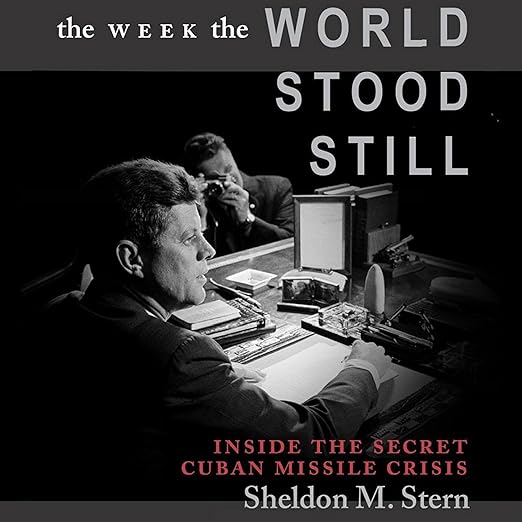
Quick Take
- Narration: Bob Dunsworth’s steady, unembellished delivery is exactly right for primary-source history, he lets the ExComm transcripts carry the drama without adding theatrical weight.
- Themes: nuclear brinkmanship, Kennedy’s decision-making under pressure, Cold War diplomacy
- Mood: Taut and authoritative, with a thriller’s quality drawn entirely from real events
- Verdict: The most direct and honest account of the ExComm meetings available in audio, Stern’s access to the actual recordings gives this book an authority that secondary accounts cannot match.
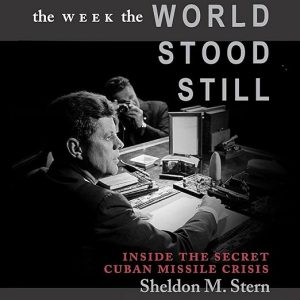
I teach a seminar on twentieth-century American political history, and I have assigned this book for four years running. The reason is simple: Sheldon Stern worked at the John F. Kennedy Library for years. He personally transcribed the secretly recorded ExComm meetings – the thirteen days of deliberations during which the Kennedy administration decided how to respond to Soviet missiles in Cuba. No other account of the Cuban Missile Crisis is built on that level of primary source access, and it shows in every chapter.
Stern himself writes in the synopsis that the participants did not have the luxury of knowing how this potentially catastrophic showdown would turn out, and that uncertainty gives their discussions the nerve-racking quality of a fictional thriller. That is not marketing language. After ten hours with Bob Dunsworth’s narration, you understand it as a precise description of the listening experience.
Our Take on The Week the World Stood Still
The book’s central archival contribution is also its most compelling argument: that JFK and his administration bore a substantial share of responsibility for creating the conditions that made the crisis possible. Covert operations in Cuba, including efforts to kill Fidel Castro, had convinced Khrushchev that only nuclear weapons would deter an American invasion. The book presents this not as revisionist contrarianism but as a finding that emerges directly from the recordings themselves. Kennedy’s own voice, his suspicion of military solutions to political problems, his willingness to steer his advisers away from the air strike option, all of this comes through with the documentary weight of an actual transcript.
Reviewer Ethan Bernard’s description of this as a different story from RFK’s Thirteen Days, and probably a more honest one, is well-calibrated. Robert Kennedy’s memoir is a participant’s account shaped by political considerations. Stern’s account is a historian’s account shaped by evidence.
Why Listen to The Week the World Stood Still
The book was explicitly written for students and general listeners rather than specialists, and that choice shows in the quality of the contextualization. Stern adds parallel information about key events outside the ExComm meetings and integrates them into a coherent narrative without making the structure feel artificially tidy. Reviewer Gualdemar Gutierrez, who read earlier scholarship, notes that Stern did not fill any gaps but added the mood and expressions of the words being said, which greatly helps understand the situation. That is a precise description of what narrative history does at its best: restore dimensionality to documented events without fabricating content.
Bob Dunsworth’s narration suits the material. At ten hours and seventeen minutes, this is a sustained listen, and Dunsworth’s measured delivery does not flag. Reviewer Justin flagged a very pro-JFK point of view as a concern, and that is a fair observation to carry into the listening experience, though the book’s primary-source grounding limits the extent of interpretive distortion.
What to Watch For in The Week the World Stood Still
The JFK-favorable framing is present, and listeners should note it. Stern’s reading of Kennedy as a restraining force during the crisis is supported by the recordings, but the broader context of Kennedy administration Cuba policy, the covert operations that contributed to the crisis, is given somewhat less weight than it might be in a more critical account. The italics that one reviewer found excessive in print do not translate to audio, so that specific complaint evaporates in this format.
Who Should Listen to The Week the World Stood Still
History readers who want the most authoritative account of the ExComm deliberations available in audio. Anyone who has read Thirteen Days by Robert Kennedy and wants a historian’s corrective perspective. Students of Cold War history and anyone interested in how high-stakes decisions are actually made under existential pressure. The ten-hour runtime is not padded – every chapter earns its place.
One final note on scope: the Stanford Nuclear Age series label positions this as academic history, but the writing is accessible to any engaged general reader. Stern’s decision to write explicitly for students and general listeners rather than specialists keeps the prose clear without sacrificing the analytical substance that makes this a credible contribution to Cold War scholarship. It is the rare history title that works equally well in a classroom and on a commute.
Frequently Asked Questions
How does this account differ from Robert Kennedy’s Thirteen Days?
Thirteen Days is a participant memoir written with political awareness and, as later historians established, with some factual adjustments to protect reputations. Stern’s account is built directly on the ExComm recordings, which he transcribed himself, and takes a more balanced view of how Kennedy and his advisers actually behaved, including the administration’s own role in provoking the crisis through covert Cuba operations.
Does Stern’s account hold JFK responsible for the crisis, or is Kennedy portrayed heroically?
Both, with nuance. Stern documents that covert operations including assassination attempts on Castro contributed to Khrushchev’s decision to deploy missiles. At the same time, the recordings show Kennedy consistently resisting military escalation and steering toward the diplomatic resolution. One reviewer notes the book has a pro-JFK point of view, which is a fair observation even if the primary-source basis limits overt advocacy.
Is Bob Dunsworth’s narration engaging for ten-plus hours of political history?
Yes. Dunsworth reads with the kind of steady authority that primary-source history requires. The drama is in the material itself, and Dunsworth correctly does not impose additional theatrical emphasis. Several reviewers describe the listening experience as highly engaging despite the density of the subject matter.
Is this book suitable for listeners who know little about Cold War history?
Stern wrote it explicitly for students and general listeners. He contextualizes the political and military situation clearly enough that prior expertise is not required. One reviewer described coming to it without clear memory of the crisis itself and finding it fascinating and fully comprehensible.