Quick Take
- Narration: Jennifer M. Dixon brings a clear, measured delivery to the material, she handles the complex name-heavy landscape of medieval European royalty without losing the listener’s place.
- Themes: women exercising power in male-dominated medieval politics, the networks of alliance and kinship, historical recovery of overlooked figures
- Mood: Scholarly but accessible, with the quiet excitement of historical detective work
- Verdict: A well-researched corrective to the sons-only Plantagenet narrative, particularly strong for listeners who already know Eleanor and want to understand the full network of women she anchored.
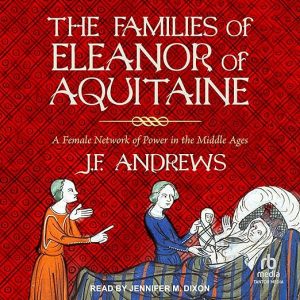
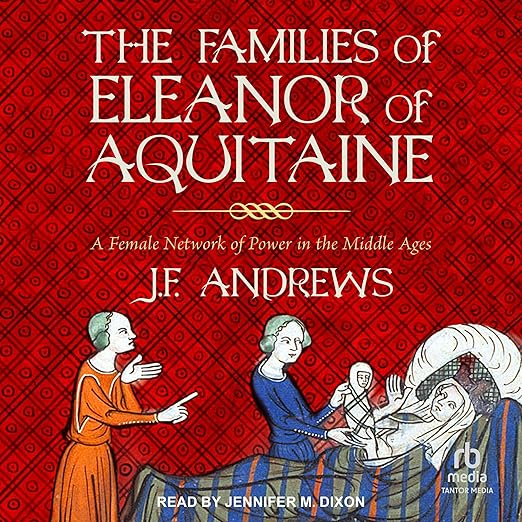
I was halfway through a longer work on the Plantagenet dynasty when I realized that the daughters and daughters-in-law at its edges were constantly described in relation to the men around them and then moved on from quickly. Eleanor of Aquitaine herself has attracted substantial scholarly and popular attention, she is too large a figure to ignore. But the ten women who were connected to her through blood and marriage, who carried her alliances into France, Castile, Sicily, and Saxony, who navigated the extraordinary complexity of being politically significant in a world structured against female authority, these women are largely absent from the standard accounts. J.F. Andrews’s The Families of Eleanor of Aquitaine sets out specifically to address that absence, and it does so with care and genuine intellectual enthusiasm.
The book organizes itself around each of the ten women in turn: Eleanor’s daughters by Henry II, her daughters by Louis VII, and the daughters-in-law who married into the Plantagenet network. Each woman gets her own section, which makes the organizational challenge of tracking multiple parallel lives across the medieval map considerably more manageable. Reviewers note this structure as a practical virtue: you always know whose story you are in, which is genuinely helpful when the women involved share family connections, names, and the same general period of history.
Our Take on The Families of Eleanor of Aquitaine
Andrews is working in a historiographical tradition that has grown substantially over the past few decades: the recovery and examination of medieval women who were politically significant but historically marginalized. The challenge in this kind of work is that the documentary record is genuinely thinner for women than for men, medieval chroniclers wrote mostly about and for men, and women appear in the sources primarily as wives, mothers, and diplomatic pawns rather than as agents in their own right. Andrews is transparent about these limitations, which one reviewer found admirable and another found frustrating. The repeated acknowledgment that we do not know how a given woman felt about a particular situation is historically honest but can feel like a refrain if you are reading for narrative momentum rather than scholarly precision.
What the book does well is convey the sheer scale and ambition of Eleanor’s family network as a political instrument. Sending daughters into strategic marriages across Europe was not incidental to medieval politics; it was one of its primary mechanisms. Andrews traces the consequences of these alliances with specificity, not just who married whom, but what political conditions shaped the match, what each woman found waiting for her on arrival, and what she made of her situation over the subsequent years. Some of these women found genuine power and even happiness. Others endured conditions that were genuinely brutal. Andrews does not flatten the differences.
Why Listen to The Families of Eleanor of Aquitaine
Jennifer M. Dixon’s narration handles the medieval name density impressively. This is a period of history where multiple women share names, there are several Eleanors, multiple Margarets, more than one Constance, and the audio format, which does not allow you to flip back to a family tree, poses real challenges. Dixon’s clear enunciation and steady pace allow the distinctions to remain in place, which is a more significant technical accomplishment than it might sound.
The book is also well calibrated for length. At seven hours and seven minutes, it covers ten women across a vast geographic and temporal range without feeling either rushed or padded. Andrews respects both her subjects and her readers enough to be direct about what is known and what is not, and to move on when the record runs dry rather than speculating beyond what the evidence supports.
What to Watch For in The Families of Eleanor of Aquitaine
The caveat about the epistemic limits of medieval women’s history will recur throughout. One reviewer specifically described the repeated acknowledgment of what we do not know as annoying. If scholarly honesty about evidentiary gaps frustrates you as a reader, you will encounter this frustration regularly. If you accept it as the appropriate intellectual posture for this kind of historical work, it will not bother you.
This is also a book that rewards some prior knowledge of Eleanor and the Plantagenet period. Andrews does not assume deep expertise, but listeners who already know the broad outlines of the period, the conflict between Henry II and Becket, the reigns of Richard I and John, the Crusades that shaped the eastern branches of the family network, will get considerably more out of the book than those coming in cold. A brief read-up on the basic Plantagenet genealogy before starting would significantly enhance the listening experience.
Who Should Listen to The Families of Eleanor of Aquitaine
This is a strong recommendation for listeners with existing interest in medieval European history, women’s history, or the Plantagenet dynasty who want a focused examination of the women at its edges. It is also well suited to anyone who has read biographies of Eleanor herself and wants to understand the full network she anchored. Listeners who want a more narrative-driven, novelistic approach to this period, something like Alison Weir’s historical fiction set in the Plantagenet court, will find this more scholarly and less emotionally involving. The historical honesty is a feature, but it does modulate the emotional register.
Frequently Asked Questions
Do I need to already know about Eleanor of Aquitaine to understand this book?
Prior knowledge of Eleanor and the basic Plantagenet genealogy will significantly enrich the experience, though Andrews does provide context. Listeners who come in completely cold may find the name density and the web of relationships harder to track without some background. A brief introduction to the Plantagenet period would be a practical preparation.
How does Jennifer M. Dixon handle the challenge of multiple women with the same name?
Well. The medieval period involves several Eleanors, multiple Margarets, and more than one Constance in this family network, and Dixon’s clear enunciation and measured pace allow the distinctions to remain comprehensible. This is one of those audiobooks where the narrator’s technical precision genuinely matters.
Why does Andrews repeatedly say she does not know how a particular woman felt?
Because the medieval documentary record does not tell her. This is the appropriate scholarly response to thin evidence, not a failure of research. One reviewer found this frustrating; it is worth knowing that this acknowledgment recurs throughout. Andrews is being historically honest rather than speculating beyond what the sources support.
How does this book compare to biographies of Eleanor of Aquitaine herself?
This book is explicitly not a biography of Eleanor, she is the organizing figure rather than the subject. Eleanor appears as context and connection, not as protagonist. Listeners who want Eleanor’s own story should look to Alison Weir or Marion Meade. This book is about the ten women whose lives radiated outward from hers.