Quick Take
- Narration: Mike Reaves delivers both volumes of this dual anthology with clear, measured storytelling energy, handling the mythological material with appropriate gravity without turning it into lecture.
- Themes: Divine pantheons, the Gilgamesh narrative across its Sumerian and Babylonian traditions, creation mythology and the underworld
- Mood: Atmospheric and systematically organized, like being guided through a museum of stories rather than dropped into them
- Verdict: A solid six-hour dual anthology covering both Mesopotamian and Sumerian mythology with contextual framing, best for listeners who want an organized overview before engaging with primary translations.
The Gilgamesh epic is one of the oldest stories in recorded human history. The flood narrative it contains predates Genesis. The friendship between Gilgamesh and Enkidu, and what Gilgamesh does when Enkidu dies, is one of the first literary treatments of grief and mortality that we have any record of. The problem is that the Epic of Gilgamesh is not easy to encounter on its own terms: the cuneiform tablets are fragmentary, the best scholarly translations are dense, and the cultural context that makes the story resonant is not obvious to modern readers arriving without preparation.
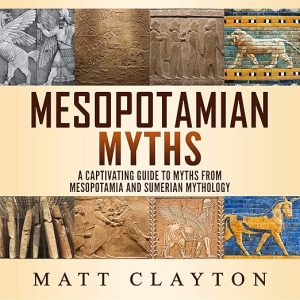
Matt Clayton’s Mesopotamian Myths, delivered as a six-hour dual anthology combining Mesopotamian Mythology and Sumerian Mythology, is explicitly designed to solve that problem. It is a guided introduction, and it functions better understood as guidance than as a primary-source experience. Mike Reaves narrates both volumes with consistent, measured clarity.
Two Volumes, Two Civilizations, One Organizing Logic
The dual structure is worth understanding before you begin. The first volume, the Mesopotamian section, covers primarily Babylonian and Akkadian material: creation myths, the full pantheon, selected Gilgamesh passages, and thematic chapters on gods and goddesses. The second volume turns to Sumerian mythology specifically, covering the earlier layer from which the Babylonian traditions largely derived, including Inanna and the Huluppu Tree, Enkidu in the Underworld as a separate Sumerian text distinct from its Babylonian reworking, and the specific Sumerian-language Gilgamesh stories including Gilgamesh and Huwawa and Gilgamesh and Aga.
A careful reviewer noted that the Mesopotamian section is heavily weighted toward Babylonian mythology rather than Sumerian, which is technically accurate but reflects the historical reality: Babylon inherited and adapted the Sumerian religious framework rather than preserving it independently. Reading the Babylonian material first and the Sumerian material second is actually backward chronologically, though it follows the order in which Western scholarship encountered these traditions. Clayton acknowledges the inheritance throughout, but the reviewer’s wish to have the Sumerian section first as a foundation is a reasonable organizational preference the audiobook does not satisfy.
What Contextual Framing Adds Over Bare Translations
The value of this audiobook over a bare translation of mythological texts is the contextual framing Clayton provides around each section. He does not merely recount the stories; he explains what they meant within the religious culture that produced them, how individual gods fit into the pantheon’s structure, what the ritual and theological purposes of specific myths were, and how different versions of the same story relate to each other. The Gilgamesh material benefits particularly from this approach: listeners who have heard of Gilgamesh but have never read the full text arrive at the passages that matter with enough context to understand why they matter.
A reviewer described appreciating the explanations of different interpretations and different versions of the myths, noting that the contextual apparatus helped them understand the material rather than just receive it. That is exactly the function this kind of anthology is designed to serve, and it is served well here.
Mike Reaves and the Sound of Ancient Material
Reaves narrates with a calm authority that suits mythological material without making it feel sacred or forbidding. He does not perform the stories with theatrical energy, which would be the wrong choice for an analytical anthology; he reads them with steady attention, allowing the content to carry its own weight. His pacing gives listeners time to absorb what they are hearing, which matters particularly for the more complex theological sections involving relationships between deities and the cosmological frameworks within which the myths operate.
The six-hour runtime covers an impressive scope without feeling rushed. The dual anthology structure means that listeners can treat the two volumes as separate listening sessions, which the chapter organization supports. The Mesopotamian section and the Sumerian section have their own internal logic, and a pause between them allows for better retention of what each tradition contributes to the overall picture.
Honest About What This Is Not
It is worth being clear about what Mesopotamian Myths cannot do. It is not a primary source experience. The translations and retellings Clayton presents are summaries and interpretations, not direct scholarly translations of the cuneiform texts. Listeners who want the full Gilgamesh epic in its authentic form should look at Andrew George’s Penguin Classics translation, which is the most complete and reliable currently available and includes the fragmentary tablets with their gaps honestly marked. For the full Sumerian mythological record, Thorkild Jacobsen’s Treasures of Darkness remains a scholarly standard. This audiobook is, accurately understood, the room before those rooms: the orientation that makes the more demanding primary encounters possible.
Frequently Asked Questions
Does this audiobook include the full text of the Epic of Gilgamesh?
No. It includes selected passages from the Gilgamesh narrative with contextual framing, not the full text. For the complete epic, Andrew George’s Penguin Classics translation is the standard scholarly recommendation.
What is the difference between the Mesopotamian Mythology and Sumerian Mythology volumes in this bundle?
The Mesopotamian volume covers primarily Babylonian and Akkadian material. The Sumerian volume addresses the earlier Sumerian layer, including specific Sumerian-language texts like Inanna and the Huluppu Tree and the earlier Sumerian versions of the Gilgamesh stories.
Is the Sumerian section covered first or second in the audiobook?
The Babylonian Mesopotamian section comes first and the Sumerian section second, which is the reverse of the chronological order in which these civilizations existed. At least one reviewer noted preferring the Sumerian section as a foundation, though Clayton provides enough contextual explanation that the order is manageable either way.
How much prior knowledge does a listener need to benefit from this audiobook?
Very little. The contextual framing Clayton provides around each section is designed specifically for listeners without prior background in ancient Near Eastern religion or mythology. Reviewers explicitly noted that the explanations helped them understand the material rather than simply encounter it.