Quick Take
- Narration: David de Vries brings journalistic clarity and appropriate gravity to a biography that demands both, no theatrics, clean delivery.
- Themes: Political courage, institutional corruption in Russia, the cost of resistance
- Mood: Riveting and sobering, weighted by the knowledge of how the story ends
- Verdict: The most complete Navalny biography available in English, and essential listening for anyone trying to understand contemporary Russia.
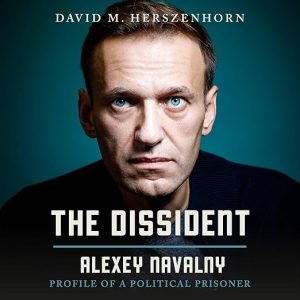
I listened to most of this one during the week after Navalny’s death was announced in February 2024, and I do not think there was a better or more necessary book to be inside during that particular news cycle. David Herszenhorn’s The Dissident was already in progress when Navalny was still alive, and its journalism is thorough enough to have held up through everything that followed. Reading a biography of someone while still uncertain whether they are alive gives a book a particular kind of present-tense urgency. That urgency has not faded.
Herszenhorn is an international correspondent who covered Russia for years and is writing from a position of deep sourcing rather than distance. This is not a reconstruction pieced together from secondary material, it is the work of someone who has been in the rooms, followed the proceedings, and cultivated sources that produce the kind of specific detail this book contains. The nerve agent assassination attempt, the Bellingcat investigation that identified the FSB hit squad, the Novichok recovery in Germany, Navalny’s decision to return to Russia knowing he would be arrested, all of it is covered with the granularity of eyewitness journalism.
Our Take on The Dissident
What distinguishes this biography from the many Navalny profiles that appeared in Western media is its willingness to hold the complexity of the man. Herszenhorn does not simplify Navalny into a saint. His controversial early positions on nationalism, his evolving views on Crimea, his complicated relationship with the liberal opposition, these are addressed rather than smoothed over. One reviewer specifically praised the author’s ability to capture the duality of Navalny’s personality. Another compared him to Martin Luther King Jr. in knowing he would not live to see his dream fulfilled. These are not irreconcilable observations, they are two lenses on the same person.
The anti-corruption investigation thread is one of the book’s most compelling sections. Herszenhorn traces how Navalny’s foundation developed the techniques that exposed billions in state graft, Putin’s Black Sea palace, the Siloviki networks, the mechanisms by which Russia’s elite have systematically looted the country. This is not just political biography; it is an account of investigative methodology that changed the landscape of anti-corruption reporting globally.
Why Listen to The Dissident
David de Vries is exactly the right narrator for this material. He does not perform Navalny’s story, he reports it. The clean, journalistic delivery matches Herszenhorn’s prose style and keeps the listener inside the facts rather than the drama. At 11 hours, the book earns its length. There is no section that feels padded, and the chronological-but-thematic chapter structure one reviewer praised gives the material breathing room without losing momentum.
The book was written when Navalny was still imprisoned but alive. His death in February 2024, a death that readers of this biography will have no difficulty attributing, lands differently in retrospect. The closing chapters of the biography, describing Navalny’s transformation into a prisoner of conscience bravely denouncing Putin’s war in Ukraine, now read as a final chapter rather than a continuing story.
What to Watch For in The Dissident
With 67 ratings and uniformly high scores, listener consensus here is more developed than many of the other books in this batch. The critical voices are largely absent from the review sample. This is a case where the book’s subject matter generates strong feeling among its audience, people who seek out a Navalny biography are self-selecting toward engagement with the material.
Listeners who are skeptical of Western media framing of Russian politics may want to approach this with that awareness. Herszenhorn writes from a perspective sympathetic to democratic opposition and critical of Putin’s government. That is not a disqualification, but it is a frame.
Who Should Listen to The Dissident
This is essential for anyone trying to understand how one person mounted credible opposition to the Russian state, how modern anti-corruption investigation works, and what the cost of political resistance looks like in practice. It is also simply one of the more compelling audio biographies of the past several years. Skip it only if you require political neutrality on the subject of Putin’s Russia, such neutrality does not exist in this book, and its absence is not a flaw.
Frequently Asked Questions
Does this biography cover Navalny’s death in February 2024?
The book was published in October 2023, before Navalny’s death. It covers his imprisonment and status as a prisoner of conscience as of that writing. Listeners will need to supplement with news coverage for the final months of his life.
Does Herszenhorn address Navalny’s controversial early nationalist positions?
Yes. The biography holds the complexity of its subject and does not simplify Navalny into a one-dimensional hero. His early nationalist rhetoric, his evolving views on Crimea, and his relationship with the Russian liberal opposition are all addressed.
How detailed is the account of the Novichok poisoning investigation?
Very detailed. Herszenhorn covers the assassination attempt, the Bellingcat collaboration that identified the FSB hit squad, Navalny’s recovery in Germany, and his decision to call one of his would-be assassins, all supported by the kind of sourcing that comes from direct journalistic access.
Is David de Vries’s narration a good fit for this material?
Yes. He delivers the material with journalistic clarity rather than dramatic performance, which suits Herszenhorn’s prose and keeps the listener grounded in fact rather than elevated into rhetoric.