Quick Take
- Narration: Virtual Voice narration handles the period dialogue competently but misses the dramatic weight of the Tudor court scenes; the AI delivery flattens emotional peaks that would benefit from a human performer.
- Themes: Survival in a court defined by shifting power, female ambition under constraint, loyalty in a dangerous political climate
- Mood: Atmospheric and tense, with the particular claustrophobia of a world where one wrong move ends careers or lives
- Verdict: A fresh perspective on Tudor court drama through the underexplored figure of Anne Stanhope, though the Virtual Voice narration limits the full experience of what is otherwise a well-researched historical fiction.
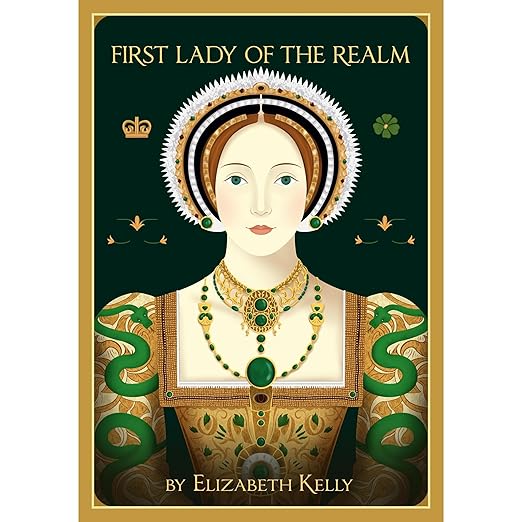
I have read more Tudor historical fiction than is probably healthy for any one person, which means I am exactly the kind of reader Elizabeth Kelly is trying to reach with First Lady of the Realm and also the hardest to impress. Most Tudor fiction gravitates toward the same few figures: Anne Boleyn, Katherine Howard, Katherine Parr. The choice to center Anne Stanhope, who arrives at court in 1527 as a maid of honour to Queen Catherine of Aragon and will eventually become one of the most powerful women in England under Edward VI, is genuinely interesting. I listened to this on a rainy afternoon, and the court atmosphere Kelly constructs held my attention through the full thirteen-plus hours despite the limitations of the Virtual Voice narration.
The 1527 setting is a particularly charged moment. Catherine of Aragon’s position at court is beginning to erode, though the full implications of Henry’s obsession with Anne Boleyn are not yet visible to everyone. A young woman arriving as a maid of honour would have entered a world already fracturing along lines that were not yet fully drawn. Kelly uses that uncertainty effectively, placing her protagonist in a position where she must read the room constantly, understanding not just the current state of the court but which way the wind is likely to blow.
Our Take on First Lady of the Realm
This is the sixth book in Kelly’s Tudors Series, and the series numbering is not the same as chronological order within the Tudor period. Reading the series in historical sequence rather than publication order would place this early, since 1527 predates the events of most other Tudor novels. The book functions as a standalone for readers new to the series, which is the experience I had with it, though series readers will likely bring additional context to the supporting characters.
The one review available at time of publication, from a reader named Damien, praised the fresh perspective of centering someone other than the usual Anne Boleyn story, and I share that assessment. Kelly does a nice job showing how dangerous and complicated life was for women at court during that time period, and the choice to filter that danger through a character who is simultaneously an insider and an outsider, arrived too recently to have established alliances, gives the novel a useful dramatic tension. Anne Stanhope is trying to understand the rules of a game whose rules keep changing.
Why Listen to First Lady of the Realm
The historical research Kelly brings to the court dynamics is evident throughout. The social hierarchy of Catherine of Aragon’s household, the physical geography of the palace spaces, the specific protocols around a queen’s ladies, are rendered with enough specificity to feel inhabited rather than researched. Kelly is not using the Tudor period as a backdrop; she is trying to reconstruct how that world actually functioned for the women who lived in it.
For listeners with strong Tudor knowledge, there is particular pleasure in watching Kelly navigate the period through a less familiar perspective. Anne Stanhope is a historical figure whose later prominence under Edward VI is well documented, which means Kelly is working with a character whose fate is known but whose inner life before that prominence is almost entirely her invention. That space between historical record and imaginative reconstruction is where the best historical fiction operates, and Kelly uses it well.
What to Watch For in First Lady of the Realm
The Virtual Voice narration is the most significant limitation of the audiobook experience. At thirteen hours and twenty-six minutes, a narration that cannot modulate emotional weight across extended court scenes or differentiate character voices with nuance is a real cost. The narration handles the prose without obvious errors, but the flat affect in scenes that require tension, fear, or the particular menace of Tudor power politics, means the audiobook delivers significantly less than a human narrator would. This is a case where reading the text might genuinely be preferable.
The story covers only the early period of Anne Stanhope’s court life, which means listeners expecting to see her full rise to prominence as Duchess of Somerset will need to continue with later books in the series. For a thirteen-hour listen, the scope feels appropriately focused, but it is worth knowing that this is an origin story rather than a comprehensive biography.
Who Should Listen to First Lady of the Realm
Tudor fiction readers who are ready for a perspective beyond the usual central figures will find this a genuinely rewarding choice. Listeners who have exhausted the major treatments of Anne Boleyn and Katherine Howard and are looking for less-charted territory will appreciate Kelly’s focus on Anne Stanhope. Those sensitive to Virtual Voice narration limitations should consider the print format instead. Listeners new to Kelly’s Tudors Series can start here without prior reading, though the series offers additional depth for those who want to explore it.
Frequently Asked Questions
Does First Lady of the Realm need to be read in series order, or can it stand alone?
It works as a standalone. Kelly provides enough context that readers new to the Tudors Series can follow the story without prior reading, though familiarity with the series will add additional resonance to certain characters.
How much of Anne Stanhope’s later prominence as Duchess of Somerset does the book cover?
The book focuses on her early period as maid of honour beginning in 1527. Her later rise to power under Edward VI is not covered in this volume; this is an origin story focused on her arrival at and navigation of the Tudor court.
How does the Virtual Voice narration affect a thirteen-hour listen?
The narration is functional but lacks emotional modulation, which matters significantly over a long listen. Scenes that require menace, fear, or dramatic tension are flattened by the AI delivery. Print may be preferable if narration quality is important to you.
Is this primarily a romance or primarily a historical fiction with romantic elements?
Primarily historical fiction. The political danger and court survival dynamics are the central focus. Romantic elements are present but subordinate to the broader narrative of how Anne Stanhope navigates a court in the process of fundamental change.