Quick Take
- Narration: Mark Ashby delivers Zuehlke’s soldier-level prose with steady authority; his unfussy style suits the grim material without ever becoming detached.
- Themes: Canadian military sacrifice, the fog of war, institutional failure vs. individual courage
- Mood: Grave and immersive, with the relentless pace of a campaign that would not stop
- Verdict: One of the strongest entries in Mark Zuehlke’s Canadian Battle Series, essential for anyone serious about the Italian campaign and the overlooked contributions of Canadian forces in World War II.
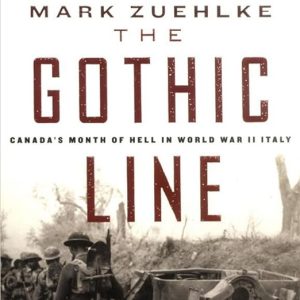
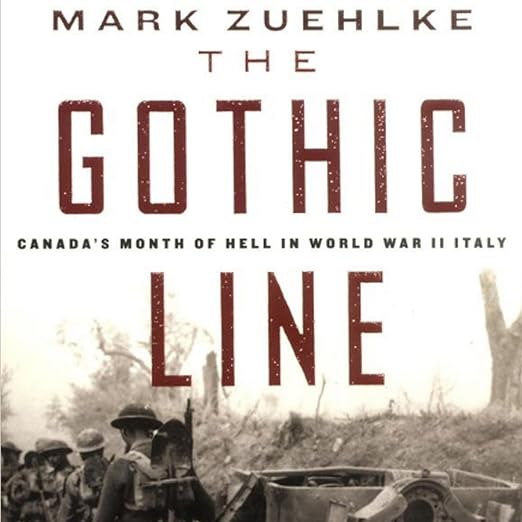
I came to The Gothic Line through the back door, the way most readers find Zuehlke: someone mentioned his name in a conversation about underrepresented chapters of the Second World War, and within a week I had downloaded three of his books. I listened to this one over the course of four long evening sessions, the kind where you eat dinner without really tasting it because you are still processing the weight of what you just heard. Fifteen hours and forty-nine minutes of Mark Ashby reading Zuehlke’s account of the 28-day battle that cracked the most fortified German defensive position in Italy, fought by Canadian troops in August 1944.
The Gothic Line stretched across Italy like what the author calls an armor-toothed belt across the country’s upper thigh. It was the third major defensive line the Germans had constructed to slow the Allied advance north, and it was the most formidable. What Zuehlke does better than most military historians is resist the top-down view. He does not give you the Gothic Line as a staff exercise. He gives you the soldiers who climbed toward it, who died in the orchards below it, and who eventually broke through it.
Our Take on The Gothic Line
Zuehlke’s Canadian Battle Series has a consistent methodology: deep archival research combined with personal testimony from veterans, woven into a narrative that reads more like Cornelius Ryan than a traditional campaign history. The Gothic Line follows that template faithfully, and the result is a book that earns its emotional weight through specificity rather than sentiment. You know where men died because Zuehlke tells you the field, the farm, the ridge. You know why certain decisions were made because he reconstructs the intelligence picture commanders were working from, often flawed, often fatal.
Reviewer Linda Ewles described the experience of suddenly reading about someone she knew from her community, which captures exactly what Zuehlke’s ground-level methodology produces. This is history close enough to touch, and for Canadian listeners especially, it functions as a kind of collective memory that the country’s official narratives have often neglected to cultivate.
Why Listen to The Gothic Line
The audiobook format suits this material particularly well. Ashby reads with the kind of measured gravity that keeps you inside the action without pushing you toward melodrama. Military history can tip into either dry recitation or breathless heroism, and Ashby navigates the middle path that Zuehlke’s writing requires. At nearly sixteen hours, it demands sustained attention, but the chapter structure, with short, densely focused sections, makes it easy to pause and return without losing the thread.
For listeners coming to this book without background in the Italian campaign, Zuehlke provides enough context in the early chapters to orient you. He situates the Gothic Line within the broader Allied strategy in the Mediterranean and explains why the Italian theater was simultaneously vital and perpetually starved of resources. That framing pays dividends later, when the human cost of those strategic decisions becomes concrete in the form of specific regiments and specific men.
What to Watch For in The Gothic Line
One reviewer flagged some factual errors in earlier books in the series, particularly around regimental identifications, and a similar level of scrutiny applies here. Zuehlke is a committed researcher, but specialist readers should not be surprised if they catch the occasional slip. The errors noted in online reviews of this title are relatively minor and do not undermine the larger narrative, but they are worth knowing about if you plan to use the book as a primary source rather than an introduction.
The book covers an extremely compressed period of time with an enormous cast of units and individuals. Zuehlke manages this skillfully, but listeners who prefer a tighter character focus may find the scope demanding. The strength of the approach is comprehensiveness; the trade-off is that no single soldier’s story dominates long enough to build the kind of sustained emotional attachment you might find in a memoir or a more novelistic treatment.
Who Should Listen to The Gothic Line
This title is for readers with genuine interest in Second World War military history, particularly those who feel the Canadian contribution to the Italian campaign has been poorly served by popular history. It works as a standalone listen, but benefits from familiarity with Zuehlke’s earlier volumes on Ortona and the Liri Valley. Listeners who prefer narrative history with a strong human center will find it rewarding; those looking for a broader strategic overview of the Italian campaign might supplement it with a wider survey. Not recommended as a casual or background listen. This is a book that asks for your full attention.
Frequently Asked Questions
Do I need to have read earlier books in Zuehlke’s Canadian Battle Series to follow The Gothic Line?
No, The Gothic Line works as a standalone title. Zuehlke provides enough context on the Italian campaign and the Canadian forces’ role that new readers can follow the narrative without prior exposure to the series.
How does Mark Ashby’s narration handle the large number of military units and officer names?
Ashby delivers the dense roll call of regiments and commanders with consistent clarity. He does not dramatize individual voices, which keeps the focus on the historical record rather than performance, and this suits the material well.
Is the book critical of Allied command decisions, or does it stick to straightforward chronicle?
Zuehlke does not shy away from showing how strategic decisions made far above the battlefield translated into avoidable casualties. He is fair rather than polemical, but readers will come away with a clear-eyed view of both the courage at the unit level and the failures above it.
How does The Gothic Line compare to popular WWII titles like Rick Atkinson’s liberation trilogy?
Zuehlke is narrower in scope and more granular in his unit-level detail than Atkinson. Where Atkinson offers a sweeping theater view, Zuehlke stays close to the ground. Both approaches have their strengths; the two authors complement rather than duplicate each other.