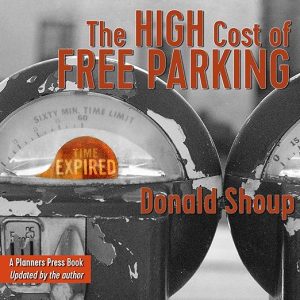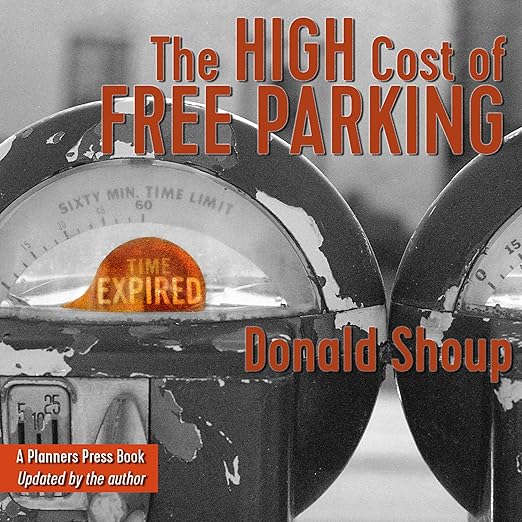
Shoup's The High Cost of Free Parking, Updated Edition is the kind of audiobook that produces converts. Donald Shoup, the UCLA planning professor whose work became the foundation of an actual intellectual movement with actual followers who call themselves Shoupistas, argues with meticulous data-backed force that free parking is one of the most expensive and destructive policy decisions embedded in American urban life. Mike Chamberlain narrates nearly twenty-four hours of this argument, and the experience is dense, specific, and - for listeners with any interest in cities, economics, or the relationship between policy and built environment - genuinely revelatory. The fact that the subject is something as mundane as parking makes the argument's reach more surprising, not less.
The central claim is counterintuitive in the specific way that only good urban economics can be: parking is never actually free. Someone pays for every parking space - whether the municipality, the private developer who built it to satisfy a zoning requirement, the business that includes the cost in its prices, or the nearby residents whose property taxes fund the surrounding infrastructure. By mandating free parking and requiring developers to build it regardless of actual demand, American cities have spent decades subsidizing car use, suppressing density, and shaping urban forms that work for vehicles rather than people. Shoup's argument is not that parking is bad. It is that the way parking is currently priced and provisioned has consequences that spread far beyond the parking lot itself.
Shoup's Three-Part Fix for Curb Parking
The reviewer Mike Chlanda describes the book as uber-helpful for dissertation research on congestion pricing, and that calibration is honest - this is genuinely academic in its rigor. Shoup is not writing popular science; he is making an extended policy argument backed by decades of research, complete with data tables and case studies that are more persuasive in aggregate than any single example. The Updated Edition designation matters: the revision incorporates more recent research and examples while preserving the foundational argument of the original, making this the version worth investing in for any new listener.
The three-part policy proposal at the book's heart - charge market rates for curb parking, return the revenue to the neighborhoods generating it, and remove off-street parking minimums from zoning codes - is elegant in the way that good policy thinking tends to be: it addresses multiple problems simultaneously rather than solving one while creating another. The reviewer Danny's observation that building parking costs municipalities and businesses significant money when the municipalities force private owners to provide it captures one of the book's core provocations: the mandate system makes parking appear free to drivers while distributing its cost invisibly across everything else in the urban economy.
Chamberlain Carries the Data-Heavy Sections
Chamberlain's narration is essential for making the twenty-three-plus hours manageable. Shoup writes with the clarity of a good academic economist - precise, structured, cumulatively persuasive - but at this length the material requires a narrator who can carry the listener through data-heavy sections without losing the thread of the larger argument. Chamberlain understands the architecture of the book well enough to give the most critical passages the emphasis they need and to treat the supporting evidence with appropriate but not tedious thoroughness.
The practical value of this audiobook extends beyond the academic. Bruce's review puts it plainly: this book should be required reading for anybody who drives, or walks where cars are driven. The argument applies with different degrees of force depending on whether you live in a dense urban environment or a sprawling suburb, but the underlying economics of parking policy affect everyone who lives in or near a city regardless of whether they drive. Understanding the mechanism is genuinely useful for participating in local land-use debates, zoning discussions, and transportation policy conversations at any level. At 4.6 across 108 listeners, the rating reflects the specific satisfaction of a specialist argument made accessible without being diluted.
Nearly Twenty-Four Hours of Systematic Argument
Twenty-three hours and forty-seven minutes is a significant commitment, and the book does not move at the pace of popular non-fiction. Shoup is building a systematic argument rather than telling a story, which means that sections focused on policy mechanism and data will have less narrative momentum than sections anchored in specific city examples. Listeners who want to engage with the full argument should approach this as a sustained intellectual project rather than a background listen. The rewards are proportional to the attention invested, and the argument builds in ways that make later sections depend on earlier ones - this is not a book that rewards skipping.
The book's primary focus is American urban planning, which means some examples and policy discussions are specific to the US regulatory and development context. Listeners in other countries will find the core economic argument broadly applicable but may need to translate specific policy references to their own systems. The international examples Shoup does include suggest awareness of this limitation, and the underlying economics of subsidized parking are not specific to the American case even if the regulatory details are.
For Data Geeks, Not Casual Newcomers
This audiobook is the right choice for anyone working in urban planning, transportation policy, or real estate development; for economically literate readers curious about how infrastructure policy shapes urban form; and for the self-described data geek who wants the full empirical treatment of an argument that matters for how cities work. Casual listeners who want an introduction to the Shoupista argument should consider whether a long-form podcast interview or a shorter text might serve better as a first encounter before committing to the full treatment. For those ready to go deep into the most comprehensive statement of the case available, this Updated Edition is the authoritative audiobook version of an argument that has already changed how urban planners think about parking across the country.