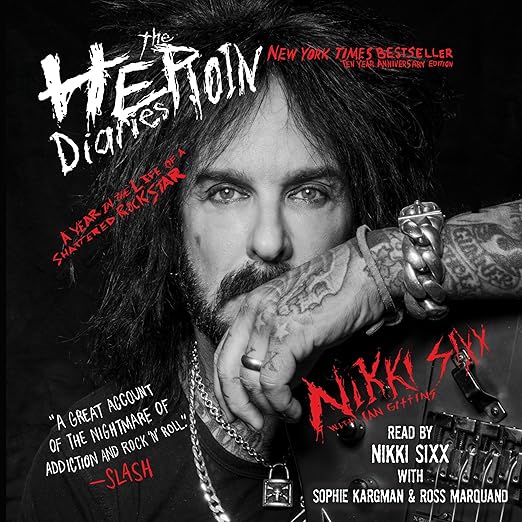
Key Details
- Narration: Nikki Sixx narrating his own addiction diary creates an emotional immediacy no third-party narrator could manufacture, with the weight of sobriety present in his voice as he reads his worst year back.
- Themes: Addiction at the height of fame, the gap between public performance and private destruction, survival and sobriety
- Mood: Raw and unflinching, with the specific darkness of a closet at rock bottom rather than the romanticized excess of standard rock memoir
- Verdict: A formally ambitious addiction memoir strengthened immeasurably by Sixx's self-narration, most powerful for listeners who want documentation rather than inspiration.
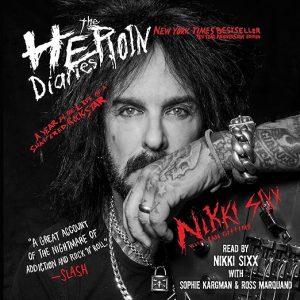
Nikki Sixx published the original Heroin Diaries in 2007, presenting actual diary entries from 1987, the year Motley Crue recorded Girls, Girls, Girls and toured with a then-unknown Guns N Roses. The ten-year anniversary edition revisits those entries with the perspective only a decade of sobriety can provide, and the audiobook version goes one essential step further: Sixx narrates it himself. That choice transforms the listening experience in ways that no celebrity memoir narrator, however skilled, could replicate. This audiobook puts you in the presence of the specific voice that wrote those entries, now reading them back from the other side.
The diary format is the book's defining structural choice. Sixx does not reconstruct his 1987 addiction year from memory and hindsight alone. He presents the actual journal: some entries poetic, some scatterbrained, some genuinely bizarre, written by a man in the grip of severe heroin and cocaine dependency during the height of his band's commercial power. That raw material is then surrounded by commentary from Tommy Lee, Vince Neil, Mick Mars, Slash, Rick Nielsen, Bob Rock, and a host of ex-managers and former lovers, creating a multi-voice account of the same period from wildly different angles of experience.
Rejecting The Dirt's Version of Rock Excess
The critical distinction between this book and The Dirt, the Motley Crue group biography published in 2001, is one of register. Where The Dirt felt to many readers like a glorification of excess, The Heroin Diaries is unflinching in its portrayal of addiction as humiliation rather than drama. Sixx describes hiding in his closet surrounded by drug paraphernalia, wrapped in paranoid delusions, as his career reached its commercial peak. There is nothing romantic about the closet scenes. There is something deeply specific about them, the gap between the performer audiences saw on stage and the man spending hours in a darkened wardrobe convinced the walls were watching, that gives the memoir its genuine power.
The multi-voice structure that surrounds Sixx's diary entries is one of the book's strongest formal choices. When Tommy Lee or Slash comments on a specific 1987 incident from their own perspective, you get a calibration that pure memoir cannot provide: you see where Sixx's perception of events during his addiction diverged from external reality, and you see where his accounts are corroborated. That interplay between subjective diary and external commentary is more sophisticated than most rock memoirs attempt, and it is particularly effective on audio because the voices shift register in ways that make the contrast immediately audible.
Sixx's Voice Bridges Rock Bottom and Sobriety
Sixx narrating his own material is not simply an author-reads-their-book situation. When he reads the most desperate diary entries, the ones written at rock bottom, from the vantage point of someone who survived and achieved lasting sobriety, the distance between those two states is present in his voice in a way that a professional narrator cannot manufacture. Listeners who expected the audiobook to feel like a performance will find instead something closer to a private reckoning made public. Reviewers described it as powerful, raw, deeply personal, and brutally honest, which is accurate. The ten-year anniversary framing adds another temporal layer: Sixx reading his 1987 diary in the present, with a decade of additional reflection since the original publication.
The eleven-hour runtime is appropriate for the scope of the project. The commentary sections, where fellow musicians and collaborators add their own recollections, require time to do justice to. Compressing the account would eliminate the multi-voice texture that distinguishes this memoir from a straightforward one-perspective addiction narrative. The pacing allows the diary entries and their commentary to breathe rather than rushing toward recovery as quickly as possible. Sixx earns the ending by not shortchanging the darkness that precedes it.
Rock Glamour Used as Evidence, Not Alibi
This is an account of severe addiction at its most destabilizing. The paranoia sections, the physical deterioration, the casual destruction of relationships, and the near-death experiences are presented without softening. Listeners who are themselves in recovery, or who have loved ones with addiction histories, should approach the material knowing that Sixx does not sanitize the experience. The book has been praised for its honesty precisely because it does not flinch, but that same honesty means some passages are genuinely difficult to hear, particularly the sequences involving Sixx's most isolated and delusional episodes.
The rock and roll context gives the memoir a specific glamour backdrop that is present throughout, but Sixx is careful not to use that backdrop as excuse or alibi. He is not writing a redemption narrative that absolves the rock star lifestyle while condemning only the substances. He is writing a documentary account of what it actually looked like from inside the closet, and the rock star trappings amplify rather than diminish the horror of the condition. Readers who come expecting the decadence memoirs that dominated the 1990s rock biography genre will find something considerably more uncomfortable and considerably more honest.
A Primary Source, Not a Recovery Guide
This audiobook is for listeners who want an honest account of addiction at the intersection of fame and self-destruction, presented with the formal ambition of actual diary documentation rather than reconstructed memoir. Rock music fans with specific interest in the 1987 Motley Crue era will find the period detail and multi-voice commentary from Lee, Neil, Mars, and others enormously satisfying. Listeners drawn to addiction memoirs that prioritize unflinching documentation over inspirational framing will find Sixx's approach more psychologically rigorous than the genre average.
Approach with care if you are sensitive to detailed addiction content, paranoia, or relationship destruction presented without contemporary therapeutic framing. This is not a guide to recovery or a clinical account of addiction psychology. It is a primary source, a man's actual diary from his worst year, surrounded by the recollections of people who watched it happen. That is an unusual and valuable thing in the addiction memoir genre, and the self-narration makes it more immediate than it would be in any other format. At 4.7 stars across a small but consistent listener sample, the response confirms what the reviews describe: a memoir that hits harder in audio than most rock biographies attempt.