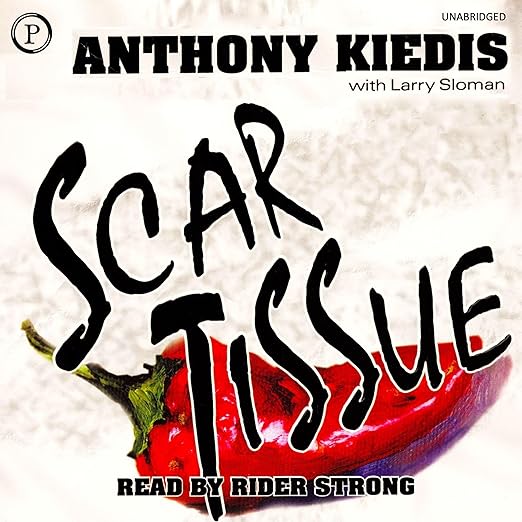
Anthony Kiedis wrote the songs first, and for two decades those songs were the only account anyone had. Scar Tissue is the Red Hot Chili Peppers frontman telling it directly: a memoir of a strange childhood, a band assembled out of friendship, sustained heroin addiction, and eventual recovery, which the description frames as a deliberate refusal of rock-star cliche. The audiobook runs fourteen hours and fifty-one minutes from Phoenix Books, and the voice on the recording is Rider Strong, not Kiedis.
As a memoirist Kiedis turns out to be the equal of Kiedis the lyricist, which is the description's claim and one the structure supports. He treats the addiction not as an interruption of the career but as part of the same continuous life, material he converted into work rather than an embarrassment to be apologized for. That refusal to separate the two is what stops the book settling into the standard shape of confession followed by absolution.
K8dono, in a four-star response, identifies the detail everything else grows from: Kiedis gets high for the first time at eleven, with his father, who was working as an actor in Hollywood during the sixties and seventies. That reviewer describes a relatively normal life with his mother against a hedonistic one with his father, and admits the cause of a lifelong dependency cannot be traced with certainty, though early exposure looks like part of it. The band arrives later than most listeners expect.
Borrowing the title from the group's own catalogue is the neatest possible statement of the book's method. A phrase that already existed as a lyric gets unpacked into the fourteen hours of life behind it, and the description says as much when it notes that until this book the songs were the only clues available. Listeners who know the discography will keep hearing that double exposure throughout.
Why Scar Tissue Works as an Audiobook
A five-star entry posted from a German storefront describes the prose in terms that matter directly to the format, saying everything reads 'as if Anthony himself who was telling the story to your ears.' That is a comment on the writing rather than on any recording, but it names the exact quality a memoir like this depends on: a voice on the page that already sounds spoken. It also sets the bar for whoever ends up reading it aloud.
Ryan, in an August 2023 response, tracks the shape of the arc: a raw and unfiltered account moving from early days in Los Angeles to what that review calls the dizzying heights of global stardom, filled with addiction, love, loss, and redemption, and delivered as a roller-coaster of emotions. Fourteen hours also leaves room for more than a highlights reel, which is the main advantage a memoir of this length holds over the interviews and documentaries covering the same ground. Candor is the quality that keeps surfacing across responses. Kiedis is not managing his reputation here, which is rarer in celebrity memoir than the genre's marketing suggests.
Casting a professional reader for a memoir this voice-driven is a real decision rather than a default. Kiedis has spent forty years being heard, on records and in interviews, so a listener arrives with a fixed idea of how these sentences should sound, and Rider Strong has to deliver a first-person account without either impersonating a famous singer or flattening him into neutrality. That balance is what a sample will settle for you before you spend fifteen hours here.
Weak Spots in Scar Tissue
Collaboration comes up unprompted in the responses. L. Shellman, writing at five stars, observes that books about musicians can get confusing when another author is involved, and argues you can tell Kiedis genuinely put the time into this one. That same review quotes another reader, J. P. Stockton, on being lucky Kiedis turned out the way he did in the end. The listing carries a single byline, which is worth noting given how routinely memoirs of this kind are built with a writing partner.
Ratings on this page pool more than they appear to. Two responses out of the five on display were posted from European storefronts, one from France and one from Germany, and the French entry carries a title clarifying that it concerns the English edition specifically. With 4.6 sitting on nine ratings, the number spans national markets, print copies, and formats at once, so treat it as a signal about the memoir rather than a measurement of this recording.
Edition provenance is worth a look too. This audio release dates from May 2012 under Phoenix Books, well after the memoir first appeared, and the description still carries its original print-era framing, telling readers that much has been written about Kiedis but that until now only his songs offered clues. That copy was written for a book launch, and nothing in it has been revised for someone choosing between formats.
The Right Listener for Scar Tissue
Music-memoir listeners are the obvious audience, particularly anyone who reads for the mechanics of how bands actually form, survive, and lose people. The book also belongs on the shelf of addiction narratives rather than only in the rock section: the drug material is not incidental color, it is the spine, and listeners who came through recovery literature will find a more useful account here than the cover art suggests. Anyone who has worked through the standard run of music biographies will also notice how seldom the subject writes the book, which is the distinction being offered.
Nick Ransdale, writing from the French storefront and flagging the English edition in the title, gets closest to the book's ethics. That response credits Kiedis with the nerve to publish it at all, notes that you could not invent the drug-induced episodes described, and concludes that 'far from glorifying the life of a junkie, he does just the opposite without trying.' Painful passages, including deaths of people close to him, are named plainly in the same response.
Early recovery is the one situation calling for real caution here, since the using scenes are detailed, sustained, and placed long before the redemption arrives. Listeners hoping for a record-by-record history of the band will find the music working as context rather than as subject, with whole stretches given over to family, friendship, and collapse. Kiedis narrating his own story is not on offer in this edition either: the fourteen hours belong to a hired reader working from a text built to sound exactly like the man who wrote it.
Is the audiobook more band history or addiction memoir?
The two are braided rather than separated. The account runs from a Los Angeles childhood through the band's formation to global success, with drug use present at nearly every stage and presented as one continuous life rather than a detour. Expect fewer studio anecdotes than a straight band history would hand you.
Does Anthony Kiedis narrate the audiobook himself?
No. Rider Strong holds the reading credit on this Phoenix Books edition, released in May 2012. The memoir is written in an unmistakably first-person voice, so the performance has to carry Kiedis's cadence without tipping over into impersonation of a singer most listeners have heard speak. Anyone hoping for the author's own voice will not find it here.
How much Red Hot Chili Peppers knowledge does this assume?
Not at all. The description positions the songs as clues to a life that the book then explains directly, so the memoir stands on its own as an account of family, friendship, and dependency. Knowing the catalogue adds a second layer, particularly around the title, but nothing depends on it.
Is this a safe listen for someone in recovery?
Handle it carefully. The arc ends in recovery and redemption, and the book takes no pleasure in the using years, but the descriptions of drug use are vivid and sustained across much of the runtime, and several deaths caused by drugs are recounted along the way. Anyone destabilized by detailed using scenes should weigh that first.