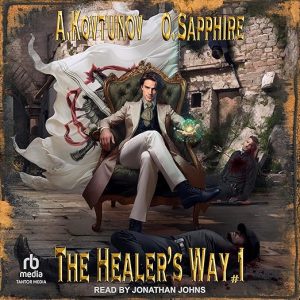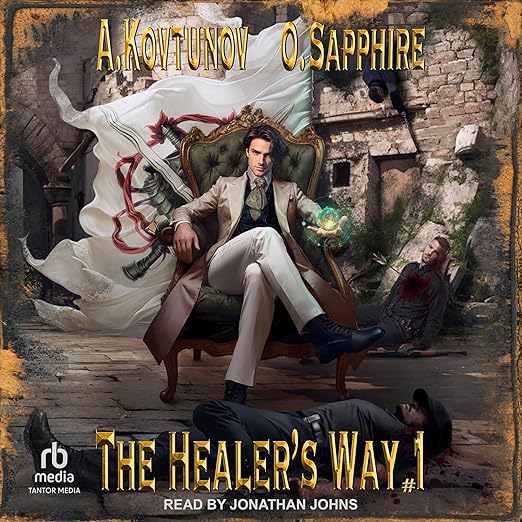
How much does a listener need to see? Oleg Sapphire's portal-fantasy audiobook runs on a premise that answers the question by refusing it: the most powerful healer of one world wakes inside the body of a young guy in another, somewhere the healing gift is treated as a minor talent because nobody has worked out what it can really do. All of it is read by Jonathan Johns, and the sharpest response in the pool argues that the scenery went missing.
What Oleg Sapphire Delivers
James Hayes, posting as The Wise Dragon, gave it five stars in April 2024 and led with the thing that genuinely separates it from the pile: no weak, mousey main characters here. That is the right place to start. The figure speaking in the description spent a lifetime mastering healing, was accused by a brother of coveting a throne, and walked out through a ritual instead of fighting a civil war. The healer lands in the new world already finished, which removes the training montage most of the subgenre still insists on.
Competence fantasy is what follows, in close to its purest form. The healing gift in this world is, by the healer's own assessment, downright pathetic, and the diagnosis offered is that these people simply do not know how to handle power. The book is the gap between what everyone believes possible and what one displaced expert can actually do, closing slowly and in public. Sapphire is not interested in a hero who has to learn, but in a world that does.
Nine hours and eight minutes is a modest length for the subgenre, and the shape shows it. The early chapters are the strongest, partly because the comedy of a master being underestimated is front-loaded, and partly because watching the healer work out how a modern world operates gives the book its lightest material. Whether the back half sustains that momentum is exactly where the responses begin to part company, and the disagreement is more instructive than the average sitting above them.
WSmith, five stars in March 2024, found the appeal in one clause: the main character carries a great mix of ruthlessness and generosity. That combination is rarer than it sounds. Healer protagonists get written as gentle by default, and the entertainment here comes from somebody who will save your life and then name a price for it without a flicker of embarrassment or a speech about the greater good. The moral arithmetic never gets softened, which keeps the wish fulfillment from turning saccharine.
Alongside that, the same response is blunt about the flaw. The story gets drawn out, and whole stretches seem to be marking time when the plot could have moved considerably faster. That verdict arrived attached to five stars, which is worth registering: the sag read as an irritation rather than a reason to quit, and the response closes with a stated plan to start the next volume very soon.
Pacing matters more to a listener than it does to a reader, because a recording cannot be skimmed. The run is short by the standards of the subgenre, but a chapter that idles costs the same real time as a chapter that delivers. I noticed the slack most around the midpoint, where one scene closes and the next spends several minutes restating what is already at stake. What compensates is that Sapphire writes at scene level with a lot of dialogue, and heavy dialogue is the kind of text that carries well when it is spoken rather than scanned.
Where Oleg Sapphire Loses Some Ground
Allahrah Rakiyah, four stars in January 2025, filed the most useful criticism on the page. The story works and the lead has personality, but the descriptions are thin: places the healer visits go undescribed, the borrowed body's appearance goes undescribed, and of the countess that response reports knowing only that she is a young woman with scars who probably looks dirty. Immersion, it concludes, becomes hard work. The observation is specific enough to be checkable, which is more than most four-star complaints manage.
In print, a reader patches those gaps automatically and barely notices doing it. In a recording the absence gets louder, because sound is the only sensory channel arriving and a scene with no described setting turns into voices in a void. Nothing in the five responses addresses Jonathan Johns or the recording at all; the vocabulary throughout is reading, ebook subscriptions and page counts, which tells you plainly which edition this evidence was gathered from.
Arithmetic on the page deserves a flag as well. The counter reads three ratings and a 4.4 average, while five signed responses sit underneath it. No combination of three whole-star votes produces 4.4: three votes can only display 4.0, 4.3, 4.7 or 5.0 at one decimal place. Whatever that average is measuring, it is not the five opinions a shopper can actually sit down and read. A counter that lands below the number of signed responses on the same page usually means two editions have been stacked under one score, and the score is the part that travels.
Who Oleg Sapphire Is Writing For
Dee, five stars in December 2024, came in having never read this author and left citing strong protagonists, snarky dialog and good storytelling. That is a fair statement of the target audience. Anyone who wants a capable lead, fast banter and a setting that keeps underestimating its newest arrival will get all three inside the first chapter, and the book never subsequently pretends to be doing something more complicated. Sapphire is writing to a request, not around one, and the clarity of that contract is a large part of why the ratings sit where they do.
Pass if you need a described world, because the complaint about missing scenery is not a matter of taste and audio magnifies it. Pass if you actually want science fiction: the listing carries that tag while the story runs on a healing gift, a ritual and a soul relocated into another world, which is fantasy by any reasonable measure. Pass, too, if you want a finished story, since this is volume one of an open series that shares its name.
Everyone else gets an honest pitch. A specialist better than anyone in the room, dropped somewhere the skill is undervalued, working steadily toward the moment the undervaluing stops. Sapphire executes that cleanly, Tantor Media gave it a straightforward single-voice production, and the first volume closes at a natural stopping point rather than a cliff. Continuing will ask considerably more of you than this first volume did.
Before You Press Play
- Narration: Jonathan Johns holds the sole credit on a first-person story told from inside one head, with no second performer listed for the surrounding cast.
- Themes: A master in a world that underrates the craft, a borrowed body, competence as revenge
- Mood: Wry and forward-leaning, deliberately thin on atmosphere
- Verdict: Strong lead, sharp dialogue, and a description problem that a recording makes louder than print ever would.
Frequently Asked Questions
Does this audiobook stand on its own, or do I need the whole series?
It is book one of an ongoing series that shares its title, and it closes a stage rather than the story. The March 2025 verdict, five stars despite everything, is blunt about what continuing demands, counting the installments at roughly 300 pages each against the 600-plus that listener expects from a fantasy volume.
Who narrates The Healer's Way audiobook, and how long is it?
Jonathan Johns, in a single-voice production issued by Tantor Media in February 2024, running a little over nine hours. No second performer or full cast appears anywhere in the credits, which suits a first-person story delivered almost entirely from inside one character's head.