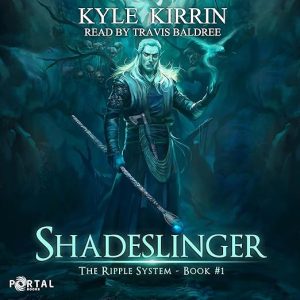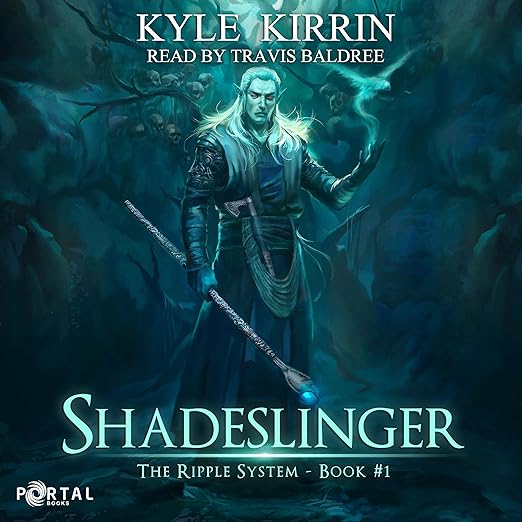
A talking axe named Frank carries more of this audiobook than the player swinging it, and the readers who got there first say so out loud. Kyle Kirrin's debut drops a corporate flameout called Ned Altimer into a virtual world named Earthblood Online, hands him three days of exclusive access before everyone else arrives, and then gives him a weapon with opinions, a sense of humor, and knowledge of the game's deepest secrets that it shares only when it feels like it.
What Kyle Kirrin Delivers
Everything here runs off a clock. Ned gets a Head Start period, and when those seventy-two hours run out, every other player in the game knows he holds something worth taking. That structure does two useful things at once: it gives a very long story a countdown, and it turns an overpowered advantage into a liability, because the axe that makes Ned dangerous is also the reason he becomes a target. The description ends by calling the coming manhunt a lot of fun, and it is not wrong. Kirrin has also sidestepped the usual problem of an opening volume, which is that nothing much can happen until the world is explained; here the explanation and the countdown run together.
Frank is the reason the book works. One of the first readers to write about it, in April 2021, came to the genre through this novel and reports that the artificial characters are the most engaging thing in it, with the talking axe holding the strongest character arc on offer. A weapon with the best arc in a novel about a man in a game is a joke the book is clearly in on, and it is also an accurate description of where the writing puts its energy.
That same reader raises the question worth raising, then gets cut off mid-sentence on the page: what can the worst outcome be when the entire story happens inside a game somebody chose to log into? It is the structural problem every virtual-world novel has to solve, and a listener deciding whether to commit should know it is being asked. The response also notes that the marketing sets up player-versus-player conflict that this first volume never delivers.
What Kyle Kirrin Gets Right
Pacing gets an unusually specific verdict, from a reader who filed in February 2021, within weeks of release. That account calls the tempo fast and on point, describes it as quite a feat for a book of this size, and says it never felt like it dragged. Coming from someone who names two other long fantasy series as benchmarks for tempo and length, that is a considered judgment rather than an enthusiastic one, and length is precisely the risk here. Series openers in this corner of fantasy routinely spend their first third on menus and stat blocks before the plot consents to start.
The same account is worth quoting on what the book avoids: no cringe, no harem, no boneheaded main character. Anyone who has waded through this corner of fantasy knows how much work those seven words are doing. It also records a change of mind about Frank, from an initial worry that a talking axe would be a gimmick to a verdict that the dialogue is a treat, both there and across the novel generally.
Characterization gets a similar endorsement: each character reading as distinct, with believable motivations of their own. If that holds for you, the runtime stops being an obstacle and becomes the reason to buy, since twenty-one and a half hours with people you enjoy is a bargain and the same span with people you do not is a sentence. The margin between those two outcomes is thinner in audio than in print, because skimming is not available.
Where Kyle Kirrin Loses Some Ground
One reader disagrees outright, and the disagreement matters more in a recording than on a page. Filing in 2025, that response argues every single character speaks in the exact same manner, to the point that a particular word recurs until it grates, and warns that anyone listening will get sick of it. Uniform speech is survivable in print, where the eye moves fast. Delivered aloud by one voice across a very long run, a verbal tic has nowhere to hide.
Nothing about the numbers here holds together. The average shows 4.6 while the rating count shows three, and three whole-star votes cannot produce 4.6: the two nearest sums display as 4.3 and 4.7. Meanwhile the page carries five written accounts underneath a counter claiming three, so more people have written about this book than are recorded as having graded it. Grade the five yourself and they average considerably higher than the figure on display. Neither number is worth trusting, which is inconvenient on a book that asks for a serious block of your time.
Nothing in those five responses grades the recording. Every one of them describes reading: reading the blurb, reading the genre, getting sick of a word on the page. Travis Baldree holds the reading credit, and a listener has no written account at all of how the delivery handles Frank's banter, the system messages, or the difference between one character and the next, which is the exact question the dialogue complaint makes urgent.
Should You Listen to Shadeslinger?
Straightforward recommendation, then, for anyone who already reads progression fantasy and wants a first volume with jokes in it. The readers who liked it best cite banter, pacing and a well-executed sidekick, and one filing from Australia in March 2021 was already impatient for the sequel and curious about a minor character's development, which is usually a good sign about how a series opener lands.
Pass on it if uniform dialogue ruins books for you, given the complaint recorded above, and if virtual-world stories bore you on principle, since this one commits entirely and never steps outside the game. Newcomers to the genre are better served here than they might expect, since the mechanics arrive as Ned meets them rather than in a preface, and two of the five written responses end by declaring themselves impatient for whatever comes next. That is precisely the reaction a series opener is built to produce.
Sampling before committing is the sensible move here. The strengths on offer, comic dialogue and a countdown structure, are the sort you can test inside twenty minutes, and so is the weakness, since a sameness of voice shows up quickly once you are listening for it. A debut this long deserves that courtesy, and the page gives you no other way to find out.
Does the Shadeslinger audiobook read like a first novel?
One reader who noticed it was a debut says it most certainly does not read like one, praising the writing, the character development and a sassy companion trope executed properly for once. Given how often opening volumes in this genre read like a first draft, that is a meaningful compliment rather than a polite one.
Is this a complete story or a setup for later books?
Both, leaning toward setup. The description ends with the greatest manhunt in gaming history still seventy-two hours away, and the page files this as volume one of The Ripple System. Expect the head start and its consequences to be resolved while the larger conflict is left standing.
Is twenty-one and a half hours a lot for one audiobook?
Yes, and it is the main thing to weigh before buying. The countdown structure gives the length a spine rather than letting it sprawl, but a commitment this size deserves a sample first, particularly since the one recorded objection concerns something that becomes more noticeable the longer you listen.
Why does the page show a 4.6 average from only three ratings?
It cannot be right. Three whole-star votes can only average out to figures that display as 4.3 or 4.7, and the page shows five written accounts beneath a rating count of three. Treat both numbers as unreliable and read the five accounts instead, which is the better evidence anyway.