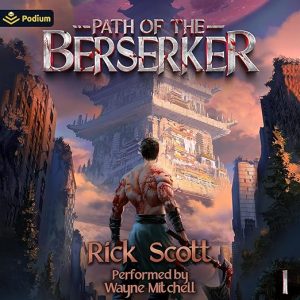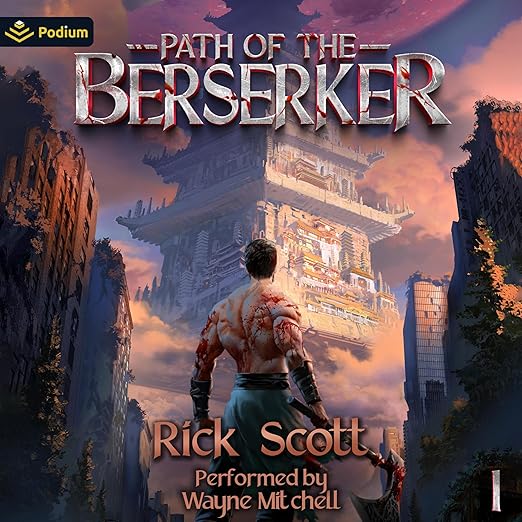
- Narrator: Wayne Mitchell brings sharp first-person energy to Max Chun's voice, sardonic, angry, and genuinely funny when the writing calls for it, handling the cultivation-system jargon with enough naturalism to keep the world-building from feeling like a technical manual.
- Subjects: Resistance against colonial oppression, rage as a power source, found purpose in apocalypse
- Tone: Propulsive and irreverent, with real fury underneath the banter
- Bottom line: A confident debut in the Western cultivation fantasy space that earns its 28-hour runtime through consistent character and escalating stakes.
Cultivation fantasy and post-apocalypse fiction make an unusual marriage on paper, and yet Rick Scott's audiobook lands the premise with more confidence than I expected from a first-in-series entry. Path of the Berserker posits a future Earth conquered by Qi-wielding cultivators - an intergalactic dynasty that reduced human civilization to rubble in a matter of hours - and follows one furious, stubborn man who wants nothing from the new order except to burn it down. That protagonist, Max Chun, is the reason this book works as well as it does.
The setup borrows familiar bones from both xianxia cultivation fiction and dystopian science fiction, but Scott is not really interested in genre pastiche. He is interested in the specific texture of colonial resentment and what happens when someone refuses the path of accommodation entirely. Max does not want to climb the cultivation ladder and become one of the oppressors. He wants out of that system altogether, which is where the mysterious goddess and the berserker path enter the picture. It is a cleaner and more emotionally coherent premise than it might first appear.
What Rick Scott Delivers
What separates this book from the crowded LitRPG and progression fantasy space is Max's voice. Scott writes a first-person narrator who earns his audience's loyalty through consistent characterization rather than wish-fulfillment. Max is angry, yes - genuinely and specifically angry, not just generically edgy - and Scott traces that anger to a concrete history of loss and subjugation that makes it feel earned rather than adolescent. Reviewers noted that the book is both inspiring and funny, which sounds like a contradiction until you spend time with Max's internal monologue. He is the kind of narrator who can be furious at an enemy and deadpan about his own misfortune in the same breath.
Wayne Mitchell's narration is well matched to that voice. Mitchell keeps the first-person register consistently present - he does not drift toward a more neutral audiobook delivery when the prose gets technical - and the result is that the world-building systems never feel like they are being recited at the listener. The magical bureaucracy of the Dynasty, the mechanics of blood-rage power, the spirit beasts and martial arts traditions all land as part of Max's experience rather than as context dumps. At twenty-eight hours and forty-eight minutes, that is a significant achievement. A weaker performance would have made this runtime feel punishing.
The cultivation-system design is one of the book's genuine strengths. Scott builds an alternative to Qi cultivation that feels thematically coherent rather than mechanically arbitrary. The berserker path runs on blood, rage, and pain - which is not just a power aesthetic but a logical extension of Max's character and situation. A man who has survived a decade of colonial subjugation, watching his world be dismantled by enemies who measure everything in Qi, finds his power not in imitation but in opposition. The system design earns its resonance.
The Best Parts of Path of the Berserker: A Daopocalypse Progression Fantasy
Fans of Western cultivation fantasy - the sub-genre that translates xianxia conventions into English-language frameworks - will find this a particularly satisfying entry because Scott clearly knows both traditions well. He knows what the xianxia reader expects and knows which expectations to fulfill and which to subvert. The immortal cultivators as colonial oppressors is not a new idea, but it rarely gets the blunt specificity that Scott gives it here. The imperial bureaucracy is not just villainous window dressing - it is a system designed to make collaboration feel like the only rational choice, and Max's rejection of that system is what the book is really about.
The post-apocalypse setting adds a visual and emotional texture that straight xianxia often lacks. Earth's ruined cities, the remnants of human technology now subordinated to Qi-based infrastructure, the psychological weight of living under a civilization that has defined your entire world as lesser - Scott builds all of this convincingly without ever stopping to deliver a history lecture. The world-building happens through Max's eyes and through the specific problems he encounters, which is how it should work.
Reviewer Eugene called it "inspiring," which is not an adjective one expects to apply to a rage-powered cultivation fantasy. But it fits. The book's thesis - that growth requires struggle, that refusing accommodation is its own form of power - lands sincerely rather than as empty motivation-poster rhetoric.
Before You Commit to Path of the Berserker: A Daopocalypse Progression Fantasy
This is Book 1 of an ongoing series, and it reads like one. Scott builds out his world and his protagonist with clear long-game intentions, which means some threads introduced here are clearly meant to pay off several books down the line. The goddess who sets Max on the berserker path, for instance, remains somewhat opaque by design. Readers who need full closure within a single volume may find that withholding frustrating.
The rating count for this audiobook is still relatively low - just three ratings at time of writing - so the enthusiasm of individual reviewers is a reasonable indicator but not a broad consensus. The positive reviews are genuinely enthusiastic rather than filler praise, but listeners who rely heavily on volume of reviews as a quality signal should factor that in.
The rage-as-power mechanic means the book spends significant time with Max in states of high emotional intensity. Scott handles this carefully enough to keep it from becoming monotonous, but listeners who prefer more emotional range in their protagonist should know that sustained fury is the register this story lives in.
Who Should Pick Up Path of the Berserker: A Daopocalypse Progression Fantasy
This audiobook will land best with readers who already have some fluency in cultivation fantasy conventions - they will get the most out of Scott's subversions. It is also a strong pick for listeners who enjoy post-apocalyptic fiction with a political edge and do not mind a protagonist who prioritizes destruction over diplomacy. Wayne Mitchell's performance makes the long runtime feel like an investment rather than an endurance test. Those looking for a cozy or low-stakes listen should look elsewhere - Max Chun is not that kind of company.
Before You Listen
Do I need to know xianxia cultivation fiction to enjoy this audiobook?
It helps but is not required. Scott integrates the cultivation system mechanics gradually enough that newcomers can follow along. Readers already familiar with xianxia conventions will get more out of the genre subversions, but the core premise, an angry man refusing to play by the oppressor's rules, is accessible on its own terms.
Is this audiobook appropriate for younger teens given the rage and violence themes?
Path of the Berserker is written for adult readers and deals with colonial violence, sustained physical suffering, and a protagonist who is explicitly motivated by hatred and grief. The tone is not gratuitous, but the material is intended for mature audiences, not younger YA readers.