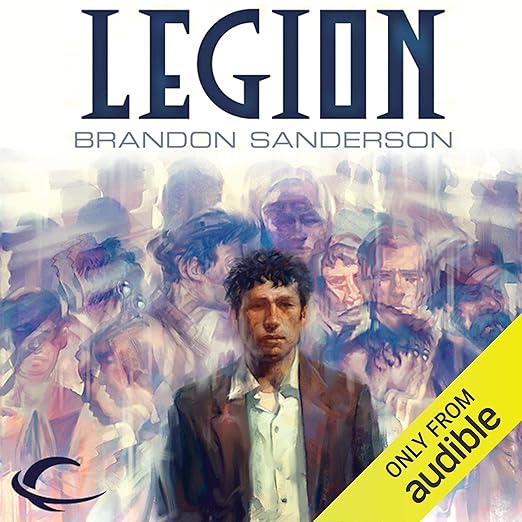
Before You Press Play
- Read by: Oliver Wyman holds the sole reading credit, with an Audie Award attached to it by the publisher's own copy rather than by any listener
- At its heart: externalized memory as detective method, a photograph of the past, faith and politics colliding over a piece of technology
- Vibe: Brisk, wry and unusually compact
- Short version: A sharp, compact experiment worth the time, though the page around it names the wrong author and undercounts its own ratings.
The byline on this audiobook page says Dan Abnett. The description underneath it spends its opening paragraph on Brandon Sanderson, on Mistborn and The Stormlight Archive and the Wheel of Time continuation, and then presents Legion as Sanderson's novella. Four of the five written responses on the page name Sanderson too. Whatever went wrong in the metadata, the book being sold here is a compact contemporary novella about a man who solves problems using the hallucinations he cannot stop generating, and it is worth knowing which one you are buying before you commit.
What We Made of It
Stephen Leeds has a condition that produces personae. They are called aspects, they turn up unbidden, each carries a narrow and deep expertise, and Leeds can only use the knowledge of whichever ones happen to be with him at the time. The premise is a detective engine dressed as a psychiatric symptom, and the plot it drives concerns a missing man named Balubal Razon and a camera whose properties would rewrite what we think we know about human history. The action runs from ordinary American settings to a divided Jerusalem, and the questions raised along the way take in the nature of time, the uses of technology and the volatile join between politics and faith. That last pairing is where the novella briefly turns serious. A device capable of altering what we know about human history lands differently in a divided Jerusalem than it would anywhere else, and the book is clear-eyed about what people would be willing to do in order to control it.
Gary Hoggatt's four-star assessment is the most measured thing on the page and lands close to my own reading. Sanderson is known for enormous multi-volume constructions, this is a compact experiment in a form he rarely works in, and the central device has been seen before elsewhere. Hoggatt's conclusion, that the epics remain the better showcase but the experiment is welcome, is a fair verdict on a book that never pretends to be more than a very clever short.
Compression is worth noticing too. A writer with a reputation for thousand-page architecture has here given himself no room to explain anything twice, and the result is a book that establishes a psychiatric premise, a supporting cast of imaginary specialists, a global manhunt and a theological problem inside a span most novels use for a prologue. Some of that speed shows. Characters get one distinguishing trait apiece and then get on with it. But the pace is the pleasure, and the ideas keep arriving faster than the plot strictly requires.
The Best Parts of Legion
The single best description of what the aspects actually do comes from Derek J. Jordan's October 2012 notice, which reaches for Sherlock Holmes and then improves the comparison. Holmes kept an attic of information; Leeds keeps people. His memory is externalized into fully realized individuals with their own personalities, which means the story can dramatize an act of recall as a conversation between characters. Jordan also names the constraint that makes the whole thing work: when an aspect is not present, Leeds is genuinely useless on that subject. A gimmick that limits its protagonist is a gimmick with a plot in it.
Two hours and six minutes is exactly the right container for that idea. The novella form keeps the premise from calcifying into a series formula, and it means the invention rate stays high throughout rather than being rationed across a trilogy. Oliver Wyman is named as the reader, and the description goes a step further by attaching an Audie Award to the credit, which is the publisher's claim rather than a listener's. What a performer has to solve here is unusual and specific: several hallucinated people talking in the same room, all of them perceptible to one character only, and none of them able to touch anything.
What Might Not Land
Start with the page itself, because the metadata is a mess in three separate ways. The author credit reads Dan Abnett while the description and the review record both point to Sanderson. The rating counter reads three even though five written notices sit underneath it, so the 4.4 figure is drawn from a smaller pool than the visible commentary suggests. And the page lists this as volume one of a series called Legion, which is also the title of the book, with no further volume named anywhere on the page. None of that affects the writing. All of it affects a buyer trying to work out what arrives.
On the book, the fair warning is scale. UchihaGodai's notice sets out the shape accurately: first person, a recluse turning work away, a protagonist who is clinically insane by any ordinary description and entirely functional by his own. The book is built to introduce a character rather than to resolve a world, and it stops well before the implications of that camera get anywhere near settled. Anyone who wants the questions about time and faith answered rather than raised will finish this frustrated rather than satisfied.
The written record is also thinner than the book's profile suggests. Five notices spread across thirteen years, from September 2012 to October 2025, is a slow-moving pool for a title with this much name recognition attached to it, and it means the average carries less information than a three-digit rating count would. Nobody in that record discusses the recording at all, so the questions a listener would actually ask about pacing and voice differentiation stay unanswered by everyone except the publisher's own copy.
Who Should Pick Up Legion
Rob Goslee frames the audience about right in an October 2025 note: less thrilling than the same author's larger books, and good company for a dark stormy night. That is the register. This is a short, warm, extremely inventive entertainment for people who like watching a writer solve a structural puzzle in public, and it will suit somebody with a short gap to fill better than somebody settling in for a weekend.
Newcomers can start here without penalty, since nothing in the story depends on any other book. Existing readers of the big epics should calibrate expectations: the pleasures are quick, verbal and close-up rather than architectural. No cosmology gets assembled and no magic system gets audited; the invention here all happens at the level of the sentence and the scene. Anyone who dislikes unreliable-mind narratives, or who wants a mystery whose rules are fixed before chapter two, should pass. Sanderson is doing something small and precise here, and the page around it does a poor job of saying so.
Before You Listen
Why does the audiobook page list Dan Abnett as the author?
That looks like a cataloging error rather than a description of the contents. The description names Brandon Sanderson four separate times and summarizes his Stephen Leeds novella, and the written responses discuss that book. Anyone hunting a different novel that shares this title should check the running time and the summary before buying.
Is Legion a complete story or a setup for later volumes?
It resolves its immediate case and leaves the larger implications wide open. One response filed from the United Kingdom captures the effect exactly: low expectations of a short story, followed by wanting more of it. Treat it as a complete novella that deliberately declines to close the door behind itself.
How does the audiobook handle several hallucinated characters in one scene?
That is the central technical demand and no listener on the page has described how it lands. Oliver Wyman carries the credit and the description attaches an Audie Award to it. What a buyer can confirm is the structure: a first-person narrator relaying voices that only he perceives, with no second performer credited anywhere.