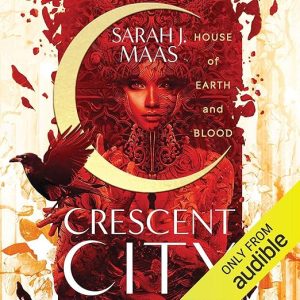
Before You Press Play
- Performance: One credited voice for both leads, so Bryce and Hunt share a reader through every scene the central romance rests on.
- What it covers: Grief and revenge, indentured service and freedom, urban fantasy politics, an investigation that will not close
- Feel: Loud, neon, grief-soaked, and very long
- Our call: Commit to the opening hours or skip it entirely, because everyone who finished says the first act nearly stopped them.
Page 599 comes up by name on the review page attached to this audiobook, cited as the location of a particular shock. The opening hundred pages get measured too, and so do the closing two hundred. Those are precise, useful landmarks, and not one of them exists in the edition you are actually buying, which is Elizabeth Evans reading Sarah J. Maas for twenty-seven hours and fifty minutes. That gap is worth understanding before you commit.
Bryce and Hunt Anchor a Genre That Won't Sit Still
Bryce Quinlan is a half-Fae, half-human woman with a job by day and a nightlife by night, until a demon kills the people closest to her. Somebody is arrested. Then the killings start again, which puts Bryce at the center of an investigation she is not supposed to be running. Hunt Athalar is a Fallen angel working off an unpayable debt as an assassin for the Archangels who defeated him, and his freedom is the price offered for helping her.
Genre is where this book gets interesting, because it refuses to sit in one. The listing files it under literary fiction, romance and science fiction and fantasy simultaneously, with an action and adventure tag on top, and none of that captures what the sharpest response in the pool describes: a big-city detective drama with mythological creatures in it, structured as a murder mystery and paced like prestige television. Contemporary urban fantasy is the closest honest label, and no version of that phrase appears on the page.
Momentum takes a long time to arrive, and the most candid response here says so without hedging. Its writer reports needing six or seven separate attempts to get past the opening hundred pages, having picked this up last among the author's series precisely because the summary did not appeal, and then being unable to put it down once the machinery engaged. That is a specific and honest description of a book with a genuinely punishing first act and a genuinely large payoff.
Evans Alone Voices Both Leads for Consistency
The world costs a great deal of time, and those hours buy something rather than pad something. Maas is building a city with functioning politics, several competing species with their own hierarchies, an enforcement structure, a criminal underside and a magic system that has rules people can exploit. Compress that and you get exposition dumps. Spread across this many hours, it accumulates instead, which is why the second half moves as fast as the responses claim.
Elizabeth Evans holds the credit alone, which sets the terms of the whole listening experience. A single reader is voicing both leads, which means every scene the central romance depends on is a conversation one performer is holding with themselves, and every antagonist, every angel, every member of an invented taxonomy has to stay distinguishable across a very long recording. Consistency matters more than range in a book this size. Nothing on the page tells you how that was handled.
Investment is the emotional subject of one of the more thoughtful responses here, which spends its opening describing what it feels like to be the fan of an author with a release schedule: the countdown, the escalating conversation, the preorder incentives, the pins and posters and prints, and then the vertigo of the book actually arriving. That reader gave it five stars. Understanding that dynamic explains a great deal about how this title's reception is shaped.
Page Landmarks Vanish When You Are Listening
Navigation is the practical casualty of the format switch. Every structural landmark this pool offers is a printed-page coordinate, and in a recording those coordinates translate to nothing at all. You cannot decide to push through to a given page, because you have no idea where it sits. You cannot flip forward to see how much of a scene remains. What you get instead is a timestamp and a running percentage, which is a poor instrument for a book whose readers plainly navigate by paper.
Names are the other thing print handles better. One five-star response describes being thrown immediately into a complex world of many different magical beings and wondering how any reader is meant to track the species, before the story took over. On a page you can look back, check a spelling, find the paragraph where a term was defined. By ear you cannot do any of that, and Maas introduces a great deal of invented vocabulary in the same stretch that already loses people.
Four of the five written responses contain actual sentences. The fifth consists entirely of repeated emoji, carrying a five-star grade into the average while saying nothing at all about the book. The pool also spans three countries, with notes posted from the United States, the United Arab Emirates and the United Kingdom, which is a reasonable spread but a small absolute sample for a title of this profile. Weigh the four that speak; ignore the one that does not.
Patience Buys the Payoff, and Skimmers Should Pass
The audience is anyone who wants a fantasy that behaves like a crime series, and who has the patience for a long onboarding. Listeners who enjoy procedural structure, a partnership that starts adversarial, and a city built with enough detail to sustain a sequel will get exactly what they came for. Existing readers of Maas already know the register and can skip straight to deciding whether they want another series running alongside the ones they already follow. Newcomers who like urban fantasy with a serious body count will find this an unusually substantial entry point.
Impatience is disqualifying here, because more than one response describes a hard opening and the format removes your ability to skim through it. Anybody wanting a self-contained story should also pass: this is the first book of a series and it behaves like one. Listeners who want the romance foregrounded from the beginning should also know that the investigation carries most of the first half, with the relationship arriving later than the summary implies.
Treat the first several hours as an entry fee rather than a sample. Judging this book on its opening is the mistake the two most detailed responses here describe making, and both of them reversed the verdict later. Set the expectation that you are learning a city rather than following a plot, give it until the investigation properly starts, and the remaining twenty hours will move faster than any summary of them can suggest.
Good to Know
Is prior Sarah J. Maas reading required for this audiobook?
Not at all. Crescent City is presented in the description as a brand-new series, and this is book one with no crossover requirement. The setting, the magic system and the entire cast are introduced from scratch here. Readers coming from Maas's earlier work will notice a harder, more contemporary register than those books use.
How big a commitment is the House of Earth and Blood audiobook?
Just under twenty-eight hours, which works out to roughly a month of ordinary commuting or several dedicated weekends. It is also the first volume of a continuing series rather than a standalone, so finishing it commits you to a cliff of unanswered questions rather than delivering a closed ending.