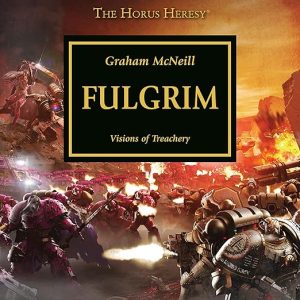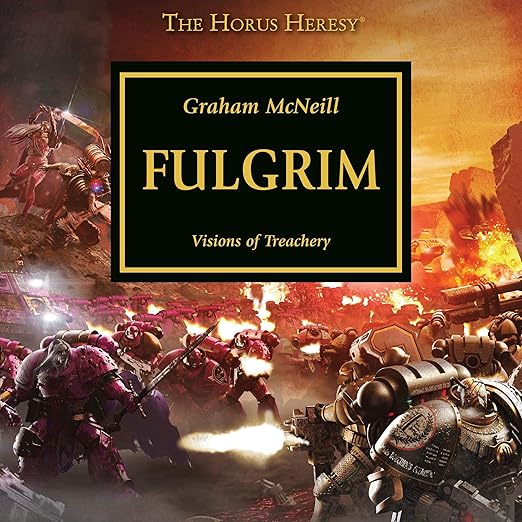
Volume five of a long-running series arrives here with three ratings behind it and five people who wrote at length. That mismatch is the first thing to notice about this audiobook, which runs fifteen hours and four minutes with David Timson named as the reader, and the second thing is that the 4.6 printed above those three ratings is not a number three whole-star votes can produce.
The Review
Corruption is the whole arc, and the description says so without flinching. Fulgrim, Primarch of the Emperor's Children, leads his warriors against an alien enemy while darker forces have already fixed on the Imperium of Man. Loyalties get tested, every murderous whim gets indulged, and the legion takes its first steps down a road that ends at Isstvan V. Graham McNeill is writing a fall, and everyone reading knows the destination in advance.
Five written responses sit beneath a counter that claims three ratings. Those five grade the book at five, five, four, five and five, which averages to 4.8 and does not match the 4.6 on display either. Three whole-star votes can only ever produce 4.0, 4.3, 4.7 or 5.0, so the figure shown is unreachable from the tally beside it. Ignore the average and read the accounts, which are the only usable evidence anywhere on the page. The publisher is Black Library, and beyond that name the listing offers no production information at all.
Two of those responses rank the book inside the series rather than describing it. One calls it a favorite among the sequence, another says flatly that it is the best so far, and a third describes working through the series and finding that the same events viewed from different angles build what it calls an amazingly grimdark picture. This is a book judged against its siblings by the people who buy it.
Timson's assignment is a hero's disintegration, which is a demanding shape to sustain at length. The reading has to sound like admiration at the start and something else entirely by the end, with the change arriving gradually enough that a listener notices it late. That trajectory is the strongest argument for taking this one by ear rather than by eye, since a voice can carry a slow souring that prose has to state outright.
Retelling helps too. One reader describes the appeal exactly: the series keeps returning to the same events from different perspectives, so a volume like this one adds a viewpoint rather than a chapter. That makes it more forgiving of interruption than a straight sequel would be, because you already know roughly where it goes and you are listening for how it looks from inside the legion that falls. The framing also means the campaign against the alien enemy functions as background rather than as the point.
Payoff is what the enthusiasts keep naming. One five-star notice calls the fall of Fulgrim tragic in as many words; another describes a book that starts slowly and builds into a solid foundation of chaos, arriving at what it calls the changes of a god. Between them they describe a character study rather than a battle chronicle, which is not what the cover promises. All five posted years after the 2017 listing date, the earliest in 2020 and three of them in 2025, so the book is still finding readers steadily.
Before You Commit to Fulgrim
Counting is the first problem. Three ratings on a title from a publisher with a large catalog is a number that means nothing statistically, and it sits below the count of people who took the trouble to write. Five specific accounts are worth more than an average built on a tally too small to be internally consistent. A buyer who reads three ratings as a popularity signal will draw exactly the wrong conclusion about how widely this volume has been read.
Vocabulary is the second. The description opens with a Warmaster, a Primarch, the Great Crusade and the Imperium of Man, and it closes on a place name that means everything to a series reader and nothing to anybody else. Not one of those terms gets explained, and the copy assumes you already know why a legion turning matters. The listing carries a series number and no entry-point guidance whatsoever, so a newcomer has no way to learn from this page that four books come first.
Pacing draws two complaints, and they land at opposite ends of the book. The four-star response takes aim at the ending, describing a chapter that cruises along with detail and lore followed immediately by the closing battle, and says it did not feel right. A separate five-star notice says the opposite about the opening, that the book started slow. Those are different objections rather than a consensus, and together they suggest a soft first act and a compressed last one.
As for the recording, nobody has described it. Not one of the five mentions the reading, the pace or the voice, and the vocabulary they reach for throughout belongs to reading rather than to listening. Whatever you are buying in Timson's performance, this page offers no listener evidence for it, so sample before committing to a book of this length.
Who It's For
Series readers arriving in order are the intended audience and will get the most from it. If you have the earlier volumes behind you, the accounts here suggest this is one of the stronger entries, and the two people who rank it in the sequence both put it near the top. The fall it describes is one the series has been building toward, and reading it in place rather than out of order is what gives the corruption its weight.
Tragedy in armor is the other draw. Underneath the campaign sits a study of a leader who gets flattered into ruin, and the responses that engage with the book engage with that rather than with the fighting. A listener who enjoyed watching a proud figure talk himself into disaster will find this a familiar and satisfying shape. The Emperor's Children are the legion in question, and watching a formation built around its own pursuit of perfection curdle into something else is the specific pleasure being sold.
Nobody new to the setting should start here. Nothing on this page defines a Primarch, explains what Isstvan V is, or points you toward the first volume, and a recording of this length is an expensive way to learn a vocabulary. Wait for the earlier books, then come back to this one.
Can I trust the rating on this audiobook page?
No, and the arithmetic settles it. Three whole-star votes cannot reach the decimal shown, and more people wrote paragraphs than the counter records as having voted at all. Where a tally and a page disagree this badly, the written accounts carry the only usable evidence.
Is this more of a battle novel or a character study?
A character study wearing battle armor. Readers who liked it point to the fall itself, one calling it tragic outright and another describing a slow build into what it names the changes of a god. Combat is present, but the interest is in a leader being flattered toward ruin.
What does the listing say about the audiobook production?
Almost nothing. A reader credit and a runtime are the only production details published, with no mention of abridgement, no sample description and no indication of who directed or produced it. Since the written pool never touches the performance either, sampling is the only route to a judgment.