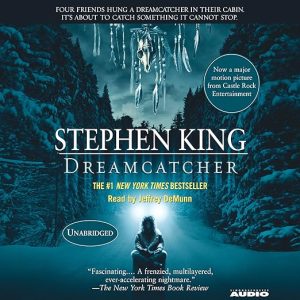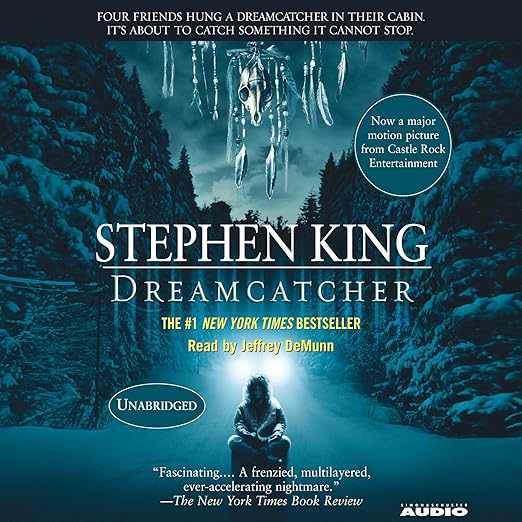
Maine woods in deep snow, four grown men on their annual hunting trip, and a stranger who staggers into camp half frozen and talking about lights in the sky. That is the setup Stephen King gives himself, and this audiobook takes twenty-two hours and forty-seven minutes to work through what follows. Jeffrey DeMunn reads. The listing files the whole thing under science fiction, which is technically defensible and still tells you less than half of what you are about to spend a weekend inside.
The Review
Derry is the other character. The four friends met there as boys, and what bound them was not a shared hobby but a single act: they stood together and pulled a mentally challenged child away from local bullies. Twenty-five years later they have separate lives, separate marriages, separate failures, and one annual weekend that keeps the original arrangement alive. King spends a long time establishing that debt before he collects on it, and the patience is the point rather than a delay.
Reputation follows this novel around, and one four-star response takes it on directly, describing a book routinely ranked in the lower tier of King's output with a coffin lid nailed over it, largely because of a motion picture adaptation that reviewer considers deplorable and deservedly so. The same account then argues the novel itself is a pretty decent yarn, and ranks it above at least two other King titles it names by name. That is a fair summary of where the book actually sits.
Halfway is where it turns, at least for one five-star listener who found the opening slow and the characters hard to reach before becoming fully invested at the midpoint. Anyone who has read King knows the shape: boyhood friends bonded by trauma, reassembled as damaged adults, plus something from outside that treats them as material. What that response calls classic King elements are exactly what the second half delivers, once the setup has finished paying for it. The slow open is a real cost, though, and it remains the likeliest reason a listener who came in cold gives up early.
Why Listen to Dreamcatcher
Nearly twenty-three hours is a serious commitment, and that time is doing structural work rather than padding. King braids several timelines and several heads at once here: the hunting camp in the present, the Derry childhood, a military containment operation, and a running interior argument inside one character who is no longer entirely alone in his own skull. Compressing that would collapse the effect. The recording gives each strand room to breathe on its own clock.
One response in the pool grades the book on two separate axes and marks narration at the top of its scale, though the note never says whether that mark belongs to this recording or to King's storytelling voice, so treat it as suggestive rather than conclusive. That same note also describes the central group as five friends, where the publisher's description counts four boys plus the child they protected. What is certain is the casting: a single credited reader, Jeffrey DeMunn, carrying every viewpoint, every accent in a Maine hunting camp, and the two distinct personalities sharing one body in the novel's central conceit.
Pain runs through this book in a way one reader connects directly to the circumstances of its writing, arguing that King composed it while enduring severe injury and that the emphasis on physical damage, particularly one character's ruined hip, reads as lived rather than researched. That is a reader's interpretation and not a documented fact about the manuscript. It is a productive lens anyway, because the novel is unusually attentive to what bodies feel like when they stop cooperating, and because the horror here works outward from physical vulnerability rather than from anything supernatural.
The Caveats
Arithmetic is the first problem on this page. The average displays 4.4 and the rating count displays 3, and three whole-star votes cannot produce 4.4: thirteen stars across three voters rounds to 4.3, fourteen rounds to 4.7, and nothing lands in between. Something in the pipeline computed a figure the sample cannot support. The five written responses beneath it carry grades of five, five, four, five and five, which is a different and more usable body of evidence.
Shipping condition, not storytelling, is the subject of one of those five responses. Its writer ordered a physical copy, reports it arrived brand new exactly as described, notes with pleasure that it turned out to be a first edition, and praises the seller. Nothing in it concerns King, the novel or any recording. On a page selling a spoken edition, that response is measuring a package, and that five-star grade is being folded into the average regardless.
Classification deserves a second look before you buy. The tags say science fiction, and the alien-invasion machinery justifies that, but the responses themselves reach for paranormal and horror when they describe the experience, and no horror tag has been applied to this page at all. For a listener who avoids horror deliberately, a page that never uses the word is actively misleading, and this novel more than earns it.
Who Should Listen to Dreamcatcher
Listeners who already trust King with long books are the obvious audience, especially anyone who responds to his childhood-friendship material and is willing to sit through a deliberate first act to reach it. The novel also suits people who like their science fiction contaminated by other genres, since the aliens arrive inside what is otherwise a snowbound survival story with a military thriller running alongside it and a haunted-town novel underneath.
Newcomers to King should start somewhere else. It is not the book that explains why he matters, and a first-timer who bounces off the pacing will draw the wrong conclusion about the whole catalog. Listeners who want tight plotting will be unhappy too, because the structure sprawls by design. Anybody sensitive to sustained body horror and graphic physical suffering should stay away as well, since the novel treats both at length, in detail, and with a specificity that makes several sequences impossible to skim past by ear.
Anyone deciding between formats should decide on the material rather than on the numbers attached to this page, because those numbers are broken in two directions at once. What is on offer is a long, strange, uneven King novel with a genuinely disturbing middle section and a friendship at its center that earns every hour spent on it. Go in expecting a sprawl rather than a machine, and the sprawl turns out to be where the book lives.
Before You Listen
Is the Dreamcatcher audiobook a complete, unabridged reading?
Close to twenty-three hours in total, which is consistent with a full-length reading of a long King novel, and no abridgement notice appears anywhere. Budget several weeks of ordinary commuting or a couple of very committed weekends, because the first act deliberately takes its time before the plot engages.
Does the audiobook cover the childhood backstory or assume you know it?
It covers it fully. The description makes the incident from twenty-five years earlier central rather than background: four boys protecting a child from bullies, an act it says changed them in ways they never understood. That episode is recounted inside the novel and is the mechanism the ending depends on.