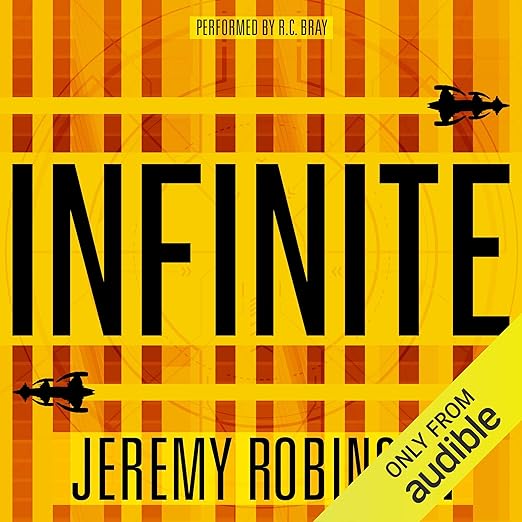
Quick Take
- Performance: R.C. Bray brings his signature hard-SF authority to William Chanokh's first-person voice, handling the isolation sequences with a patience and gravity that suits Robinson's conceptual ambitions.
- What it covers: Immortality and the burden of endless time, the nature of reality and consciousness, love as the one tether to meaning
- Feel: Contemplative and strange, with horror undertones and a philosophical core that rewards patience
- Our call: Robinson's most ambitious novel gets Bray's most interior performance, and the combination produces an audiobook that operates in a genuinely different register from standard SF fare.
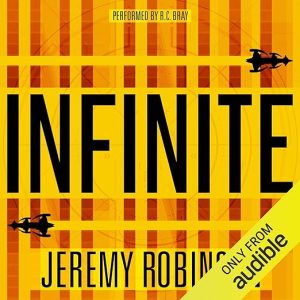
Jeremy Robinson established his career on fast-paced genre hybrids, the kind of books that move so quickly you rarely stop to question the architecture underneath. Infinite is something different. R.C. Bray narrates this audiobook with the deliberateness of someone who recognizes that Robinson is asking more of his audience here than in his earlier work. The premise begins with a screwdriver to the heart and the first death of a man who will die many more times. From that violent opening, the book pivots into one of the stranger SF novels Robinson has written: a meditation on consciousness, isolation, love, and what it means to exist when existence refuses to end.
William Chanokh spent 10 years in a malfunctioning cryogenic bed aboard the Galahad, body asleep and mind awake. When he finally emerges, his friend Tom stabs him. When he wakes again, Tom is dead and the ship is locked on an eternal faster-than-light trajectory toward nowhere. What follows is not a rescue story. Infinite is the story of what a man does, what he becomes, and what he discovers about reality when nothing remains but to keep going forever.
How Infinite Holds Up
Robinson is drawing from a particular tradition of philosophical SF here, the kind that uses extreme physical circumstances to strip the protagonist down to first-order questions about existence. Chanokh's immortality is not the cheerful variety of some SF narratives. It is a condition that creates encounters with solitary desperation that the synopsis names without minimizing. Robinson is honest about the psychological weight of endless time, and one of the audiobook's genuine achievements is that it does not soften what it would actually mean to be the only conscious being on a ship going nowhere, forever.
The forbidden love element, introduced as Chanokh and the sole surviving crew member Capria Dixon navigate their impossible situation, brings necessary warmth to a narrative that could easily collapse under its own conceptual weight. Robinson does not allow the romance to dominate the book's philosophical project, but he uses it to give Chanokh something to anchor to, a human tether in circumstances that otherwise have no human scale. One reviewer describes this as SF with a heart, which is an accurate if compact summary of what Robinson accomplishes by pairing the big cosmological questions with an emotionally grounded central relationship.
The encounter with strange and violent lifeforms during Chanokh's travels extends the book beyond pure existential meditation into something with more genre variety, and these sections give Bray something kinetic to work with alongside the interior reflection. Robinson's imagination for alien encounter is intact even when the philosophical machinery is running at full capacity. The book does not choose between being a conceptual novel and being an adventure. It attempts both and largely succeeds.
R.C. Bray is one of the most trusted narrators in science fiction audio, and his work here is among his most interior performances. William Chanokh's first-person voice requires a narrator who can sustain emotional credibility through extreme isolation and repetitive death-and-revival cycles without letting the delivery become monotonous or the existential weight become theatrical. Bray accomplishes this by keeping Chanokh's voice grounded in specificity, in the immediate sensory and emotional reality of each situation, rather than reaching for abstraction to match the book's philosophical ambitions.
The 10-hour-and-21-minute runtime is calibrated well for the story Robinson is telling. Readers who have noted that some parts are too easy to guess are correct that Robinson's plotting is not the source of tension here. The question of where William ends up physically is less interesting than the question of what he discovers about reality and what that discovery costs him. Listeners who come to Infinite oriented toward Robinson's other faster-paced work may need to recalibrate, but the book signals its intentions early and does not pretend to be something it is not.
The Infinite Timeline series designation indicates this is the first book in a continuing universe. One reviewer notes they immediately downloaded the second book, which picks up significantly later in the series numbering, suggesting Robinson's timeline is non-linear. Listeners who want to understand where the series goes should check entry points carefully.
Weak Spots in Infinite
Infinite is, by Robinson's own design, the most conceptually ambitious thing he has written. One reviewer at the time of writing noted that earlier reviews had claimed it was his best work, while expressing some skepticism about that assessment. The honest reading is that Infinite is Robinson's most philosophically serious work, which makes it different from his best action-science-fiction, and whether that is better or worse depends on what you are looking for from him.
The pacing in the middle sections of the book is deliberately slow. Chanokh's isolation across extended periods of the journey is meant to register as weight, not as narrative urgency. Listeners who want consistent plot movement across a 10-hour runtime will find the contemplative stretches test their patience. This is a feature rather than a flaw, but it is a real feature that affects the listening experience.
The nature-of-reality content in the final sections of the book requires listeners to engage with SF conceptual frameworks rather than simply following a plot. Robinson's vision of what Chanokh discovers about the universe asks for a willingness to sit with ideas that do not resolve into clean explanations. Listeners who want the philosophical payoff to be fully legible and unambiguous will find Infinite leaves more open than some would prefer.
Who Should Listen to Infinite
Listeners who enjoy SF that operates in the tradition of philosophical isolation narratives, the kind of story where what happens externally is less important than what the circumstances reveal about consciousness and meaning, will find Infinite a distinctive entry in the genre. Bray's narration and Robinson's ambition combine to produce something that does not arrive often in commercial SF audio.
Listeners who know Robinson from his action-SF catalog and are curious whether he can sustain a different register across a full novel will find this audiobook answers that question affirmatively, with some reservations about pacing in the middle. Fans of R.C. Bray across his SF catalog will find this among his more interesting performance challenges, and the 10-hour runtime gives him enough space to build Chanokh's voice into something fully inhabited. Listeners who need fast plot resolution and consistent narrative momentum should approach this one with adjusted expectations.
Frequently Asked Questions
Is Infinite a standalone audiobook or do I need to listen to other Robinson books first?
Infinite is the first book in the Infinite Timeline series and works as a standalone entry point. The premise is self-contained. One reviewer notes they immediately sought the second book in the series, which sits significantly further along in the series numbering, suggesting the timeline expands non-linearly.
How does R.C. Bray's narration of Infinite compare to his other science fiction audiobooks?
Bray's performance here is more interior and contemplative than his work in faster-paced SF. Chanokh's extended isolation and repeated death-and-revival cycles require sustained emotional credibility without dramatic peaks, which Bray handles by keeping the character voice grounded in immediate sensory reality throughout.
Is this audiobook more philosophical or more action-oriented?
Primarily philosophical, with action elements that punctuate but do not dominate. Robinson is asking questions about consciousness, immortality, and the nature of reality, and the narrative structure is built around those questions. Listeners expecting Robinson's typical action-SF pacing should calibrate for a slower, more meditative experience.
Is the forbidden love storyline central to this audiobook or secondary to the SF concepts?
The relationship between William and Capria Dixon is used as an emotional anchor for the philosophical content rather than as the book's primary focus. Robinson develops it with genuine warmth but keeps it in service of the larger existential questions Chanokh is navigating across his impossible circumstances.