Hard science fiction usually asks you to forgive its characters. Andreas Karpf's first novel makes that bargain unusually explicit: the physics is careful, the abandoned alien colony is genuinely unsettling, and two separate readers say the crew of Earth's first interstellar ship behaves like schoolchildren. Whether this audiobook works for you comes down to which half you weigh more heavily, and the five written responses on the page split almost exactly along that line.
What Andreas Karpf Delivers
Karpf opens on a landing that should feel triumphant and does not. Jack Harrison steps off the ladder after a decade in command, warm sunlight on his helmet, and the ground crackles like dried leaves over the remains of a civilization that was hundreds of millennia ahead of humanity before somebody erased it. Dorian Roberts, a self-described man of science, found the blend of real theory and adventure pacing refreshing despite the familiar premise of a deep-space crew stumbling into somebody else's war. That contrast between serene tropical surroundings and long-abandoned structures is the novel's single best effect, and Karpf puts it in the opening paragraph rather than saving it for later.
Curiosity is the mechanism that traps them. An abandoned alien device cuts the landing party off from their ship, supplies run down, and a rescue by another species arrives only to reveal that the rescuers are themselves under siege. Karpf builds the book as a widening dread, where every answer about the massacre makes the thing that caused it larger, until the description's own last line leaves Jack choosing between caution and a threat nobody can begin to understand.
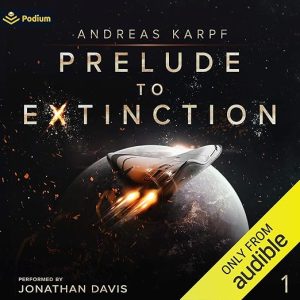
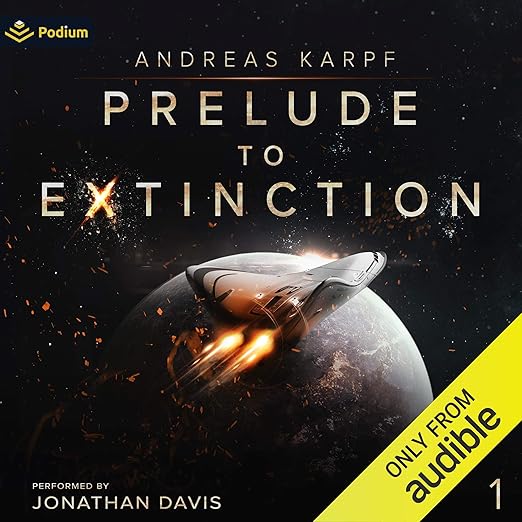
Podium Audio names Jonathan Davis as the reader across seventeen hours and eight minutes, a substantial commitment for a debut novel. The series line calls this the Xenophobia Series, volume one, and the title does a certain amount of work in advance, since it tells you the alien encounter is not heading toward cooperation. Set your expectations for an opening book rather than a self-contained story.
What Andreas Karpf Gets Right
F R Ross, who claims to get through at least three hundred books a year, filed the most extravagant response here, ranking this the best science fiction read since the turn of the millennium and describing a night spent unable to find a stopping point. The concrete part of that account is more useful than the superlative: the book is loaded with actual science theory, and the only fault offered is that some might find it excessive.
Science is the reason to be here, and the page agrees on that more than on anything else. The physics is well presented, the theory is structural rather than decorative, and the accounts that complain hardest about other things still open by praising it. For listeners who want first-contact fiction built on something sturdier than hand-waving, that pattern of agreement is the most reliable signal the page offers. Both five-star responses talk mainly about ideas, while the two most detailed criticisms concern people rather than physics, which is a clean division between what this novel does well and what it does not.
Worldbuilding does real work too. A colony exterminated so long ago that time has erased the attackers is a stronger hook than a live enemy, because it turns the first half into archaeology, and archaeology in a spacesuit is a mood few novels attempt. The tropical calm sitting over the ruins is the image that stays, and Karpf holds it long enough to make what follows feel like an intrusion. The scale of the crime helps as well, because wiping out a species that far advanced establishes an antagonist without ever showing it, and a threat defined only by what it left behind stays frightening far longer than one with a face.
Where Andreas Karpf Loses Some Ground
Mark Daniels, writing in March 2023 at four stars, names the problem precisely: the expedition shows no command structure, and its staff behaves, in that account's words, like "middle-school teens scuffling in the hall" rather than serious professionals. The same response credits the physics as the author's forte while flagging the treatment of gas flows as flawed, which is the sort of specific criticism worth ten vague ones.
Fred Liessmann's three-star response reaches the same conclusion from the opposite direction, praising the story line, the science, the captain and the aliens, and then reporting no feeling whatsoever for anybody else aboard. Bickering, that account concludes, "ruined what could have been a good book". Two readers arriving independently at the same objection is the clearest warning this page issues about the novel.
Counting is the page's own oddity. The rating counter reads three while five written responses sit underneath it, so the average rests on fewer votes than the page displays reviews. October 2020 is the audio release date, and three of those five responses predate it, which means most of what you can read was written by somebody holding a printed book rather than listening to this one.
Who Should Pick Up Prelude to Extinction
Patient readers who want hard SF and can tolerate thin characterization are the clear fit. The four-star response from March 2026 offers the most level assessment available: one of the better ones lately, not a classic, very readable, a decent story. That is probably the right calibration for a debut which does one thing extremely well and another thing poorly, and it is the note I would take into the first hour.
Character work, if that is what you listen for, is the reason to pass. Two of the five responses raise the same objection and neither comes from a hostile reader; both wanted to like the crew and could not manage it. A complete story is not on offer either, since volume one of a series named for xenophobia will not close its arc, and nothing on the page pretends otherwise. Length is the other consideration, since the sections that irritated two readers are conversations rather than incidents, which means the parts you might want to skip are woven through the book instead of clustered in one place.
My own verdict lands close to that four-star reading. The setup is genuinely good, the science is honest, and the archaeology of a murdered civilization carries the first half without needing anybody aboard to be likeable. Go in for the ideas and the ruins, accept that the crew will irritate you at intervals, and treat the run as an investment in a series rather than a finished novel.
A Few Questions About Prelude to Extinction
Is the science solid enough for a technically trained listener?
The accounts that engage with it say yes, with one exception. A four-star response calls the physics the author's strength while judging the treatment of gas flows flawed, and adds that few readers would catch it. Another describes real theory rather than decoration, its only complaint being that some would find it excessive.
Does this audiobook tell a complete story or set up a series?
The listing marks it volume one of the Xenophobia Series, and the description closes with Jack facing a threat nobody understands. Expect an opening book. Nothing on the page promises resolution, and the series name itself signals which direction the alien relationships are heading across later volumes.
Why does the page show three ratings but five written reviews?
That mismatch is real, and it matters more than the 4.3 average sitting above it. A counter lower than the number of visible responses means the score rests on a very small sample, so a single grade moves it substantially. Read the five written responses individually rather than trusting the number above them.
How do the characters compare with the worldbuilding in this audiobook?
Unevenly, by the page's own account. One response praises the captain and the aliens specifically while reporting no connection to the rest of the crew, and two reach for school-age comparisons to describe the dialogue. The ruins and the science carry the novel; the interpersonal scenes are the price of admission.