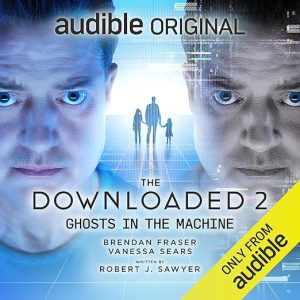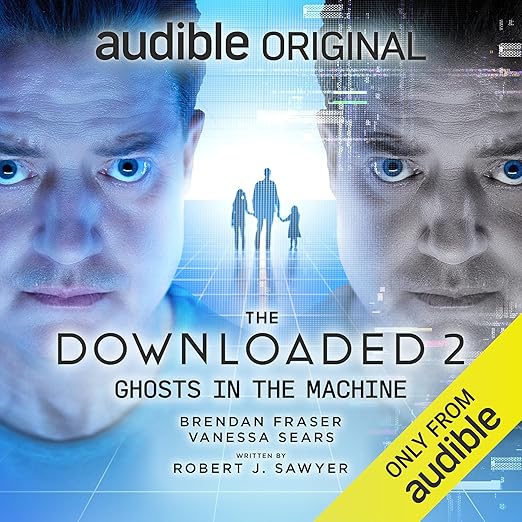
Sequels to sealed-off science fiction premises carry an odd burden: the first book already spent its central question, so the second has to earn a new one. Robert J. Sawyer sets this follow-up in 2555, long after the Phoenix colonists were pulled out of cryogenic suspension, and hands it a fresh problem, what happens when an uploaded mind runs into a copy of itself. This audiobook comes to seven hours and sixteen minutes, lean for an idea that size, and the original audio production behind it builds the whole thing around Brendan Fraser.
The Verdict, Briefly
Everything turns on how the colony divides. Captain Letitia Garvey leads the group that re-uploads to the quantum system and points itself at Zeta Tucanae to finish the astronaut mission that started all of this. Mayor Roscoe Koudoulian leads the other group toward Mars, clear of the asteroid due to end Earth. Then tragedy lands on the day Roscoe is set to leave, he uploads as well, and everyone is back inside the virtual silos where the duplicates are waiting.
Joe Karpierz, posting four stars under the headline "Worthy successor to the first book in the series," places the novel inside a long run: Sawyer's first, GOLDEN FLEECE, appeared in 1990, and this is the twenty-sixth. That context matters. The book reads like the work of someone who has been circling consciousness, morality and machine sentience for thirty-five years and has stopped feeling obliged to explain the furniture. It moves fast, states its positions early, and expects you to keep pace with both.
Those duplicates are the genuinely good idea. They are less monsters loose in the machine than arguments with faces: if a stored consciousness can be copied, which copy holds the better claim to keep running, and who is qualified to rule on it? Sawyer stages the question as a race against a hard deadline rather than a seminar, which keeps it moving, and the choices the colonists land on cost them something real. This is the rare sequel whose central problem could not have existed in the first book.
The Best Parts of The Downloaded 2: Ghosts in the Machine
Fraser is the reason this exists as an original audio production rather than a novel with a recording bolted on. The Commodore, posting five stars, is blunt about the result: "The production is great; Fraser is absolutely fantastic." That same account frames the series as speculative fiction that uses its hardware to hold "a mirror up to our own beliefs, fears, prejudices." Both halves of that are fair, and they are connected, because a story about people who exist only as voices needs a voice worth following.
One thing the listing gets wrong is the cast. The narrator line names Fraser alone, while the publisher description bills Vanessa Sears, a Dora Award winner, as a featured performer in the same breath. Anyone picking this for the ensemble is looking at a credit narrower than the copy directly beneath it. That is not a small discrepancy on a title whose central conceit is that identity can be duplicated and mislabeled.
Compression works in its favor as well. Sawyer does not spend the running time on atmosphere; the countdown to Earth's last day is already going when the book opens, and both departures are set in motion early. Listeners who want their science fiction to marinate will find this brisk to the point of curt. Listeners who have quietly given up on bloated space opera will find the economy a relief. The book seems to know exactly which of those readers it wants.
Points to Consider
Not every listener is on board. Kayla Lynn's two-star account puts the objection plainly: this one "didn't have all the voice actors like the first," and it "seemed to take a different direction" from where the opening book left things. Both observations are about expectation as much as execution, but they identify a real risk. A production that narrows its cast while widening its plot will feel like a different animal to anyone who came for the ensemble.
Entry point is the second problem. This is unambiguously a second installment, and the page does nothing to help you place it: no series is named and no volume number appears anywhere, so nothing tells a browsing listener that the story begins elsewhere. The description fills in enough backstory to keep you afloat, and in doing so it hands over the state of play the first book worked its way toward. Begin here and you arrive pre-spoiled.
Numbers next. That 3.7 average comes from three ratings, and the three posted write-ups run five stars, four, and two, which is precisely the average and precisely nothing you can generalize from. A sample that thin tells you the recording is recent, not that the audience is split. Read the three accounts instead of the number; each one is arguing about something different, and only one of them engages with the performance.
Watch the product page itself, too. It arrives pre-loaded with award citations and superlatives, and it walks through the emotional arc of both missions before you have met a single person in them. That is a marketing decision rather than a flaw in the novel, but the cost lands squarely on the listener: press play after reading it and you already know who leaves, who stays, and roughly what waits inside the silos. Skimming the page is better preparation than studying it.
Who Should Listen to The Downloaded 2: Ghosts in the Machine
Anyone who finished the first book and wants to know what the colony did with its second chance is the obvious audience, and the only real question for them is whether a smaller cast is a deal-breaker. Longtime Sawyer readers who have followed the consciousness-and-morality thread across the back catalog will recognize the machinery within minutes and will probably enjoy watching it run at speed.
Newcomers should not start here, and not because the book is impenetrable, because it is not. A duplicate-consciousness story only pays off if you have watched these particular people become who they are. Listeners allergic to hard-premise science fiction that argues out loud about identity and ethics should also pass, since this is a novel of positions as much as events, and the debating is the point rather than the interruption.
Everyone else gets a compact, argumentative sequel with a genuinely strong lead voice and a plot that never idles. It is not the wider, louder ensemble piece the first installment was, and it does not appear to want to be. Judge it on the trade it actually makes, which is scale for speed.
Good to Know
Is Robert J. Sawyer a good fit if this is my first of his audiobooks?
The publisher copy calls Sawyer Canada's most decorated science fiction author, and the preoccupations on display, consciousness, memory, the ethics of copying a person, run through decades of that output. This is a weak entry point to the series but a fair sample of the concerns. A standalone would serve a newcomer better.
Does the audiobook work for listeners who dislike hard science fiction?
Mostly. The physics stays in the background, the asteroid and the quantum system function as premises rather than lectures, and the real conflicts are moral ones. What will not suit everybody is the argumentative register: characters state positions and test them aloud. If you want ideas buried inside action, look elsewhere.