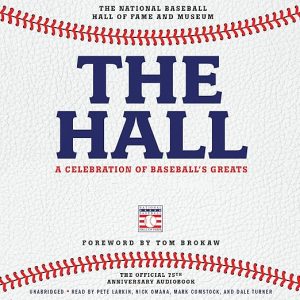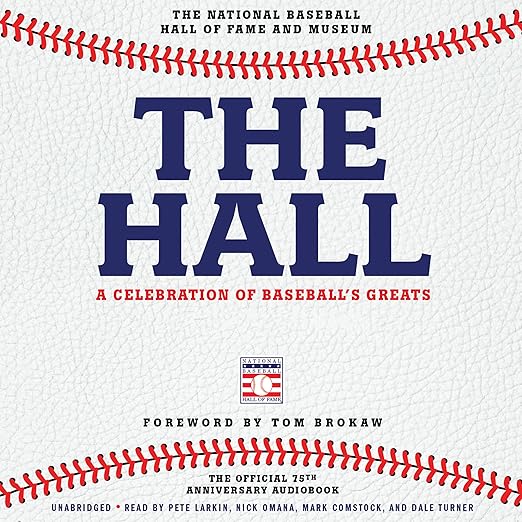
Nineteen hours and fifty-nine minutes of Cooperstown biography is a genuine commitment, and The Hall earns most of it by organizing that time around position rather than chronology, catcher by catcher, shortstop by shortstop, rather than year by year. This is the National Baseball Hall of Fame and Museum's own 75th anniversary registry, and this audiobook edition covers every inducted player with an essay and a biography, matching the print original's complete registry of plaques. Narrator Pete Larkin carries the bulk of that runtime alone, a long solo assignment for a reference work this dense.
Ripken and Ryan Write What No Outsider Could
Structure is really the whole story here. Each positional section opens with an original essay from a Hall of Famer who played that spot, Hank Aaron, George Brett, Orlando Cepeda, Carlton Fisk, Tommy Lasorda, Joe Morgan, Jim Rice, Cal Ripken Jr., Nolan Ryan, Robin Yount, before moving into the individual player biographies. That's a smart way to organize a registry this large: expert framing from someone who actually played the position, followed by the historical detail.
One reviewer's overview holds up well: the book is 'full of concise overviews of every Hall member up to the publication date'. That's an accurate description of the ambition here, comprehensiveness over depth on any single figure, which is the right tradeoff for a reference work covering the entire history of Cooperstown's inductees rather than a biography of just one or two legends.
Two of the ten essayists show the format's real value especially clearly: Cal Ripken Jr. writing the shortstop section carries a durability and defensive expertise no outside sportswriter could match, and Nolan Ryan on pitchers brings decades of mound experience that reframes stats a fan might otherwise just skim past. That's ten genuinely different expert voices inside one audiobook, not one narrator's summary of ten different careers.
The synopsis is careful to note this is the first time the Hall of Fame and Museum has published 'a complete registry of inductees with plaques, photographs, and extended biographies', which positions the book as a genuine institutional milestone rather than just another licensed baseball product riding the Cooperstown name.
Filed as Arts and Entertainment, Not Sports Stats
Filing this under arts and entertainment rather than sports specifically is a reasonable call given how much of the book's actual content is essay and biography rather than statistics or play-by-play; this reads closer to a literary anthology organized around a shared subject than a stats-driven sports reference.
Hearing a Hall of Famer Beats Reading One
Reviewer Jeffrey P. Aloisio, who listened to the audio edition specifically, called it 'very entertaining and knowledgeable' and singled out what he described as the interviews ahead of each position as 'worth listening to'. The synopsis itself calls these section openers essays rather than interviews, but whichever term fits best, Aloisio's real point stands: hearing a Hall of Famer's own reflections on their position, in something closer to a spoken voice than a page of text, is exactly the kind of value audio adds that the print edition can't replicate the same way.
MJ's review comes from someone who owns both the book and the CD set; even while saying they weren't sure why they'd bought the CD at all, preferring the book overall for its photography, they still credited the narration positively before the review cuts off. That's a useful data point: the audio experience holds up on its own terms, even by the account of a reviewer who leans toward the physical edition. At twenty hours, dipping into a single position's section rather than sitting down for a start-to-finish listen is probably the more natural way to actually use this one.
Cooperstown functions as something closer to a pilgrimage site than an ordinary museum for serious baseball fans, and a book built entirely around that specific institution understands its own audience's relationship to the place; this isn't generic baseball history; it's an attempt to put the actual physical experience of walking through the Hall, plaque by plaque, into a form a fan can revisit anywhere.
That institutional backing also means the biographical content carries an authority a privately authored baseball encyclopedia wouldn't automatically have; this is the Hall's own account of its own inductees, not a third party's outside research.
Long-form audio also solves a real problem the print edition can't: a fan can have this playing during yard work, a long drive, or any of the hundred small tasks that don't leave hands free for an oversized book, which meaningfully expands when and how this material actually gets consumed.
Tagged Photography for a Book About Plaques
The elephant in the room is photography. This book's own genre tag is literally Photography, and reviewer Ann Sherry described the print edition as 'somewhat oversized, filled with the photos of the players' plaques that hang in the Hall of Fame in Cooperstown', and none of that, the plaque photographs, the oversized layout, the visual design that makes the physical edition a genuine 75th-anniversary treasury, carries over into the audio edition. A listener gets the words. The images stay on the page.
Most of the reviews attached to this listing also describe a combined book-and-CD purchase rather than a pure digital audio experience, which skews the visible reactions slightly toward comparing formats rather than assessing the audio edition purely on its own. Worth knowing going in: this is a reference work organized by position, not a linear narrative, so it rewards browsing a specific era or player more than a single marathon sit-down.
At nearly twenty hours, this runs close to the length of binging a full week of regular-season baseball broadcasts, which is worth naming as a comparison point for anyone trying to gauge the actual time commitment against a more familiar benchmark than just a raw hour count.
Road-Trip Listeners Get the Most Mileage
Cooperstown pilgrims and stat-sheet completists will happily sink twenty hours into this one, and so will anyone who wants a legend's own take on the position they played rather than a modern sportswriter's secondhand summary. Long-haul road-trip listeners looking for a reference work they can dip into across many drives, rather than one continuous story, are a particularly good fit.
Gift-buyers shopping for the baseball fan who already owns every general-interest sports biography also have a strong option here; a complete positional registry narrated by the Hall of Famers themselves offers something a standard single-subject biography audiobook simply can't replicate.
The plaques and photographs that define the print edition's 75th-anniversary treasury do not carry over to audio, so collectors chasing that visual material need the physical book alongside this listen, not instead of it. Listeners wanting one continuous narrative arc rather than a position-by-position reference should also adjust expectations before committing to all twenty hours.
Are the essays from Hall of Famers like Hank Aaron and Cal Ripken Jr. included in the audiobook?
Yes, each positional section opens with an original essay from a living Hall of Famer who played that position, read aloud as part of the narration.
How long is The Hall audiobook, and is that runtime worth it for a baseball fan?
It runs nineteen hours and fifty-nine minutes. For a serious Cooperstown fan wanting a complete inductee registry, that length reflects genuine comprehensiveness rather than padding.