At a Glance
- Read by: Simon & Schuster Audio cast Tovah Feldshuh rather than the author, so a survivor's first-person case material reaches you through a performer at one remove.
- At its heart: Self-imposed mental prisons, grief and guilt, healing after atrocity.
- Vibe: Direct, warm, unsparing.
- Short version: The prescriptive companion to her survival memoir, and the better buy if you want tools instead of testimony.
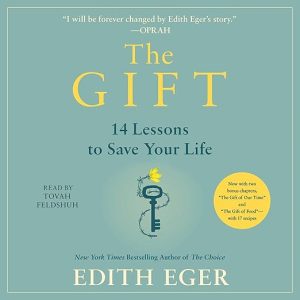
An award for audio production sits at the very top of this description, ahead of the blurb and ahead of the summary: winner of the 2021 Audie Award. No category is named, and nothing else on the page says a word about the recording, which leaves that single line as the only audio-side evidence a buyer gets. Tovah Feldshuh reads the audiobook in five hours and twenty minutes, and Edith Eva Eger's subject is what people do with the prisons they build for themselves once somebody else has already locked them in one.
Where This One Lands
Eger is a psychologist who survived the camps, and the distinction her book runs on is stated plainly: the worst prison she experienced was not the one the Nazis put her in but the one she created in her own mind. Everything after that is practical. She names the beliefs she considers most imprisoning, fear, grief, anger, secrets, stress, guilt, shame and avoidance, and gives each one a chapter's worth of tools drawn from her own life and from her patients.
Five stars in September 2021, from Zoey Roosevelt, who calls it a memoir, a how-to and a fun book all at once and does not treat that as a contradiction. The detail worth keeping from that response is the question Eger puts to every new patient: what is something that you do too much of? Roosevelt describes an in-your-face walk through life's challenges that anticipates a reader's resistance before the reader has finished raising it.
That anticipation is the craft. Eger has heard the objection already, usually from a patient and sometimes from herself, and the writing stays a half step ahead of the reflex to say yes, but you do not understand my situation. It makes the prescriptive passages land harder than the genre usually manages, because the person prescribing holds an unarguable claim on the subject of suffering and declines to use it as leverage.
Why Listen to The Gift
Five stars again on January 4, from Caleb, who reports a changed outlook on life and writing that makes you ponder and reflect. That is the shape of the enthusiasm on this entry: not admiration for the prose but a claim about after-effects, which is the only claim a book like this can honestly be judged on. Every written response on this listing makes some version of it, and all five of them awarded the top grade.
Length is part of why the material suits audio. Five hours and twenty minutes means the tools arrive close together and the case studies stay compressed, so you are never far from the next one. Eger writes in short movements, a story, a turn, an instruction, and that rhythm survives being spoken better than a book built on sustained argument would. Take one belief per session, guilt on the walk out and avoidance on the walk back, and nothing is lost.
Pandemic material is the other reason to consider it now. Two chapters cover what Eger says she learned during lockdown about rediscovering freedom inside confinement, which is either the most on-the-nose application of her thesis available or the most convincing, depending on your patience for the framing. She also uses that stretch to argue that preparing and sharing meals is a deep expression of love and connection, which is where the recipes come from.
What Gives Us Pause
Recipes are the one problem this format cannot solve. Five stars on December 31, from Andres, who calls the recipe chapter filler and says plainly that it does not fit the vibe of the book. On the page that is a matter of taste. Spoken aloud it turns structural: ingredient lists and quantities are the one kind of text a listener cannot hold, cannot skim and cannot return to without scrubbing back through a chapter.
That same response wants more depth in places and singles out the adage that we are born from love as one Eger could have pushed further. Pair it with an edition question the listing never answers. The description sells a revised text: two new chapters written after the pandemic, plus recipes updated and tested by Eger's daughter Marianne Engle. Nothing on the page labels which version Feldshuh recorded, and one release date is all a buyer gets.
Then the numbers, which do not work. The listing displays 4.8 as an average over a rating counter reading 5, while five written responses sit underneath it and every one of them grades the book five stars. Five whole-star votes averaging 4.8 must total 24, which requires exactly one four-star vote, and no four-star vote appears anywhere in the text. The counter and the written record are describing different sets of people.
Category placement is its own small scandal. This entry is shelved under business and careers, tagged Career Success, for a book by a Holocaust survivor about grief, guilt, shame and avoidance. The psychology and self-help audience that would buy it on sight has to already know it exists, while the buyer browsing career titles gets a book that mentions work only in passing. That is the kind of misfiling which quietly caps a title's reach.
Should You Listen to The Gift?
Anyone carrying something old and unresolved is the audience, and Eger's framing gives them somewhere to put it that is neither denial nor endless excavation. It suits listeners who bounced off the more clinical end of trauma writing and want a practitioner who works through stories, and it suits people who already know her account of survival and want the part that says what to do next. It works best for buyers who want instruction rather than testimony.
Hold off too if the survival narrative is what you came for. This is the follow-up, built on her earlier readers writing in to ask for something more prescriptive, and it assumes the camps rather than describing them. Anyone who dislikes being addressed directly should also pass, since Eger uses the second person freely and asks questions she expects answered. Listeners who want the cooking material will be fighting the format the whole way.
Five stars on January 2, from CK, who started reading, began to cry, and framed the book as a gift from God and a reason to do the work of healing. That is a religious reading of a secular text, and the fact that the material supports it without inviting it says something about how far it stretches. Oprah Winfrey's line at the top of the description praises Edith Eger's story, which is the subject of the earlier book summarized directly beneath it, so judge this one on the tools rather than on the blurb.
Do I need to read The Choice before starting this one?
No. The description summarizes the earlier book for you: it told the story of her survival in the concentration camps, her escape, her healing and her journey to freedom, and readers wrote asking her for something more prescriptive. This is that book. Knowing the first deepens the case studies, but nothing here depends on it.
Does the audiobook include the recipes, and can you use them by ear?
The cooking material is in the text, and no, you cannot really use it by ear. Quantities and method steps need a page or a very patient pause button. Treat that stretch as a chapter about food as an expression of love, which is how Eger frames it, and find the recipes in print if you plan to cook.
Is this audiobook a good idea for somebody in the middle of a crisis?
Cautiously. The September 19 response, filed under a default account name, calls the lessons hard and full of truth, which is fair warning. Eger does not soften grief, guilt or shame, and she asks direct questions expecting answers. If you are in the acute stage of something, the tools will keep even if the confrontation is not what this week needs.
How much of the camps does Eger actually describe here?
Briefly, and by reference. The camps are the ground the argument stands on rather than its subject, so the hardest material appears as the source of a claim instead of as a scene. If you want the survival narrative at full length it belongs to her earlier book; here she uses it to make a point about the prison she built afterward.