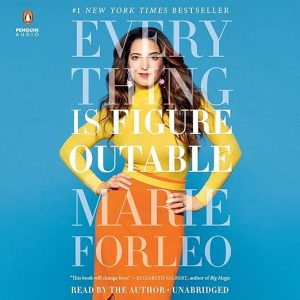
- Performance: Forleo reads her own material, and since broadcasting is her actual trade the recording sounds like its native form rather than a translation of a printed page.
- What it covers: Belief as the variable, resourcefulness over resources, criticism and imposter syndrome
- Feel: Warm, energetic, unrelentingly positive
- Our call: A genuinely useful starter's handbook, though the written exercises argue for having the print edition too.
An instant number one bestseller carrying five recorded ratings is the first oddity on this page, and the arithmetic behind those five is the second. Marie Forleo reads her own book across just under eight hours, and the philosophy fits on a bumper sticker: everything is figureoutable, a line her mother handed her and she has spent a career proving out. Whatever you think of that proposition, this audiobook is the fullest version of it anybody has recorded.
Forleo's case is narrower and smarter than the title suggests. She is not claiming every problem has a solution; she is claiming that the belief itself is the variable, and that installing it changes what you attempt. The copy puts it directly: if you are stuck, the problem is not you, it is that you have not yet installed the one belief that changes everything. Everything downstream is machinery for doing that installation.
A self-described entrepreneurial training junkie posting on October 21, 2019 under the handle Kim Mann gives the most useful endorsement on the page, precisely because it comes from somebody saturated in the genre. Having worked through a great many self help books and a considerable amount of coaching, that account still singles out the small simple steps here as the thing that finally brought the material home.
Self-narration is not a novelty on this one, it is the point. The description sells Forleo as the host of MarieTV and a podcast, which means the author's primary craft is speaking rather than writing, and the book was almost certainly composed with that voice in the writer's ear. Books by broadcasters frequently read better than they scan, and this is one of them.
What Stands Out
Structure is what separates this from motivational filler. Magareeshi, writing four days after that first response and also at five stars, flags the mechanism exactly: the book is technically a simple read, but doing the Insight To Action exercises scattered through it takes real time and focus. Those exercises are the product. Skipping them leaves you with an agreeable philosophy and no change in behavior whatsoever.
The promised contents are unusually specific for the category. You are told to expect a habit the copy says makes achieving goals 42 percent more likely, a method for handling shortages of both time and money, and a section on criticism and imposter syndrome. That last pairing is smart. Most books in this space treat external discouragement and internal doubt separately, when in practice they feed each other.
What Forleo mostly avoids is the quick fix, and the description says so plainly by positioning the book against exactly that. The examples span leaving a dead end job, breaking an addiction, learning to dance, healing a relationship and building a business, which is a deliberately unglamorous spread. The dance example matters more than it looks: it signals that the method is meant for small stakes as well as large.
What to Watch For in Everything Is Figureoutable
Those exercises are a genuine format problem and nobody on the page pretends otherwise. Written prompts requiring you to stop, think and record an answer do not survive being heard while driving, and this listing advertises no companion document to hold them. Anyone serious about the method needs a notebook and a stationary hour, at which point the print edition starts looking like the better purchase.
Now the rating line, which cannot be what it appears. The page shows 4.7 from five votes, and five whole-star ratings cannot produce 4.7 at all: twenty-three gives 4.6 and twenty-four gives 4.8, with nothing in between. Meanwhile the five written grades, four at the ceiling and one at four stars, sum to twenty-four and average exactly 4.8. The displayed figure is understating what the written record actually says.
Treat the 42 percent figure the way you would treat any statistic delivered aloud. It arrives in the marketing copy without a study named, and audio gives you no footnote, no citation and no bibliography to chase. The claim may well be sound; you simply have no way to check it while listening. Take the number as a rhetorical flourish rather than as evidence, and the surrounding advice loses nothing.
One of those five graded responses is not about this book. Lauren, the four-star from February 2024, describes applying a system credited to somebody named James across 100 days of tiny habits, a name appearing nowhere else on this listing and a method nothing here teaches. On a pool of five that single misfiled entry is a fifth of everything counted, and it happens to be the only grade below the ceiling.
Best Suited For
Somebody stuck at the start of a project, rather than midway through one, is the reader this actually serves. The book is about crossing the line from thinking about a thing to attempting it, so people already in motion will find much of it familiar. Anyone who has watched Forleo's videos and wants the underlying framework laid out properly is buying exactly the right thing.
Lion Ryder's January 2026 five-star describes the quality that keeps the material usable: it moves from lived experience into real situations where the concepts can be applied, which is a practical way of seeing ordinary daily life. That is the honest register. Nobody is being promised transformation, only a different default response to being stuck.
The listener this will not reach is the one who wants evidence rather than encouragement. Forleo argues from anecdote, conviction and a mother's aphorism, and readers who need studies cited and mechanisms explained will find the whole structure insubstantial. Skeptics of the genre should also note the relentless positivity, which is deliberate and unbroken. Everybody else gets a well-organized, warmly delivered handbook read by the person who wrote it.
Before You Listen
Does the audiobook work without the written exercises?
It works as an argument, not as a program. You will come away understanding the philosophy and remembering several examples, which has value on its own. The behavior change the book is built to produce comes from the Insight to Action prompts, and those require stopping, writing and returning to what you wrote.
Is Marie Forleo a good reader of her own work?
The setup favors it strongly. She built a career hosting a video series and a podcast, so speaking to an audience is her established craft, and books written by broadcasters tend to be composed for the ear rather than for the page. Sample a few minutes anyway if delivery style is something you react to.
Will this audiobook suit a non-native English speaker?
It appears to. One five-star response entered from the Spanish storefront in January 2021 came from a listener who worried the language would be too difficult and found the opposite, describing the book as easy to get through with lessons worth keeping. The vocabulary is conversational and the sentences short.