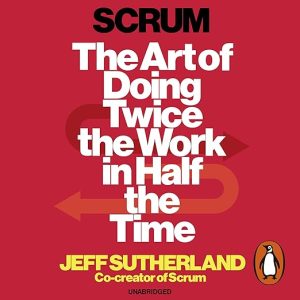
Jeff Sutherland co-created the Scrum methodology in 1993, and his audiobook of the same name is one of those rarer management texts that moves between the philosophy of how teams should work and the very specific mechanics of how they can. Narrated by his son J.J. Sutherland, a choice that gives the recording an unusual intimacy, this six-hour-and-forty-three-minute listen makes the case that Scrum is not a software development tool but a fundamental rethinking of how humans accomplish work under conditions of complexity and uncertainty.
A Closer Look at Scrum
The framework Sutherland describes emerged from his observation of a simple problem: most projects, across industries, are late, over budget, and deliver less than promised. He traces the origin of this pathology to waterfall project management, the assumption that a plan made at the beginning of a project can anticipate everything that will matter at the end of it. The Scrum alternative is iterative: work in short cycles called sprints, deliver something functional at the end of each one, inspect what you have learned, and adjust. The theory is elegant. The case Sutherland builds for it, spanning the FBI's failed $400 million software project and its Scrum-enabled replacement at one tenth the cost, healthcare applications, military deployments, and domestic household management, is expansive to the point of occasional overreach.
One reviewer, writing with considerable wit, notes that reading Sutherland's account of his own accomplishments would lead you to believe he personally rescued the US economy, cured cancer, and won the Vietnam War. The critique has merit. The book's greatest weakness is its tendency toward grandiosity in the authorial voice, the sense that Scrum is not merely an effective methodology but the singular solution to human organizational failure. That tone can grate, and it does periodically across six hours. The answer to it is the evidence itself: the case studies are well-documented and the outcomes are verifiable. Sutherland earns most of what he claims, even when the claiming is less than humble.
What Makes Scrum Worth Hearing
J.J. Sutherland's narration is a genuine asset. He narrates his father's material with the conversational ease of someone who has heard these ideas discussed across a lifetime, without deference, which would be sycophantic, and without visible skepticism, which would undermine the work. The result is a voice that sounds genuinely engaged rather than dutiful. For a business audiobook that depends heavily on the listener's willingness to follow the author through case study after case study, that quality of engagement is important. Management texts read by anonymous professionals often feel processed. This one does not.
The case studies are the book's primary strength. Sutherland uses real organizations and real outcomes, the FBI system replacement is the most striking, but his accounts of Scrum in medical device development, in public health, and in a high school classroom are equally illuminating. The breadth of application is the argument: if the framework only worked in software development, it would be a narrow tool. Sutherland demonstrates convincingly that the underlying logic applies wherever humans need to deliver complex work under conditions of incomplete information.
Things to Know Before Starting Scrum
The book's advocacy for Scrum is total rather than calibrated. Sutherland is not a neutral analyst of project management methodologies. He is Scrum's co-creator and CEO of Scrum Inc., and he writes from inside the conviction that his methodology is superior in nearly all contexts. Listeners familiar with alternative frameworks such as Kanban, Lean, or Prince2 will notice that these are either absent or briefly dismissed. The book makes no sustained effort to position Scrum within a landscape of competing approaches. For an overview of options, you will need to look elsewhere. For an authoritative, detailed account of one framework, this is the definitive source.
The personal material in the book, Sutherland's own professional journey, his time in Vietnam, his development of the framework through successive iterations, is more interesting than it might appear in a management book. It grounds the methodology in the specific observations of a specific mind working through specific failures, which makes the framework feel less like received wisdom and more like something earned through experience.
The Agile Manifesto, which Sutherland helped draft in 2001, sits in the background of this book without being foregrounded. Listeners who know the Agile landscape will hear echoes of that document in Sutherland's descriptions of Scrum's values: working software over comprehensive documentation, customer collaboration over contract negotiation, responding to change over following a plan. What Sutherland adds in the book is the organizational and psychological dimension that the manifesto left implicit. Why do teams work better with sprints than with long planning cycles? What is it about daily stand-ups that changes how people relate to shared work? The answers Sutherland offers are grounded in behavioral science as well as anecdote, which gives the book a depth that its occasional boastfulness can obscure.
Who Should Pick Up Scrum
This audiobook rewards anyone who manages teams, leads projects, or works within organizations that regularly fail to deliver on time and on budget, which is to say, most organizations. The software development origins are well-explained but not prerequisite knowledge. The Sutherland-narrates-Sutherland arrangement is one of the more distinctive choices in business audio and works better than most such arrangements. Those who already practice Scrum professionally may find the foundational material familiar, but hearing it from the co-creator's account adds context about why specific choices were made that practitioners often miss in training materials. Skeptics of evangelical business methodology will need to hold the grandiosity at arm's length, but the underlying case is genuinely strong.
Before You Listen
Does J.J. Sutherland narrating his father Jeff's audiobook create any awkwardness, or does it work?
It works considerably better than expected. J.J. narrates with a natural conversational energy that suggests genuine familiarity with the material rather than filial obligation. The intimacy of the arrangement actually suits a book that deals partly in personal anecdote and professional biography.
Does the Scrum audiobook cover both the theory and practical implementation, or is it more philosophical?
Both, in substantial proportion. The theoretical argument for why conventional project management fails is developed in detail, and the practical mechanics, sprints, backlogs, stand-ups, retrospectives, are explained concretely with real-world application examples. The book functions as both a case for the methodology and an introduction to its practice.