
In Brief
- Read by: Self-narrated for Penguin Audio; the material began life as talks and posts, and the credit puts it back in the voice it started in.
- At its heart: Positioning as exclusion, permission over interruption, status and tension inside a buying decision.
- Vibe: Brisk and aphoristic, each idea stated once and then left alone.
- Short version: The right first marketing book for a beginner, and mostly a mirror for anyone already practicing.
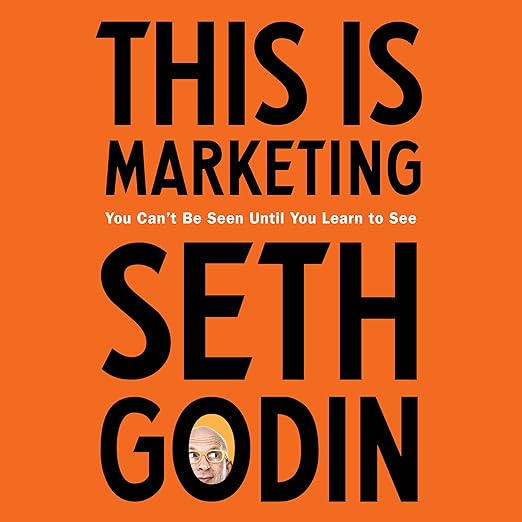
Seth Godin has spent decades turning his own vocabulary into ordinary business language, and this audiobook is the attempt to compress all of it into a single argument. Permission Marketing, Purple Cow, Tribes and The Dip each earned a volume of their own; This Is Marketing states the position sitting underneath them once, plainly, for a tech startup founder or a small business owner or somebody three levels down inside a large corporation. Godin reads it himself for Penguin Audio, which changes what the recording is doing.
More a Permission Slip Than a Marketing Insight
At the center sits a moral claim wearing the clothes of a tactic. Great marketers, the argument runs, do not use consumers to solve a company's problem; they use marketing to solve other people's problems, and the instruments for that are empathy, connection and what the book calls emotional labor rather than attention-stealing ads and spammy email funnels. Positioning, permission, status and tension all hang off that one inversion. Accept it and the whole structure coheres. Refuse it and you are listening to a homily.
Kim Pollack's five-star account from May 2019 shows most clearly who this lands on. Eight years of following Godin online, a stretch as a stay-at-home homeschooling mother, a business started afterward, and the phrase that kept surfacing through all of it was work that matters. That is not a marketing insight in the ordinary sense. It is a permission slip. A large share of the affection this book attracts comes from people who needed one and were never going to get it from a title about conversion rates.
Whether that reads as generosity or evasion depends on what you arrived for. Nobody gets a media plan out of this, no budget allocation, no channel strategy, no measurement framework. What you get instead is a method for deciding who a thing is for and, much harder, who it is not for, which the book treats as the entirety of positioning. Getting that decision wrong does more damage than any tactic can repair, so the emphasis is defensible even when it frustrates.
The Book That Fills Cialdini's Gap
Length is the first practical argument in its favor. Seven hours is brief for a business title with this much reach, and the brevity looks structural rather than accidental: the chapters run blog-length, each holding one idea long enough to land and then stopping. Taken across a week of short sessions it behaves less like a course and more like a run of short talks, which is close to the form this material had before it ever became a book.
A four-star response from April 2019 does the most useful comparison work on the page. That reader came to Godin after Cialdini's Influence, having read marketing books defensively for years as a shield against being manipulated, and concluded that Cialdini falls short of what an internet-dominated market now demands. This Is Marketing, the same account says, fills the gap. It is a precise compliment: not a better book about persuasion, but a book about the part persuasion no longer covers.
Positioning is where the argument earns its keep. Deciding who a product is not for sounds like a slogan until you try it on something you actually sell, at which point it removes most of your audience and all of your comfort. The related insistence that the best route to your own goals runs through helping other people become who they want to be is that same idea seen from the other side, and it survives contact with a real business better than most maxims do.
The Gap Between 4.6 and 4.8 Is One Vote
Start with the average, because it does not add up. Five written verdicts sit under this listing, graded five, five, four, five and five, which averages 4.8. The posted score reads 4.6, across a rating counter that also reads five. Either the counter and the written responses are not the same five people, or something in the tally has slipped. At this scale the gap between 4.6 and 4.8 is a single vote, and you cannot see which one it is.
Reading Verdicts for a Product Built on Voice
Reading verbs appear in three of those five verdicts, and the other two argue with the ideas without saying how they met them. Three were filed from the United States, one from Italy and one from the United Kingdom, and every one of them landed after the recording went up, the most recent by more than seven years. So what you are reading is a verdict on a text, attached to a product whose entire proposition is the author's own voice.
February 2025 brought a verdict calling it a masterclass in modern marketing, singling out the emphasis on understanding the needs, fears and desires of the people you serve. Fair enough, but notice what the praise is about: the frame, not the execution. This recording dates from 2018, and the stretches concerned with platforms, funnels and branding wear that date more visibly than the stretches about status and tension, which have not moved at all.
A Mirror Only Helps Those Willing to Look
Somebody at the beginning of a sales career is the cleanest fit, and that is exactly the recommendation attached to the January 2026 five-star note: easy to understand, and useful for people in sales who need a place to start and a direction to go in. That is the right size of claim. A beginner gets a coherent worldview to work from, and a worldview is worth considerably more early on than a set of tactics that will be obsolete by the second job.
Practitioners with a decade behind them will find most of this already metabolized. If you have run positioning exercises, written deliberately to a segment you excluded, or built a permission-based list from nothing, you are being told things you enacted years ago, at a level of abstraction that will feel thin. Anyone needing channel-level instruction, attribution modeling, pricing or paid media should go somewhere else entirely; none of it is here, and the book never pretends otherwise.
The clearest use for this recording is as a reset rather than a course. Put it on when a project has drifted into chasing attention and you need reminding that the first question is who it is for, and who it is not. As a first marketing book it is generous and unusually honest about its own limits. As a tenth it works more like a mirror, and a mirror only helps somebody willing to look into it.
Good to Know
Does This Is Marketing work as an audiobook if you already follow Godin's blog?
Partly. The chapters are short and self-contained in a way that closely matches how these ideas circulated before, so regular readers will recognize the shape immediately. What the book adds is sequence: the same positions arranged into one deliberate order rather than met piecemeal across years. Buy it for the arrangement, not for new material.
Does the book give you enough to actually run a campaign?
No, and it does not claim to. The argument works at the level of who a product is for, what tension prompts a decision, and what story a buyer tells themselves about status. Channels, budgets, attribution and creative execution all sit outside its scope, so pair it with something operational if that is the gap you need closed.
Who is the audiobook actually aimed at, product sellers or service sellers?
Both, on purpose. It addresses tech startup founders, small business owners and people inside large corporations in the same breath, because the unit of analysis is the promise made to one person rather than the size of the organization making it. Consultants and freelancers tend to get more from it than the framing suggests.
Is the praise on this page coming from marketers or from general readers?
Mostly general readers with a stake in doing better work rather than credentialed practitioners. A September 2020 entry filed from Italy calls it the marketing manual par excellence and praises it as linear, comprehensible and inspiring, which is a reader's compliment about clarity rather than a professional's about method. Weight the page accordingly.







