
At a Glance
- Narrator: Karen Murray's narration captures the period's texture and the three protagonists' distinct registers with intelligence and restraint; she suits the Wall Street Journal's description of the book as 'compulsively readable.'
- Subjects: Women's leadership in commercial spaces, department store as social institution, American fashion independence
- Tone: Stylish and meticulously researched, with the pleasure of well-told institutional history
- Bottom line: Julie Satow's triple portrait of Hortense Odlum, Dorothy Shaver, and Geraldine Stutz is one of the most fully realized pieces of American business history in recent memory, and Karen Murray's narration does it full justice.
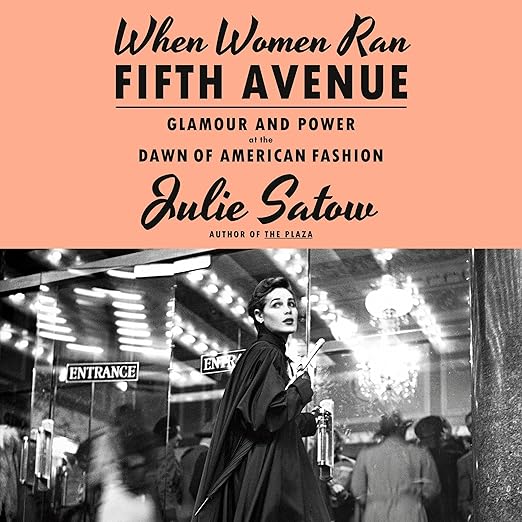
Hortense Odlum walked into Bonwit Teller as a housewife trying to save her husband's department store and left it as the woman who ran it. Dorothy Shaver earned the first million-dollar salary of any American businesswoman, at Lord and Taylor, during the same decade when US fashion still deferred entirely to Paris. Geraldine Stutz reinvented Henri Bendel in the 1960s and spent the next decades watching copycats try and fail to replicate what she had made. When Women Ran Fifth Avenue, narrated by Karen Murray and written by journalist Julie Satow, is an audiobook that treats these three careers as the New York Times bestseller it became suggests they deserve: as major chapters in the history of American commerce and of women's presence within it, not as footnotes to the stories of the men who owned the buildings.
Odlum Unlikely, Shaver Ambitious, Stutz Visionary
Satow's previous book, The Plaza, established her credentials as a writer who can find genuine human drama inside institutional history, and she deploys those skills here with confidence. The three women she profiles are not presented as uniformly sympathetic or flawless; each of them operated within and through the constraints of her era, made choices shaped by the social architecture around her, and achieved things that were genuinely extraordinary by any measure. Odlum is the most unlikely - a housewife with no retail background who recognized that women shopping the store were people like herself and transformed the buying experience accordingly. Shaver is the most strategically ambitious - her campaign to champion American designers during World War II was simultaneously a wartime practical necessity and a long-term repositioning of the entire US fashion industry. Stutz is the most visionary - her intuitive sense for what chic shoppers wanted before they knew they wanted it produced a store that felt like a personality rather than a floor plan.
The Wall Street Journal described the book as "compulsively readable," comparing it to a novel. This is accurate in the sense that Satow sequences and develops her material with narrative momentum rather than in the register of formal history. One reviewer from a book club notes that the histories "are well researched and bring back great memories," while another observes that the book functions as "a well-researched archival study" - which is both a compliment and a calibration note. This is serious, sourced journalism, not novelistic invention. The pleasures are real but they are the pleasures of reporting done well rather than of fiction.
Murray Avoids Vocal Whiplash Across Three Careers
Karen Murray's narration is a genuine asset. She reads Satow's prose with the assurance of a narrator who has done her research - the period details, the retail terminology, the fashion vocabulary specific to each store's identity all land correctly, and she moves between the three women's stories without the vocal whiplash that can afflict audiobooks with multiple subjects. Murray's register suits the book's particular tone: stylish without being superficial, authoritative without being academic. The ten-hour runtime mirrors the book's ambition; Satow has three complete careers to cover, and the audio format rewards the full commitment rather than encouraging the skimming that a print reader might do through the more densely archival sections.
The audiobook also benefits from what the format does for institutional history specifically. The department store as social institution - the place where women found a kind of public life in the early twentieth century, where class aspiration and commercial transaction and genuine aesthetic pleasure intermingled - is a world that requires sustained description to make sensory. Murray's narration gives physical texture to Satow's descriptions of the stores' interiors, the rhythm of shopping seasons, the specific atmosphere of each address. For listeners who have spent any time in the remnants of that retail world, the audio recreation of it is genuinely evocative.
Business History Carrying Real Human Texture
The book is structured around three separate biographical arcs rather than a single continuous narrative, which means it will pause the momentum of one story to develop another. This is the right structural choice given the material - running all three careers simultaneously would create confusion - but listeners who become deeply invested in one woman may find the transitions to the next chapter slightly disruptive. Satow is careful to maintain thematic continuity across the three arcs, and the connections between what Odlum built, what Shaver transformed, and what Stutz reinvented become clearer as the audiobook progresses. The full picture emerges in retrospect.
The reviewer who expected "something entirely different" and found a "well-researched archival study" is a useful warning for a specific type of reader. Satow does not fictionalize, does not invent scenes, and does not reduce her subjects to their romantic lives. The personal drama is present - Stutz's relationships, Shaver's ambition navigating the limits imposed on women in the corporate structure, Odlum's improbable trajectory - but it is always in service of the institutional story. This is business history with human texture, not biographical narrative with business context. The distinction matters for setting expectations.
Readers of Satow's The Plaza, and of Orlean
American business history readers with an appetite for well-documented institutional narrative will find this among the more satisfying entries in the genre. Fashion history enthusiasts will find Satow's treatment of Dorothy Shaver's campaign for American designers particularly valuable - it is a story that shaped the entire postwar US fashion industry and is underappreciated in most fashion history. Listeners who enjoyed Satow's The Plaza or who engage with the work of journalists like Susan Orlean, who brings similar archival rigor to American social history, will recognize the mode and appreciate the execution. Book clubs looking for richly sourced nonfiction that generates discussion around both historical narrative and present-day resonances about women in business will find this well-suited to that purpose.
Questions Listeners Ask
How does Karen Murray handle the audiobook's shifts between three different biographical subjects?
Murray maintains consistent vocal authority across all three arcs without creating artificial vocal distinctions between the subjects. The transitions between stories are smoothed by her pacing rather than marked by tonal shifts, which suits the book's unified thematic frame.
Does this audiobook address how these women's achievements have been recognized or forgotten by history?
Satow engages directly with the erasure of these careers from mainstream business history. The book's purpose is partly recuperative - these were not minor figures, and their absence from the standard accounts of American retail and fashion is itself part of the story Satow is telling.







